

 Start a conversation
AI system design and integration
Designing AI human oversight: the checkpoints that actually work
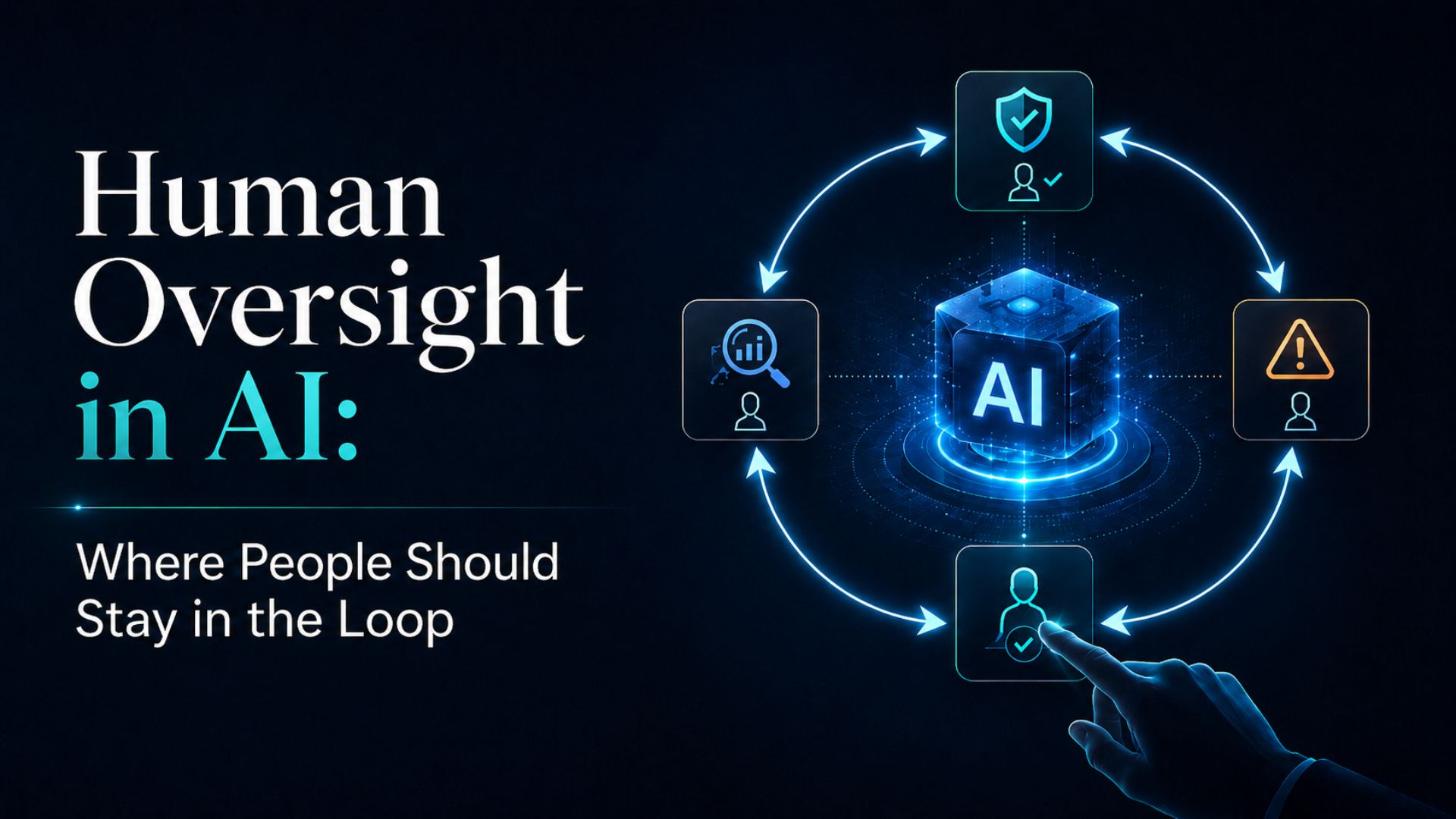
Designing AI human oversight means building specific checkpoints into the system architecture, not hiring someone to watch a dashboard. Under POPIA Section 71, South African businesses already have a legal reason to get this right before they scale an AI agent, not after a complaint lands with the Information Regulator. This isn't a policy document problem. It's a system design problem, and most explainers get that backwards.
Almost everything written about AI oversight treats it as a governance exercise: write a policy, appoint a committee, document a process. That's fine for an audit file. It does nothing for the WhatsApp bot that just auto-declined a loan application at 11pm. Real oversight lives in the architecture: the node or workflow branch where a human gets pinged, has actual authority to override, and the override gets logged back into the system instead of vanishing into a chat thread. That's the gap between a compliance policy and a working system.
What human oversight actually means in system design
Oversight is a build requirement, not a staffing policy
If your plan for "human oversight" is "someone will check the logs weekly," you don't have oversight. You have a liability trail. Oversight has to be designed into the workflow at the point of decision, with a defined trigger, a named authority, and a response time that matches the risk. That means specifying, before you ship, exactly which actions a human must approve, which ones get flagged after the fact, and which ones run fully automated with no review at all. This is an architecture decision, made at the same stage you decide which API calls the agent makes.
Human-in-the-loop vs human-on-the-loop vs human-in-command
These terms get used interchangeably and they shouldn't be. Human-in-the-loop means a person approves the action before it executes, used for high-stakes steps like releasing a payment or rejecting a job applicant. Human-on-the-loop means the system acts automatically but a person monitors output and can intervene after the fact, suited to lower-stakes, high-volume actions like sending order confirmations. Human-in-command sits above both: a person retains the authority to disable or override the whole system regardless of what individual decisions look like. Most production systems need all three operating at different tiers simultaneously, not one chosen as "the" oversight model. Getting this distinction wrong is why so many teams building human-in-the-loop properly in production AI end up with a bottleneck on one end and a rubber stamp on the other.
Why 'review everything' breaks at scale
Review-everything sounds safe and fails fast. At ten messages a day, a human reviewing every AI output works. At ten thousand, the reviewer either stops reading carefully or becomes the system's actual bottleneck, and usually both. This is the point where teams quietly abandon oversight rather than redesign it, because nobody built a tiering system up front. The fix isn't more reviewers. It's deciding which 5% of decisions need a human and routing only those.
The POPIA angle nobody explains for builders
Section 71 and automated decisions with legal or substantial effect
POPIA Section 71 says a data subject has the right not to be subject to a decision based solely on automated processing, including profiling, if that decision would result in legal consequences for them or affect them to a substantial degree, unless specific conditions are met. In plain terms: if your AI agent is the only thing deciding whether someone gets credit, gets hired, or gets denied a service, you are inside Section 71's scope, not adjacent to it.
What 'substantial degree' means for WhatsApp bots, credit checks, and hiring tools
"Substantial degree" isn't defined with a bright line in the Act, which is exactly why builders underestimate it. A WhatsApp bot that reschedules appointments isn't substantial. A WhatsApp bot that auto-approves or declines a credit application, screens job candidates, or determines pricing based on a risk profile almost certainly is. The test isn't how the decision was delivered, it's what the decision does to the person on the other end. If you're building AI into hiring, lending, insurance, or any access-to-service decision, assume Section 71 applies and design the human checkpoint in from day one. This is the same reasoning covered in what holds up under POPIA for AI hiring tools, where screening automation gets flagged as high-risk regardless of how well the model performs.
The Information Regulator's penalties and why this isn't theoretical
South Africa's Information Regulator has already issued enforcement notices and fines under POPIA, and automated decision-making is squarely on its radar as AI adoption accelerates. This isn't a hypothetical future risk sitting behind GDPR-style headlines. It's a current statutory obligation with an active regulator. If you deploy a customer-facing AI agent without a documented human override mechanism for decisions with legal or substantial effect, you're not under-engineered, you're non-compliant.
How this compares to EU AI Act Article 14 (useful context, not your law)
Article 14 of the EU AI Act requires human oversight measures for high-risk AI systems, including the ability for a human to understand, monitor, and intervene in or halt the system. It's a useful reference point because it's more prescriptive than POPIA about what oversight must look like structurally. But the EU AI Act does not apply to a South African business unless you're processing data for EU subjects or operating in the EU market. Don't build for Article 14 compliance by default. Build for Section 71, and borrow Article 14's structural clarity about what a real intervention capability looks like.

Risk-tiered oversight: the model that actually scales
Tier 1: automated monitoring, flag on anomaly
Low-stakes, high-volume, reversible actions: order confirmations, FAQ responses, appointment reminders. These run automatically with logging and anomaly detection. A human looks at flagged outliers, not every transaction.
Tier 2: human review triggered by conditions
Medium-stakes actions get a conditional trigger: a refund over a certain ZAR threshold, a customer complaint that mentions legal language, a support ticket flagged as a complaint about discrimination. The AI drafts the response or action, a human reviews before it goes out, and the review window is measured in minutes, not days.
Tier 3: mandatory human authorisation before execution
High-stakes, hard-to-reverse, legally significant actions: releasing a payment above a threshold, rejecting a credit application, declining a job candidate, terminating an account. No execution happens without an explicit human approval step, logged with who approved it and why.
Matching tiers to real automations: order bots, payments, HR screening
An order bot taking WhatsApp orders for a retail business sits mostly in Tier 1, with Tier 2 triggers for large or unusual orders. A payment automation accepting PayFast or Yoco transactions needs Tier 2 for standard amounts and Tier 3 for anything above a set ceiling or flagged as suspicious, which matters a lot once you're accepting payments through WhatsApp with PayFast or Yoco at any real volume. An HR screening tool is Tier 3 by default, full stop, because the decision has clear legal effect under Section 71.
Where oversight fails in practice
Automation bias: why trained staff still defer to the AI
Automation bias is the well-documented tendency for people to trust an automated system's output even when it contradicts their own judgment or the available evidence. It's not a training gap, it's a cognitive default. Reviewers who are told "approve unless something looks wrong" will, over time, approve almost everything, because the system is right often enough that vigilance decays. Designing against this means giving reviewers a reason to engage: show them the AI's confidence score, flag disagreements with past overrides, and rotate review responsibility so no one person rubber-stamps the same pattern for months.
Competence, training, and authority: the three things most 'reviewers' lack
A reviewer needs three things to provide real oversight, not theatre: competence to judge the decision on its merits, training on what the AI system actually does and where it fails, and authority to override without needing to escalate further. Most companies assign oversight to whoever's available, give them a dashboard, and call it done. That person usually has none of the three. Oversight by an untrained, under-authorised reviewer is slower than no oversight and gives you worse legal protection, because you've documented a review that wasn't meaningful.
The rubber-stamp problem: when a human sign-off isn't real oversight
A rubber stamp is any approval step where the human cannot realistically disagree, doesn't understand the basis for the decision, or faces pressure (time, volume, hierarchy) to approve regardless. If your "human in the loop" is a support agent clicking "approve" on 400 AI-drafted messages an hour with no time to read them, you have a rubber stamp, not oversight, and it won't hold up under POPIA scrutiny or in an actual dispute. Meaningful oversight requires the reviewer to have the information, time, and standing to say no, and a record showing that saying no was a real possibility exercised at some non-zero rate.

What this looks like inside an n8n/WhatsApp workflow
Building an escalation and handoff checkpoint
In an n8n workflow, this is a literal branch node: a condition checks confidence score, action type, or customer sentiment, and routes to either auto-execution or a human queue. The human queue pushes a WhatsApp or Slack notification to a named reviewer with context (the customer message, the AI's proposed action, the reason it was flagged) and waits for an explicit approve, reject, or edit response before the workflow continues. This is exactly how human handoff actually works on WhatsApp when it's built properly, and it's the single most skipped piece in DIY automation builds.
Logging overrides as a feedback signal, not an exception
Every override gets written to a structured log: what the AI proposed, what the human changed, and why (even a one-line reason field). This log is not just an audit trail for the Information Regulator, it's training data. If the same type of override happens repeatedly, that's a signal your prompt, your confidence threshold, or your Tier 1/2 boundary is wrong, and the system should get rebuilt around that pattern rather than treating every override as a one-off exception to be tolerated.
Error handling as a form of oversight
A workflow that fails silently is a workflow with no oversight, regardless of how many approval nodes you've built, because a silent failure skips the checkpoint entirely. Oversight design has to include what happens when the API call times out, the webhook doesn't fire, or the model returns malformed output. That's the core of stopping workflows from failing silently, and it's inseparable from the oversight question even though most compliance checklists don't mention it.
A worked example: payment automation with a human approval gate
A customer orders via WhatsApp, the agent calculates the total and generates a PayFast payment link. Under a set ZAR threshold, the link is sent automatically (Tier 1). Above the threshold, or if the order includes a flagged SKU, the workflow routes to a staff member via WhatsApp with order details and a one-tap approve button before the link is sent (Tier 3). Every approval and rejection is logged with a timestamp and reviewer ID. This took one extra branch node and a notification step. It's the difference between a system you can defend to a regulator and one you can't.
Designing oversight that doesn't become a bottleneck
Setting confidence thresholds for auto-approval vs escalation
Confidence thresholds should be set per action type, not globally. A customer FAQ response can run at a lower confidence bar than a refund decision, because the cost of being wrong is different. Start conservative, measure override rates over the first few weeks, and loosen the threshold only where the human reviewer is consistently agreeing with the AI's proposed action. This is a tuning exercise, not a one-time setting, and it's why most AI projects that skip system design end up with either a bottleneck or a rubber stamp within the first month.
When to use a senior reviewer vs a domain expert
Not every escalation needs your most senior person. Route by the nature of the risk: a legal or regulatory question needs someone with authority to accept liability, a product or pricing question needs a domain expert who knows the catalogue, and a tone or sentiment flag needs whoever's good at de-escalation. Matching reviewer type to escalation type is part of what separates a genuine agentic assistant from a bot with an approval button bolted on, which is really the actual difference between a chatbot and an agentic assistant in production.
Turning overridden decisions into model improvements
Overrides are free labelled data. If a human consistently edits the AI's draft refund message to remove a certain phrase, or consistently rejects auto-approvals above a certain order size, feed that pattern back into the prompt, the confidence threshold, or the escalation rule. Oversight that doesn't feed back into the system is just friction. Oversight that does is how the system gets better without retraining a model from scratch.
Common questions
Does POPIA require human oversight of automated decisions? Yes, indirectly. Section 71 gives data subjects the right not to be subject solely to automated decisions with legal or substantial effect, unless specific safeguards exist, which in practice means a meaningful human review step. There's no line in POPIA saying "install human oversight," but compliance with Section 71 requires it functionally.
What is Section 71 of POPIA and who does it apply to? Section 71 restricts decisions based solely on automated processing, including profiling, where the decision has legal consequences or affects someone to a substantial degree. It applies to any South African business or processor using AI for credit, hiring, insurance, pricing, or similar access-to-service decisions involving personal information.
Does the EU AI Act apply to South African businesses? Generally no, unless you process data belonging to EU residents or operate in the EU market. It's useful as a reference for what structured human oversight should look like (Article 14), but your binding legal obligation in South Africa is POPIA Section 71, not the EU AI Act.
What's the difference between human-in-the-loop and human-on-the-loop? Human-in-the-loop requires approval before an action executes, used for high-stakes, irreversible decisions. Human-on-the-loop lets the system act automatically while a person monitors and can intervene afterward, suited to high-volume, lower-risk actions. Most production systems need both, applied to different action types based on risk.
What counts as meaningful human oversight versus a rubber stamp? Meaningful oversight requires the reviewer to have enough time, information, and authority to genuinely disagree with the AI's output, and evidence (a non-zero override rate) that disagreement actually happens. A rubber stamp is an approval step where saying no is practically impossible due to volume, pressure, or lack of context.
Who should review AI outputs: a domain expert or a dedicated AI oversight role? It depends on the decision type. Domain experts should review decisions requiring product, pricing, or policy knowledge. A dedicated oversight role makes sense for cross-cutting concerns like bias patterns or system-wide override trends. Most companies need both, routed by escalation type, not one generalist reviewer handling everything.
How do you design oversight that scales with AI agent volume? Use a risk-tiered model: automate and log low-stakes actions, conditionally escalate medium-stakes actions, and require mandatory human sign-off only for high-stakes or legally significant ones. This keeps human attention focused on the small percentage of decisions that actually need it instead of reviewing everything equally.
What is automation bias and how do you design against it? Automation bias is the tendency to trust an automated system's output even against contrary evidence, and it erodes review quality over time. Design against it by showing reviewers confidence scores, flagging disagreements with historical patterns, rotating reviewers, and tracking override rates to catch when review has become passive.
What happens when an AI decision affects someone to a substantial degree under POPIA? If a decision has legal consequences or substantially affects someone (credit, employment, access to service), Section 71 requires safeguards, generally meaning the person can request human intervention, express their view, and contest the decision. Design that path into the workflow rather than treating it as a policy afterthought.
What does an escalation checkpoint look like inside an n8n workflow? It's a conditional branch node that checks a trigger (confidence score, action type, flagged keyword) and routes to a human review queue instead of auto-executing. The reviewer gets full context via WhatsApp or Slack, responds with approve, reject, or edit, and that response, including the reasoning, is logged before the workflow continues.
If you're building or auditing an AI agent and want the oversight checkpoints actually wired into the workflow rather than written up as policy, message Sagentics on WhatsApp and we'll talk through what your system needs.
Common questions
Does POPIA require human oversight of automated decisions?
Yes, indirectly. Section 71 gives data subjects the right not to be subject solely to automated decisions with legal or substantial effect, unless specific safeguards exist, which in practice means a meaningful human review step. There's no line in POPIA saying 'install human oversight,' but compliance with Section 71 requires it functionally.
What is Section 71 of POPIA and who does it apply to?
Section 71 restricts decisions based solely on automated processing, including profiling, where the decision has legal consequences or affects someone to a substantial degree. It applies to any South African business or processor using AI for credit, hiring, insurance, pricing, or similar access-to-service decisions involving personal information.
Does the EU AI Act apply to South African businesses?
Generally no, unless you process data belonging to EU residents or operate in the EU market. It's useful as a reference for what structured human oversight should look like (Article 14), but your binding legal obligation in South Africa is POPIA Section 71, not the EU AI Act.
What's the difference between human-in-the-loop and human-on-the-loop?
Human-in-the-loop requires approval before an action executes, used for high-stakes, irreversible decisions. Human-on-the-loop lets the system act automatically while a person monitors and can intervene afterward, suited to high-volume, lower-risk actions. Most production systems need both, applied to different action types based on risk.
What counts as meaningful human oversight versus a rubber stamp?
Meaningful oversight requires the reviewer to have enough time, information, and authority to genuinely disagree with the AI's output, and evidence (a non-zero override rate) that disagreement actually happens. A rubber stamp is an approval step where saying no is practically impossible due to volume, pressure, or lack of context.
Who should review AI outputs: a domain expert or a dedicated AI oversight role?
It depends on the decision type. Domain experts should review decisions requiring product, pricing, or policy knowledge. A dedicated oversight role makes sense for cross-cutting concerns like bias patterns or system-wide override trends. Most companies need both, routed by escalation type, not one generalist reviewer handling everything.
How do you design oversight that scales with AI agent volume?
Use a risk-tiered model: automate and log low-stakes actions, conditionally escalate medium-stakes actions, and require mandatory human sign-off only for high-stakes or legally significant ones. This keeps human attention focused on the small percentage of decisions that actually need it instead of reviewing everything equally.
What is automation bias and how do you design against it?
Automation bias is the tendency to trust an automated system's output even against contrary evidence, and it erodes review quality over time. Design against it by showing reviewers confidence scores, flagging disagreements with historical patterns, rotating reviewers, and tracking override rates to catch when review has become passive.
What happens when an AI decision affects someone to a substantial degree under POPIA?
If a decision has legal consequences or substantially affects someone (credit, employment, access to service), Section 71 requires safeguards, generally meaning the person can request human intervention, express their view, and contest the decision. Design that path into the workflow rather than treating it as a policy afterthought.
What does an escalation checkpoint look like inside an n8n workflow?
It's a conditional branch node that checks a trigger (confidence score, action type, flagged keyword) and routes to a human review queue instead of auto-executing. The reviewer gets full context via WhatsApp or Slack, responds with approve, reject, or edit, and that response, including the reasoning, is logged before the workflow continues.
About Sagentics
Sagentics is an AI systems studio based in South Africa. We design and build WhatsApp automation, n8n workflows, and custom AI products for local and international clients. We write from systems we have actually shipped.
Start a WhatsApp conversation with SagenticsRelated reading
- AI system design implementation: what it actually means and why most projects skip it
- AI process mapping: what it is, what it isn't, and whether it's worth paying for
- How to select an AI model for a task
- Integration architecture for AI systems: the real decision framework for South African businesses
- how human handoff actually works on WhatsApp
- what needs to be true for WhatsApp automation to be POPIA compliant
- building human-in-the-loop properly in production AI
- stopping workflows from failing silently
- what holds up under POPIA for AI hiring tools
- the actual difference between a chatbot and an agentic assistant
- connecting WhatsApp to n8n
- accepting payments through WhatsApp with PayFast or Yoco
- why most AI projects skip system design
- custom AI development built for South African compliance needs