

 Start a conversation
WhatsApp and conversational AI automation
Human in the loop AI chat escalation: how it actually works on WhatsApp
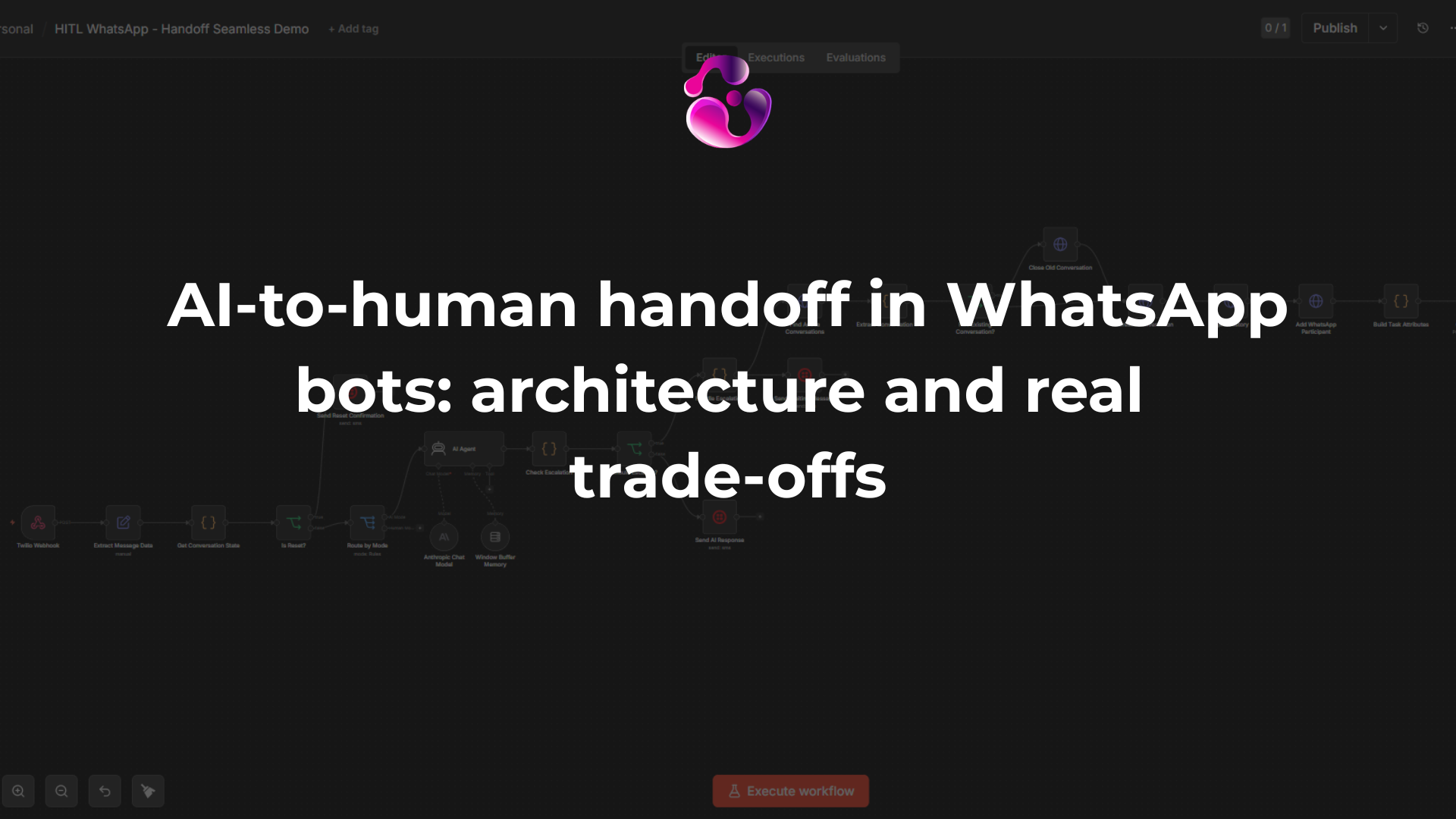
Human in the loop AI chat escalation is the set of rules and technical plumbing that decide when an AI agent stops replying and hands a conversation to a person. It fails or succeeds based on two things: how much context the human gets when they take over, and how fast the handoff happens. Get either wrong and you end up with a customer repeating themselves to a confused agent, or worse, a bot and a human replying at the same time.
Most write-ups on this topic treat escalation as a philosophy question: when should AI "know its limits"? We treat it as a state management problem. On WhatsApp Business API there is no native handoff event. Nothing tells the platform "a human just took over this chat, mute the bot." If you don't build that flag yourself, both agents reply, and that's the single most common failure we've seen in South African deployments.
What human in the loop escalation actually means
The difference between mandatory review and escalation-based HITL
Human in the loop (HITL) is an umbrella term. Escalation is only one flavour of it. Mandatory review means a human checks every AI output before it goes out, common in regulated industries like insurance claims or medical advice. Escalation-based HITL means the AI handles everything by default and only kicks a conversation to a person when a trigger fires. Most WhatsApp customer service builds use escalation, because reviewing every message before send kills response time and defeats the point of automation.
Why escalation is only one HITL model, not the whole concept
Is escalation-based HITL the only model, or are there alternatives? No. There's mandatory pre-send review, there's training and labelling loops where humans correct AI outputs after the fact to improve future performance, there's exception handling for specific transaction types, and there's spot-check moderation where a sample of AI conversations get reviewed for quality without blocking any of them in real time. Escalation is the one most relevant to live customer chat because it's the only model built for real-time handoff during an active conversation.
Context continuity as the make-or-break quality attribute
The single variable that determines whether an escalation feels smooth or broken is context continuity. Does the human agent see the full conversation history, or do they see a blank chat and have to ask "how can I help"? Customers who've already explained their problem to a bot and get asked to explain it again to a human are the ones who leave angry, regardless of how good the eventual resolution was. This is the quality attribute we design around first, before we even think about trigger logic.
The four patterns you can build escalation around
Live handoff on low confidence or negative sentiment
This is the pattern most people mean when they say "chatbot escalation." The AI is mid-conversation, something trips a trigger, and ownership of the chat moves to a human agent while the conversation stays live. Triggers are usually a mix of model confidence scores, sentiment detection, and explicit keyword matches like "agent" or "human."
Training and labelling loops that improve the model
This isn't real-time handoff. It's a background loop where humans review a sample of past AI conversations, correct or label the outputs, and that feedback improves prompts or fine-tuning over time. It's slower and doesn't touch the live customer experience, but it's how you stop the same escalation triggers firing over and over for the same underlying gap in the bot's knowledge.
Exception handling for refunds, deletions and threshold cases
Some actions should never be fully automated regardless of how confident the model is. Refunds above a certain rand value, account deletions, anything touching payment details on PayFast or Yoco integrations. These get hard-coded as exceptions that always route to a human, independent of sentiment or confidence scoring.
Content moderation and spot-checking flagged outputs
A lighter-touch pattern where AI responses get flagged (not blocked) for review after sending, usually based on risk scoring. Useful for compliance-heavy sectors but overkill for most SME WhatsApp deployments, where live escalation and exception handling cover the real risk.
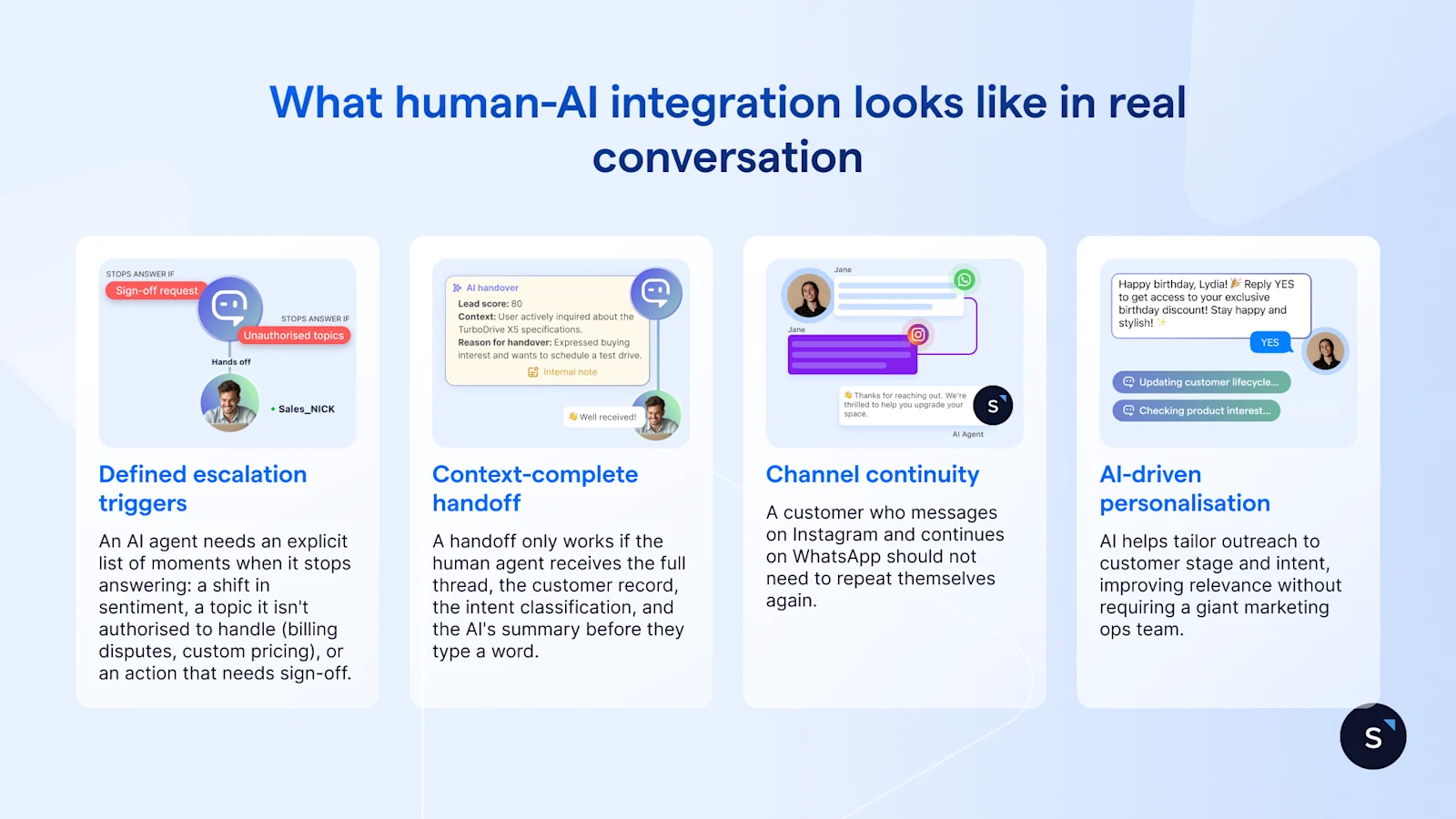
When users actually want a human, based on the data
How many mistakes before someone gives up on the bot
Watch failure count, not just failure type. Customer service research consistently shows most users tolerate one misunderstood message from a bot. By the second failed attempt at the same query, patience drops sharply, and a third failure is where most people disengage entirely, either abandoning the chat or demanding a human. That means your escalation trigger shouldn't just fire on "low confidence," it should fire on "low confidence, second occurrence in this thread."
Why sentiment-based escalation beats confidence-based escalation
Confidence scores tell you how sure the model is about its own answer. They don't tell you how the customer feels. A bot can be 90% confident in a technically correct response while the customer is typing in all caps because they've already been bounced between three channels trying to sort out a delivery problem. Sentiment-based triggers, watching for frustration markers, repeated punctuation, negative word choice, catch the emotional state that confidence scoring misses entirely. In practice, the best setups combine both: confidence for "the bot doesn't know," sentiment for "the customer is done with the bot regardless of whether it knows."
The gap between what CX leaders expect and what gets shipped
Escalation gets built as a prompt-engineering afterthought instead of as a workflow, and that's where the gap opens. CX leaders ask for seamless, context-aware handoff. What actually ships is a bot that says "let me get someone to help you" and then nothing happens for twenty minutes because there's no queue routing behind it. This isn't a strategy problem. It's a build problem.
Escalate early or escalate late: the cost of waiting
What happens to service quality once frustration has already built up
Escalate as soon as a trigger condition is met, not after multiple failed retries hoping the bot recovers. The transition should preserve full conversation history, notify the human agent with a summary (not just a raw transcript dump), and confirm to the customer that a person is now involved, ideally with an estimated response time if there's any queue at all.
Why technical escalations recover fine but emotional ones don't
There's an asymmetry worth understanding. A technical escalation (the bot genuinely doesn't have the information) recovers fine even if it happens a bit late, because the customer's frustration is with the lack of an answer, not with being mishandled. An emotional escalation (the customer is angry, unhappy, or feels unheard) does not recover the same way once it's left too long. Every extra bot reply that misses the emotional tone makes the eventual human handoff harder, because now the agent has to undo frustration with the bot on top of solving the original problem.
Cost to serve: AI resolutions vs human agents in rand terms
Does human in the loop escalation cost more than pure AI, and by how much? Yes, materially. An AI-resolved WhatsApp conversation typically costs a fraction of a rand in compute and messaging fees. A human-handled conversation carries the agent's hourly cost, which in South Africa runs from roughly R25 to R80+ per hour depending on seniority and skill. The economics only work if escalation is reserved for the conversations that genuinely need it, not triggered so cautiously that half your volume ends up with a human anyway. For a full breakdown of where those numbers land for different business sizes, see AI customer service agent on WhatsApp: what it costs in South Africa.

Building the handoff on WhatsApp Business API
The double-response bug: stopping the bot from replying after handoff
How do you stop a bot and a human agent replying at the same time after handoff? You need an explicit ownership flag per conversation, stored outside the AI itself, that the bot checks before generating any reply. The moment a human agent picks up a chat, that flag flips, and the bot's workflow checks it on every incoming message and exits silently if a human owns the thread. Without this, both systems process the same incoming message independently and you get two replies stacked in the customer's chat, which is confusing and looks unprofessional. We've seen this exact bug in more SA deployments than any other escalation failure, because WhatsApp Business API has no native concept of "this chat now belongs to a human."
Handoff flags and stateful logic in n8n
This is where a workflow tool like n8n earns its keep. We build a session state table, a lightweight datastore keyed on the customer's phone number, that tracks who owns the conversation (bot or agent), when ownership last changed, and why. Every incoming WhatsApp message triggers a lookup against that table before any reply logic runs. If a human owns it, the bot workflow ends immediately. If the bot owns it, normal AI processing continues, with the escalation triggers (confidence, sentiment, keyword, exception rules) checked as part of that same flow. This is a solved problem, but it has to be built deliberately. It doesn't fall out of a good system prompt.
Passing full conversation context so customers don't repeat themselves
Preserve full message history and pass it to the human agent as a readable summary, not a raw log. Flag the reason for escalation (low confidence, negative sentiment, explicit request). Confirm the handoff to the customer in-chat. And make sure the bot goes fully silent the moment ownership transfers, so nobody is fielding two different replies to the same message.
South African context: POPIA, staffing and cost
What POPIA means for consent and audit logs during handoff
POPIA doesn't have a clause written specifically for chatbot handoffs, but the general principles apply directly: you need a lawful basis for processing personal information, and you need to be able to account for who accessed a customer's data and when. When a conversation moves from an AI system to a human agent, that's a new party gaining access to potentially sensitive personal information, which means you need an audit log recording when the handoff happened, why, and which agent picked it up. This is a compliance question South African businesses genuinely haven't had to think about with pure chatbots, because a bot processing data under a documented, consistent policy is a different risk profile to a human reading raw customer messages ad hoc. Building that audit trail into the same session state table that manages ownership is the practical fix, not a separate compliance project bolted on afterward.
Staffing a human queue when your team is small
Escalation only works if there's someone on the other end. For small teams, this usually means routing escalated chats into a shared inbox (WhatsApp Business app, or a proper multi-agent tool sitting on top of the API) with notification alerts, rather than assuming 24/7 live coverage. Setting honest expectations with customers ("a person will respond within the hour" rather than implying instant human availability) matters more than the technology here.
Where AI resolution cost stops making sense vs a human agent in ZAR
The chatbot can't answer a question. It should escalate immediately rather than guessing or looping the customer through variations of the same unhelpful answer. The cost math favours AI resolution right up until a conversation needs judgement, negotiation, or emotional handling, at which point the cost of a badly handled AI reply (a lost customer, a complaint, reputational damage) outweighs any saving on agent hours. For businesses weighing this trade-off in detail, what WhatsApp automation costs in South Africa breaks down the real numbers by conversation volume.
How Sagentics builds escalation into WhatsApp AI systems
Trigger design: explicit request, repeated failure, sentiment
We build escalation triggers as a layered system, not a single rule. Explicit request ("can I speak to someone") fires immediately, no debate. Repeated failure fires on the second unresolved attempt at the same query, not the first. Sentiment fires independently of both, catching frustration even in conversations that are technically going fine on the surface. Hard exceptions (refunds, account deletions, payment disputes) route to a human regardless of any of the above.
State management so agent and bot never reply at the same time
Every deployment gets a session ownership table before it gets a single prompt written. This is non-negotiable in our build process, because it's the difference between a handoff that feels instant and professional, and one that produces the double-reply bug that erodes customer trust in the first thirty seconds of a human agent's involvement. This is also where POPIA-relevant audit logging lives, tracking every ownership change with a timestamp and reason.
What this looks like in a live deployment
We've built this pattern into donor engagement and customer service systems where getting the handoff wrong isn't a minor bug, it's the difference between a donor staying engaged or dropping off entirely. You can see how we built escalation into a donor engagement chatbot for a concrete example of trigger design and state management working together in production, and see the Antistatic case study for how this plays out in a commercial support context. If you're evaluating whether to build this in-house or bring in a team that's shipped it before, our custom AI development for South African businesses page covers how we scope these builds, and our WhatsApp automation built for South African businesses page covers the broader platform work this usually sits inside. For the underlying platform decision itself, WhatsApp Business API vs the app is worth reading before you commit to either.
Common questions
How can a company determine the right moments for chatbot escalation to a human agent? Track failure count per thread, not just individual message confidence. Most customers tolerate one bot mistake but disengage by the second or third. Combine that with sentiment detection and explicit keyword triggers ("agent", "human", "speak to someone") so escalation catches both technical gaps and emotional frustration, not just one or the other.
What are the key steps to ensure a smooth chatbot escalation process and avoid customer frustration? Preserve full conversation history and pass a readable summary (not a raw transcript) to the human agent. Confirm the handoff in-chat so the customer knows a person is now involved. Flag the escalation reason for the agent. And make the bot go completely silent the moment ownership transfers.
What happens when the chatbot can't answer a question? It should escalate immediately rather than retrying variations of the same unhelpful reply. Looping a customer through several failed attempts before finally handing off does more damage than escalating on the first clear failure, since frustration compounds with every additional bot message that misses the mark.
When should a bot escalate, and how should the transition work? As soon as a trigger condition (explicit request, repeated failure, negative sentiment, or a hard exception like a refund) is met. The transition should flip an ownership flag, mute the bot instantly, pass full context to the agent, and notify the customer that a person is now handling their chat.
How do you stop a bot and a human agent replying at the same time after handoff? Build an explicit session ownership flag stored outside the AI, checked on every incoming message before any reply logic runs. WhatsApp Business API has no native handoff event, so without this flag both bot and agent will independently process and reply to the same message.
Does human in the loop escalation cost more than pure AI, and by how much? Yes. AI-resolved conversations cost fractions of a rand in compute and messaging fees, while human-handled ones carry an agent's hourly rate, roughly R25 to R80+ in South Africa depending on seniority. The economics only work if escalation triggers are calibrated tightly enough that they're not routing routine queries to humans unnecessarily.
Is escalation-based HITL the only model, or are there alternatives? No. Mandatory pre-send review, training and labelling loops, exception handling for specific transaction types, and spot-check content moderation are all separate HITL models. Escalation-based handoff is the one most relevant to live WhatsApp customer chat, but it's one pattern among several, not the whole concept.
What does POPIA require when a conversation moves from AI to a human agent? There's no clause specific to chatbot handoffs, but general POPIA principles apply: a lawful basis for processing, and accountability for who accessed personal data and when. A handoff audit log recording the timestamp, reason, and receiving agent for every conversation transfer is the practical way to meet that requirement.
If you're weighing up how to build this into your own WhatsApp setup, message us and we'll talk it through, no pitch deck required.
Common questions
How can a company determine the right moments for chatbot escalation to a human agent?
Track failure count per thread, not just individual message confidence. Most customers tolerate one bot mistake but disengage by the second or third. Combine that with sentiment detection and explicit keyword triggers ('agent', 'human', 'speak to someone') so escalation catches both technical gaps and emotional frustration, not just one or the other.
What are the key steps to ensure a smooth chatbot escalation process and avoid customer frustration?
Preserve full conversation history and pass a readable summary (not a raw transcript) to the human agent. Confirm the handoff in-chat so the customer knows a person is now involved. Flag the escalation reason for the agent. And make the bot go completely silent the moment ownership transfers.
What happens when the chatbot can't answer a question?
It should escalate immediately rather than retrying variations of the same unhelpful reply. Looping a customer through several failed attempts before finally handing off does more damage than escalating on the first clear failure, since frustration compounds with every additional bot message that misses the mark.
When should a bot escalate, and how should the transition work?
As soon as a trigger condition (explicit request, repeated failure, negative sentiment, or a hard exception like a refund) is met. The transition should flip an ownership flag, mute the bot instantly, pass full context to the agent, and notify the customer that a person is now handling their chat.
How do you stop a bot and a human agent replying at the same time after handoff?
Build an explicit session ownership flag stored outside the AI, checked on every incoming message before any reply logic runs. WhatsApp Business API has no native handoff event, so without this flag both bot and agent will independently process and reply to the same message.
Does human in the loop escalation cost more than pure AI, and by how much?
Yes. AI-resolved conversations cost fractions of a rand in compute and messaging fees, while human-handled ones carry an agent's hourly rate, roughly R25 to R80+ in South Africa depending on seniority. The economics only work if escalation triggers are calibrated tightly enough that they're not routing routine queries to humans unnecessarily.
Is escalation-based HITL the only model, or are there alternatives?
No. Mandatory pre-send review, training and labelling loops, exception handling for specific transaction types, and spot-check content moderation are all separate HITL models. Escalation-based handoff is the one most relevant to live WhatsApp customer chat, but it's one pattern among several, not the whole concept.
What does POPIA require when a conversation moves from AI to a human agent?
There's no clause specific to chatbot handoffs, but general POPIA principles apply: a lawful basis for processing, and accountability for who accessed personal data and when. A handoff audit log recording the timestamp, reason, and receiving agent for every conversation transfer is the practical way to meet that requirement.
About Sagentics
Sagentics is an AI systems studio based in South Africa. We design and build WhatsApp automation, n8n workflows, and custom AI products for local and international clients. We write from systems we have actually shipped.
Start a WhatsApp conversation with SagenticsRelated reading
- WhatsApp automation in South Africa: what it costs and whether you need it
- WhatsApp Business API vs the app: which one your business actually needs
- AI customer service agent on WhatsApp: what it is, how it works, and what it costs in South Africa
- How to accept payments through WhatsApp in South Africa using PayFast or Yoco
- AI customer service agent on WhatsApp: what it costs in South Africa
- WhatsApp automation built for South African businesses
- WhatsApp Business API vs the app
- what WhatsApp automation costs in South Africa
- custom AI development for South African businesses
- how we built escalation into a donor engagement chatbot
- see the Antistatic case study