

 Start a conversation
WhatsApp and conversational AI automation
Chatbot vs agentic assistant: what's the actual difference

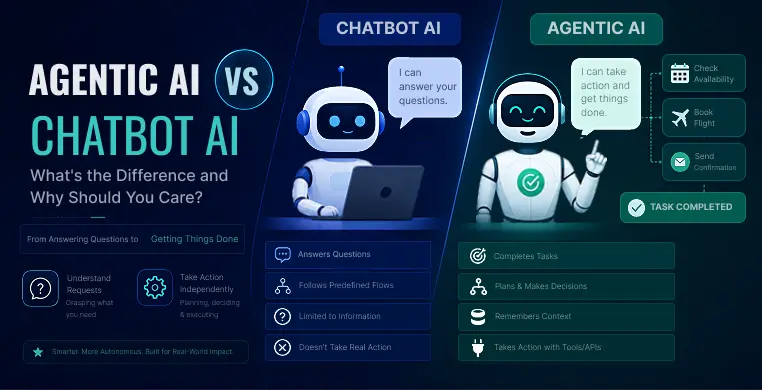
A chatbot answers questions from a script. An agentic assistant reads your systems, makes decisions, and takes actions like booking a slot, generating a quote, or processing a payment without a human doing the actual work. That's the whole difference. Everything else in this article is detail on how that plays out in a South African WhatsApp business context, and how to tell which one you're actually being sold.
Chatbots respond, agents act
The one-line definition everyone agrees on
Strip away the marketing decks and every serious AI practitioner lands on the same line: a chatbot responds, an agent acts. A chatbot takes an input and returns text. An agent takes an input, decides what needs to happen, and does it, whether that means updating a record, sending a payment link, or rescheduling a booking. If the system's job ends when it produces a sentence, it's a chatbot. If its job ends when something in the real world has changed, it's an agent.
Why the AI model underneath isn't the difference
Business owners often assume GPT-4 versus a cheaper model is what separates a "basic bot" from an "AI agent." It isn't. You can run a chatbot on the most advanced language model available and it's still a chatbot if all it does is generate replies. Conversely, a fairly simple rules-based system that can write to a CRM and trigger a payment request is doing agentic work, even without a fancy model behind it. The model choice affects how natural the conversation feels. It does not determine whether the system can act.
The write-back test: can it change something in your systems?
Here's the practical test we use with clients before any project starts: can this system write back to your systems, or can it only read from them? A tool that looks up your pricing table and recites it back is reading. A tool that creates a new row in your booking calendar, marks an invoice as paid, or updates a lead's status in your CRM is writing. Read-only systems are chatbots no matter how conversational they sound. Write-capable systems are agents, even when the interface is the same WhatsApp thread.
What an agentic assistant actually does differently
Plan, act, observe, refine versus prompt in, text out
A chatbot's loop is simple: prompt in, text out. An agentic assistant runs a longer loop: it plans a sequence of steps, acts on one, observes the result, and adjusts before moving to the next step. If a payment fails, an agent can retry, flag it, or escalate. A chatbot just told you the price and stopped there.
Example: a chatbot lists a quote, an agent generates it, sends the PayFast link, and confirms payment
Say a customer messages asking for a quote on a bulk order. A chatbot pulls the standard price list and replies with a number. An agentic assistant checks current stock, calculates a quote based on quantity and delivery zone, generates a PDF or formatted message, sends a PayFast link for the deposit, watches for the payment webhook, and confirms receipt back to the customer, all inside the same WhatsApp thread. That's the difference between telling someone what something costs and getting the invoice paid.
Multi-step workflows across WhatsApp, CRM, and payment systems
Agentic work usually spans more than one system. A booking request might touch WhatsApp for the conversation, a CRM for the customer record, a calendar for availability, and a payment gateway for the deposit. None of these systems know about each other unless something coordinates them. That coordination is the agent's job. It's also the part most vendors skip when they build a "WhatsApp bot" that only talks and never touches the other systems.

Agent-washing: why most 'AI agents' in South Africa are still chatbots
Agent-washing is the practice of bundling a chatbot's reading and labelling skills with agent-like language in marketing, then selling the whole bundle as an agentic product. It's common enough in South Africa that it warrants its own section.
Gartner's finding: only a fraction of vendor 'agents' are verifiably agentic
Gartner has flagged this pattern globally: of the vendors marketing "AI agents," only a small percentage of those products are actually agentic in the sense described above. Most are conversational tools with agent language bolted onto the sales page. South Africa isn't different. If anything, the local market has less scrutiny on these claims because fewer buyers have built or bought one before.
How local WhatsApp vendors blur the line in their own marketing
Scan the listings for South African WhatsApp automation vendors and you'll see the same phrase repeated: "AI agent that answers calls, qualifies leads, and updates your CRM." Read the fine print and often only one of those three is true. It answers, sure. Qualifying a lead sometimes means tagging a conversation with a category, which is still just reading and labelling. Updating the CRM is the part that actually requires write access, and it's the part most quietly missing from the demo. This is agent-washing in action: bundling a chatbot's reading and labelling skills with agent language, then selling the whole bundle as one product. If you're comparing vendors, it's worth reading our breakdown of an AI customer service agent on WhatsApp: what it is and what it costs before you sign anything, because cost and capability don't always move together.
The test to ask any vendor: what can it write, not just read?
Ask directly: "What can this system write to, not just read from?" A vendor with a genuinely agentic product will answer specifically, naming the CRM fields it updates, the payment statuses it can change, the calendar slots it can book. A vendor selling agent-washed chatbots will answer vaguely, talking about "intelligent responses" and "understanding intent." That vagueness is the tell.
The cost reality: agents are not always worth it
Why an agent costs more per resolved task than a chatbot
Agentic systems cost more to build and run. They need integrations into your CRM, payment gateway, and often your calendar or inventory system, each with its own authentication, error handling, and monitoring. A chatbot needs a knowledge base and a WhatsApp connection. That difference in scope shows up directly in the price, and in the ongoing maintenance, since more moving parts means more that can break when an API changes on the other end.
When agentic complexity adds cost without adding value
If your business gets the same ten questions every day about hours, pricing, and delivery times, an agent adds cost without adding value. There's nothing to act on. The customer wants an answer, gets it, and the conversation ends. Building a multi-step agentic workflow for that use case is spending on capability you'll never use.
The SME decision rule: does it replace a human action or just a search?
Here's the rule we use with SME clients: does this system replace a human action, or does it just replace a human search? If your staff currently look something up and type a reply, a chatbot replaces that. If your staff currently create a quote, send a payment request, then manually update a spreadsheet, an agent replaces that whole chain. Match the tool to which one is actually happening in your business. For a fuller cost breakdown across different automation tiers, see what WhatsApp automation costs and whether you need it.
When a chatbot is the right call in South Africa
Low-risk, linear use cases: pricing FAQs, hours, order status
Chatbots are the right tool for anything low-risk and linear: trading hours, pricing tiers, order status lookups, delivery zone confirmation. These are questions with a single correct answer that doesn't change based on context. There's no decision to make, just information to retrieve.
Why over-engineering a simple WhatsApp FAQ flow wastes budget
We've seen businesses pay for agentic capability to handle what is, in practice, a five-question FAQ flow. That's money spent on integrations and monitoring for a system that never needs to write anywhere. If your WhatsApp inbox is mostly the same handful of questions on repeat, a well-built chatbot handles it at a fraction of the cost, and it's usually the first stage worth building regardless of where you end up.
Signs your business has outgrown a chatbot
You've outgrown a chatbot when your team is manually doing the same follow-up actions after every chat: copying a customer's details into a CRM, generating a quote by hand, sending a payment link separately, then chasing confirmation. If a human is doing repetitive data entry after every WhatsApp conversation, that's the signal to move up.
Building the path: from chatbot to agentic workflow
Stage 1: reduce repetitive WhatsApp volume
Start by cutting repetitive volume. Get the FAQ answers, hours, and order status questions off your team's plate first. This stage is cheap, fast to build, and gives you a baseline of what your customers actually ask before you invest in anything more complex.
Stage 2: connect to CRM and payment data
Once the basic responses are handled, connect the system to your CRM and payment data as read sources. It can now pull a customer's order history or check whether an invoice is paid, still without writing anything back. This stage tells you where the manual bottlenecks really sit.
Stage 3: let it act, quote, book, invoice, with human approval on sensitive steps
The final stage grants write access for specific actions: generating a quote, booking a slot, sending a payment link, updating a CRM stage. Sensitive steps, like large payments or contract changes, still route to a human for approval. This is also where how human handoff actually works on WhatsApp becomes the part of the build that matters most, because an agent that can act still needs clear rules for when it shouldn't.
A South African example: WhatsApp quote-to-payment flow
Chatbot version: answers pricing questions, hands off to a human
A customer messages a merchandise supplier asking for a quote on 200 branded caps. The chatbot recognises the intent, sends the standard price sheet, and tells the customer someone will follow up. A staff member then manually builds the quote, sends it, waits for a reply, and processes payment separately later.
Agent version: qualifies the lead, drafts a quote, sends the payment link, updates the CRM
The agentic version handles the same request differently. It asks the clarifying questions needed for an accurate quote: quantity, colours, delivery address. It checks current stock and lead time, calculates the price including delivery, and sends a formatted quote in the chat. It then generates a Yoco or PayFast payment link for the deposit. Once payment clears, it updates the CRM with the order stage automatically. If you're weighing up which gateway fits your setup, our guide on accepting payments through WhatsApp using PayFast or Yoco covers the practical differences. We built a similar flow for a merchandise client. The actual before-and-after numbers are documented in a case study we published, showing how the routine 80% of quote requests moved to fully automated handling.
Where human handoff still belongs in the flow
Even in the agent version, a human should still get looped in for large custom orders, disputed pricing, or first-time corporate clients where trust hasn't been established yet. Agentic doesn't mean unattended. It means the routine 80% of the flow runs without a person typing, while the sensitive 20% still gets a human's eyes on it.
POPIA and compliance considerations for either approach
Consent, opt-out logging, and audit trails apply to both chatbots and agents
Whether you're running a chatbot or an agent, POPIA applies the same way to any personal information collected over WhatsApp. You need documented consent for how you'll use a customer's data, a working opt-out mechanism, and an audit trail showing what was collected and when. This is true even for a simple FAQ bot storing phone numbers and order history.
Why giving a system write access raises the compliance bar
Once a system can write to your CRM or trigger a payment, the compliance bar goes up. You're now responsible for how that system handles sensitive fields like banking references or ID numbers, who can access the logs of what it changed, and how errors get corrected if it writes something wrong. Read-only chatbots carry less risk simply because they can't alter a record incorrectly.
What to ask a vendor about data handling before signing
Before signing with any vendor, ask where the data is hosted, whether it's processed by a South African entity or routed offshore, how long conversation logs are retained, and what happens to payment data after a transaction completes. If the answers are vague, that's a red flag regardless of how impressive the demo looked. For the full compliance picture, our detailed guide on whether WhatsApp automation is POPIA compliant walks through what a compliant setup actually requires.
Common questions
What is the difference between an AI agent and a chatbot? A chatbot generates replies based on a prompt and stops there. An AI agent plans a sequence of steps, takes actions like updating a record or sending a payment link, checks the result, and adjusts if something fails. The core test is whether the system can write to your systems or only read and respond from them.
What is the difference between conversational AI and agentic AI? Conversational AI focuses on understanding and generating natural language, answering questions, and holding a coherent chat. Agentic AI adds decision-making and action on top of that conversation layer, connecting to other systems to actually complete tasks like booking, quoting, or processing payments, rather than just describing what could be done.
How much more expensive is an AI agent than a chatbot? Agentic builds typically cost more due to the integrations required into CRM, payment, and calendar systems, plus ongoing monitoring for those connections. A basic chatbot might only need a knowledge base and WhatsApp setup. The exact multiple depends on how many systems need connecting, but expect meaningfully higher build and maintenance costs for genuine agentic capability.
Do I need a chatbot or an AI agent for my business? Use the write-back test: does your business need the system to just answer questions, or does it need to actually complete actions like booking, quoting, or invoicing? If your team currently manually processes the next step after a conversation, that repetitive action is what an agent replaces. If there's no action to take, a chatbot is sufficient and cheaper.
What is the difference between an AI agent, an assistant, and a chatbot? These terms overlap in marketing but the useful distinction is capability, not label. A chatbot responds only. An assistant usually implies some personalisation and memory of context. An agent implies the ability to act on systems, not just converse. Ask any vendor what their product can write to, regardless of which of these three words they use.
Is a chatbot or AI agent better for customer service on WhatsApp? It depends on the volume and complexity of what customers ask. Routine questions about hours, pricing, or order status are handled well by a chatbot. If customer service regularly requires looking something up in a CRM and taking action, like rebooking or refunding, an agent reduces the manual work your team does after each conversation.
How do I know if a vendor's 'AI agent' is actually just a chatbot? Ask specifically what the system can write to, not just read from. A genuinely agentic system will name exact CRM fields it updates, payment statuses it changes, or calendar slots it books. Vague answers about "understanding intent" or "smart responses" without naming a specific write action usually mean you're looking at a rebranded chatbot.
Is an agentic WhatsApp assistant POPIA compliant? It can be, but compliance requirements are higher than for a basic chatbot because the system holds write access to customer records and payment data. You need documented consent, working opt-out logging, clear data retention rules, and visibility into where the data is hosted and processed. Ask any vendor these questions directly before signing.
If you're trying to work out which of these your business actually needs, a quick WhatsApp chat with the team at Sagentics' AI automation work is a good way to think it through, no pitch required.
Common questions
What is the difference between an AI agent and a chatbot?
A chatbot generates replies based on a prompt and stops there. An AI agent plans a sequence of steps, takes actions like updating a record or sending a payment link, checks the result, and adjusts if something fails. The core test is whether the system can write to your systems or only read and respond from them.
What is the difference between conversational AI and agentic AI?
Conversational AI focuses on understanding and generating natural language, answering questions, and holding a coherent chat. Agentic AI adds decision-making and action on top of that conversation layer, connecting to other systems to actually complete tasks like booking, quoting, or processing payments, rather than just describing what could be done.
How much more expensive is an AI agent than a chatbot?
Agentic builds typically cost more due to the integrations required into CRM, payment, and calendar systems, plus ongoing monitoring for those connections. A basic chatbot might only need a knowledge base and WhatsApp setup. The exact multiple depends on how many systems need connecting, but expect meaningfully higher build and maintenance costs for genuine agentic capability.
Do I need a chatbot or an AI agent for my business?
Use the write-back test: does your business need the system to just answer questions, or does it need to actually complete actions like booking, quoting, or invoicing? If your team currently manually processes the next step after a conversation, that repetitive action is what an agent replaces. If there's no action to take, a chatbot is sufficient and cheaper.
What is the difference between an AI agent, an assistant, and a chatbot?
These terms overlap in marketing but the useful distinction is capability, not label. A chatbot responds only. An assistant usually implies some personalisation and memory of context. An agent implies the ability to act on systems, not just converse. Ask any vendor what their product can write to, regardless of which of these three words they use.
Is a chatbot or AI agent better for customer service on WhatsApp?
It depends on the volume and complexity of what customers ask. Routine questions about hours, pricing, or order status are handled well by a chatbot. If customer service regularly requires looking something up in a CRM and taking action, like rebooking or refunding, an agent reduces the manual work your team does after each conversation.
How do I know if a vendor's 'AI agent' is actually just a chatbot?
Ask specifically what the system can write to, not just read from. A genuinely agentic system will name exact CRM fields it updates, payment statuses it changes, or calendar slots it books. Vague answers about "understanding intent" or "smart responses" without naming a specific write action usually mean you're looking at a rebranded chatbot.
Is an agentic WhatsApp assistant POPIA compliant?
It can be, but compliance requirements are higher than for a basic chatbot because the system holds write access to customer records and payment data. You need documented consent, working opt-out logging, clear data retention rules, and visibility into where the data is hosted and processed. Ask any vendor these questions directly before signing.
About Sagentics
Sagentics is an AI systems studio based in South Africa. We design and build WhatsApp automation, n8n workflows, and custom AI products for local and international clients. We write from systems we have actually shipped.
Start a WhatsApp conversation with SagenticsRelated reading
- WhatsApp automation in South Africa: what it costs and whether you need it
- WhatsApp Business API vs the app: which one your business actually needs
- AI customer service agent on WhatsApp: what it is, how it works, and what it costs in South Africa
- How to accept payments through WhatsApp in South Africa using PayFast or Yoco
- AI customer service agent on WhatsApp: what it is and what it costs
- accepting payments through WhatsApp using PayFast or Yoco
- how human handoff actually works on WhatsApp
- whether WhatsApp automation is POPIA compliant
- what WhatsApp automation costs and whether you need it
- WhatsApp appointment booking automation
- see how this played out for MerchLab
- Sagentics' AI automation work