

 Start a conversation
WhatsApp and conversational AI automation
Is WhatsApp automation POPIA compliant? Here's what actually needs to be true
WhatsApp automation is legal in South Africa under POPIA, but only if consent capture, opt-out handling, data minimisation, and cross-border storage rules are built into the workflow itself, not bolted on afterward as a policy document. A privacy policy sitting next to your chatbot proves nothing to the Information Regulator. A workflow that logs consent state, honours opt-out across channels, and routes sensitive data to a human instead of an LLM does.
That distinction is the whole article. Let's get into it.
Is WhatsApp automation legal under POPIA?
Why the question keeps coming up
Every business owner running or considering WhatsApp automation asks some version of this at least once: "am I allowed to do this?" The question surfaces because WhatsApp automation touches personal information at scale, and POPIA governs how South African businesses collect, store, and process that information. There's no law banning automated WhatsApp messaging. There is a law governing what you do with the data flowing through it.
What POPIA actually regulates on WhatsApp
POPIA doesn't care that you're using WhatsApp specifically. It cares about the personal information moving through the channel: phone numbers, names, order history, ID numbers, health details, financial records. Every automated message you send, every reply you log, every contact you add to a broadcast list is a processing activity under the Act. That applies whether you're running the standard WhatsApp Business app or a full WhatsApp Business API integration. If you're unclear on the difference between the two and what each one exposes you to, our piece on WhatsApp Business API vs the app breaks down the technical and compliance gap.
The gap between "legal in principle" and "compliant in practice"
Here's where most businesses get it wrong. They read that WhatsApp automation is legal, treat that as the finish line, and stop there. Legal in principle means POPIA doesn't prohibit the activity. Compliant in practice means your system can prove, on demand, that every contact consented, every opt-out was honoured, and every sensitive field was handled correctly. Most WhatsApp bots we've been asked to audit fail the second test even when they pass the first.
What POPIA non-compliance actually costs
Fines and imprisonment under the Act
POPIA allows for administrative fines up to R10 million, and in serious cases, imprisonment of up to 10 years for the responsible party. These aren't theoretical numbers. They sit in the Act specifically to give the Information Regulator teeth, and the Regulator has been using them.
Information Regulator enforcement activity (2023 to 2025)
Since 2023 the Information Regulator has issued a growing number of enforcement notices against South African companies, covering everything from unsecured databases to unlawful direct marketing. The pattern is consistent: businesses that treated compliance as paperwork got caught by processes that didn't match the paperwork.
Why the enforcement notice against WhatsApp itself matters
In 2025 the Information Regulator issued an enforcement notice concerning WhatsApp's own data practices in South Africa. The detail matters less than the signal: the Regulator is willing to act against major platforms, not just small local businesses. If the platform itself is under scrutiny, the businesses building automation on top of it need to be even more careful about what they add to that risk, not less.
The consent rules your workflow needs to enforce
Why a trade show business card is not consent
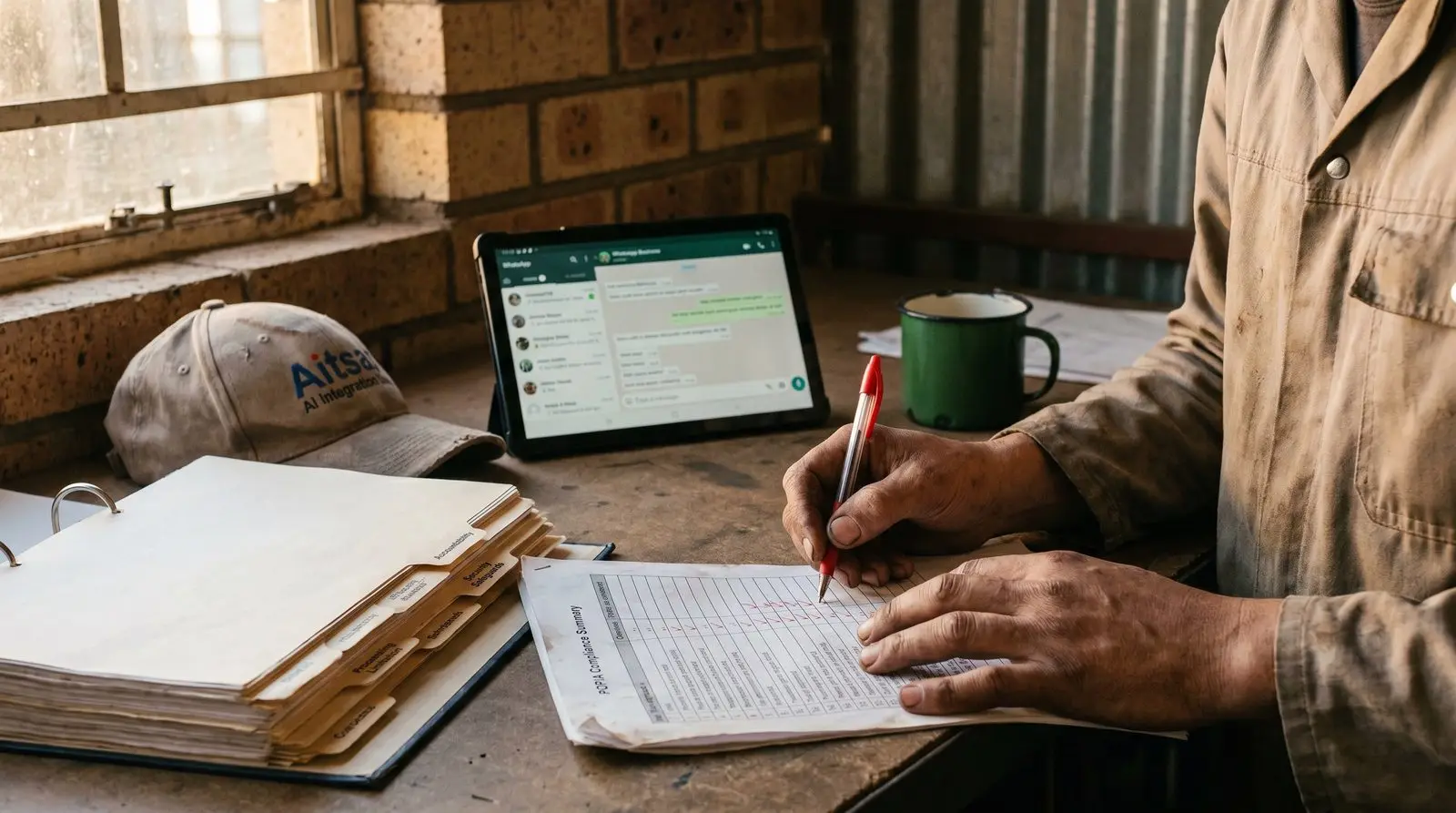
A number on a business card, a WhatsApp message someone sent you once, or a number scraped from an old spreadsheet is not consent to receive automated marketing messages. POPIA requires consent to be specific, informed, and freely given. If you can't point to the moment someone agreed to receive automated messages from you, you don't have consent, you have a contact.
Opt-in patterns that hold up: checkbox, keyword reply, double opt-in
Three patterns actually hold up under scrutiny. A checkbox at signup, clearly worded and unticked by default. A keyword reply, where a contact texts "JOIN" or similar to a published number. A double opt-in, where the initial signal is confirmed with a second message before marketing begins. Each of these creates a timestamped, attributable record. That record is what you'll need to produce if asked.
Building mandatory unsubscribe into every marketing message
Every marketing message needs a clear, working way to opt out, and it needs to actually be tested, not assumed. "Reply STOP" only counts as compliant if replying STOP actually stops the messages, immediately, without a support ticket in between.
Syncing opt-out across WhatsApp, SMS, and email
This is where most setups quietly fail. A contact opts out on WhatsApp, and the marketing team keeps emailing them because the CRM and the WhatsApp platform don't talk to each other. POPIA doesn't recognise channel boundaries. If someone withdraws consent, that withdrawal has to propagate everywhere their data lives, not just the channel they used to say it.
Data handling inside the automation itself
Purpose limitation: why your bot shouldn't store more than it needs
POPIA's purpose limitation principle means you only collect and retain data relevant to why you collected it. A booking bot doesn't need to permanently store a customer's home address if the only reason it asked was to calculate delivery cost for one order. Every field your workflow stores should have a reason attached to it, and that reason should have an expiry.
Sensitive data (IDs, payslips, medical info) and why bots should hand these to a human
ID numbers, payslips, medical records, and financial documents are special personal information under POPIA, and they carry a higher bar for processing. An AI node that reads an uploaded ID document and extracts fields for storage is a processing activity with real risk attached. The safer architecture routes these requests straight to a person instead of an LLM call. We've written in detail about routing sensitive requests to a human agent as a workflow pattern, and it's one we build into every system that touches sensitive documents, including payment flows. If you're accepting payments through WhatsApp via PayFast or Yoco, the same logic applies to card details and proof-of-payment uploads.
Section 72 and cross-border data transfer: what "my BSP is compliant" actually needs to prove
Section 72 of POPIA restricts sending personal information outside South Africa unless the recipient country has adequate protection, the data subject has consented, or one of a few other conditions is met. Many WhatsApp Business Solution Providers route message data through servers outside South Africa. "Our BSP says they're compliant" is not proof. You need to know where the data physically sits, under what legal basis it crosses the border, and whether that basis is documented, not assumed.
Why POPIA has no adequacy whitelist, unlike GDPR
Unlike the EU, South Africa hasn't published a formal whitelist of countries considered to have adequate data protection. That means every cross-border transfer needs its own justification rather than a blanket "this country is fine" assumption. This is one of the more overlooked parts of POPIA, and it's exactly where vendor claims tend to be vaguest.

Choosing or building infrastructure that stays compliant by design
Vendor checklist: ISO 27001, SOC 2, data residency, audit logs
Before signing with any WhatsApp automation vendor, ask for four things: an ISO 27001 or SOC 2 certification (or a clear roadmap to one), a straight answer on data residency, audit logging on every message and consent event, and a documented process for deleting a contact's data on request. If a vendor can't answer these clearly, that's the answer.
Why manual processes are often riskier than automation done properly
Ironically, a lot of businesses assume manual WhatsApp handling is safer than automation. It usually isn't. A human agent copying customer numbers into a spreadsheet, forwarding chats over email, or storing screenshots of ID documents on a shared drive creates far more exposure than a workflow with proper access controls and audit trails. Automation done properly is more auditable than most manual processes, not less.
What a POPIA-safe n8n or custom-build architecture actually looks like
In practice, this means consent timestamp and channel are stored as fields that gate every outbound message node. An opt-out keyword trigger writes to a shared record that suppresses sends across WhatsApp, SMS, and email, not just the channel it arrived on. Any node handling an ID number, payslip, or medical detail routes to human handoff instead of an LLM call. This is what WhatsApp automation built for South African businesses should look like structurally, and it's also usually cheaper to build correctly from the start than to retrofit. If you're budgeting, our breakdown of what WhatsApp automation actually costs in South Africa covers where compliance work fits into the price.
Where the 2026 enforcement phase changes the risk calculus
The Information Regulator has signalled a move into active enforcement from 2026, meaning fewer warnings and more direct action. Businesses treating POPIA as a someday problem are running out of someday.
POPIA vs GDPR for WhatsApp automation: what's different
Fine thresholds compared
GDPR fines can reach €20 million or 4% of global annual turnover, whichever is higher. POPIA caps administrative fines at R10 million. The numbers look smaller in rand terms, but for most South African SMEs, R10 million is still an existential figure.
Extraterritorial scope for international clients using SA numbers
POPIA applies to any entity processing personal information of data subjects in South Africa, regardless of where the processing entity is based. An international client using South African WhatsApp numbers, or a South African business serving EU customers, may need to satisfy both regimes simultaneously. That's a real consideration for businesses building custom AI development for compliance-sensitive workflows that cross borders.
How Sagentics builds POPIA compliance into WhatsApp systems
Consent and opt-out as workflow logic, not documentation
Our position, shaped by actually building these systems rather than writing about them, is that consent state and opt-out state have to live as fields and conditions inside the workflow itself. A contact's consent timestamp and channel gates every outbound message node. An opt-out keyword trigger writes to a shared record that suppresses email and SMS sends too. This is the difference between a privacy policy and a system that can produce an audit trail on demand.
Human handoff for sensitive requests
Any node that would touch an ID number, payslip, or medical detail routes to a human, full stop. No LLM call, no automated extraction, no exception for convenience.
What this looks like in a real build
We've applied exactly this pattern in nonprofit and donor-facing work, where consent and sensitive personal data both carry extra weight. You can see how this played out in a real donor engagement build, including how consent gating and human handoff were structured into the automation from day one. It's representative of how we approach Sagentics' AI automation work generally: compliance as system logic, not an afterthought.
Common questions
Is WhatsApp automation legal in South Africa? Yes. POPIA doesn't prohibit WhatsApp automation, but it regulates how you collect, store, and process the personal information flowing through it. Legality depends on your consent capture, opt-out handling, and data retention practices being built into the system, not just described in a policy document that sits separately from how the workflow actually operates.
Is WhatsApp itself POPIA compliant? WhatsApp as a platform has faced Information Regulator scrutiny in South Africa, including a 2025 enforcement notice. That means businesses can't assume the platform's compliance covers their own use of it. Your consent records, data retention, and cross-border transfer justifications are your responsibility regardless of what WhatsApp or your BSP claims about their own practices.
Do WhatsApp groups need POPIA consent before adding people? Yes. Adding someone to a WhatsApp group exposes their number to every other member and constitutes processing their personal information. Without clear consent beforehand, this breaches POPIA's consent and purpose limitation principles. Businesses running community or customer groups need an explicit opt-in step before adding anyone, not an assumption based on prior contact.
How should AI/chatbot automation handle sensitive documents like IDs or payslips under POPIA? Sensitive documents should route to a human agent, not an LLM call. Special personal information under POPIA carries a higher processing bar, and automated extraction or storage of ID numbers, payslips, or medical details increases risk significantly. The safer architecture flags these requests and hands them to a person with proper access controls.
If a customer opts out on WhatsApp, does that apply across other channels? It should, and POPIA effectively requires it, since withdrawal of consent isn't channel-specific. If your systems don't sync opt-out status across WhatsApp, SMS, and email, you risk continuing to message someone who withdrew consent, which is a compliance failure regardless of which platform sent the message.
Do small businesses need to comply with POPIA, or only large companies? POPIA applies to any business processing personal information in South Africa, regardless of size. There's no small business exemption. A five-person business running WhatsApp marketing carries the same consent, opt-out, and data handling obligations as a large enterprise, though enforcement priority in practice often follows scale and complaint volume.
What's the difference between POPIA and GDPR for WhatsApp automation? GDPR fines can reach 4% of global turnover or €20 million, while POPIA caps at R10 million with possible imprisonment. POPIA also lacks a formal country adequacy whitelist for cross-border transfers, unlike GDPR. Businesses serving both EU and SA customers may need to satisfy both frameworks at once.
What happens if a business is found non-compliant with POPIA? The Information Regulator can issue enforcement notices, impose administrative fines up to R10 million, and in serious cases pursue imprisonment of responsible parties for up to 10 years. Enforcement activity has increased since 2023, with a shift toward active enforcement expected from 2026, making non-compliance a growing operational risk.
Can South African businesses use WhatsApp automation tools hosted or built outside South Africa? Yes, but Section 72 of POPIA requires a lawful basis for transferring personal information across borders, such as consent or proof of adequate protection in the destination country. South Africa has no formal adequacy whitelist, so businesses need to verify and document exactly where their data is stored and processed, not assume vendor compliance covers it.
What should businesses check before choosing a WhatsApp Business API vendor for POPIA compliance? Check for ISO 27001 or SOC 2 certification, clear answers on data residency, audit logging for consent and message events, and a documented process for deleting contact data on request. Vague answers on any of these points signal risk you'll inherit if the Information Regulator ever asks questions.
If you're weighing up building or fixing a WhatsApp system and want to talk through what compliant actually looks like for your setup, message us on WhatsApp and we'll walk through it.
Common questions
Is WhatsApp automation legal in South Africa?
Yes. POPIA doesn't prohibit WhatsApp automation, but it regulates how you collect, store, and process the personal information flowing through it. Legality depends on your consent capture, opt-out handling, and data retention practices being built into the system, not just described in a policy document that sits separately from how the workflow actually operates.
Is WhatsApp itself POPIA compliant?
WhatsApp as a platform has faced Information Regulator scrutiny in South Africa, including a 2025 enforcement notice. That means businesses can't assume the platform's compliance covers their own use of it. Your consent records, data retention, and cross-border transfer justifications are your responsibility regardless of what WhatsApp or your BSP claims about their own practices.
Do WhatsApp groups need POPIA consent before adding people?
Yes. Adding someone to a WhatsApp group exposes their number to every other member and constitutes processing their personal information. Without clear consent beforehand, this breaches POPIA's consent and purpose limitation principles. Businesses running community or customer groups need an explicit opt-in step before adding anyone, not an assumption based on prior contact.
How should AI/chatbot automation handle sensitive documents like IDs or payslips under POPIA?
Sensitive documents should route to a human agent, not an LLM call. Special personal information under POPIA carries a higher processing bar, and automated extraction or storage of ID numbers, payslips, or medical details increases risk significantly. The safer architecture flags these requests and hands them to a person with proper access controls.
If a customer opts out on WhatsApp, does that apply across other channels?
It should, and POPIA effectively requires it, since withdrawal of consent isn't channel-specific. If your systems don't sync opt-out status across WhatsApp, SMS, and email, you risk continuing to message someone who withdrew consent, which is a compliance failure regardless of which platform sent the message.
Do small businesses need to comply with POPIA, or only large companies?
POPIA applies to any business processing personal information in South Africa, regardless of size. There's no small business exemption. A five-person business running WhatsApp marketing carries the same consent, opt-out, and data handling obligations as a large enterprise, though enforcement priority in practice often follows scale and complaint volume.
What's the difference between POPIA and GDPR for WhatsApp automation?
GDPR fines can reach 4% of global turnover or €20 million, while POPIA caps at R10 million with possible imprisonment. POPIA also lacks a formal country adequacy whitelist for cross-border transfers, unlike GDPR. Businesses serving both EU and SA customers may need to satisfy both frameworks at once.
What happens if a business is found non-compliant with POPIA?
The Information Regulator can issue enforcement notices, impose administrative fines up to R10 million, and in serious cases pursue imprisonment of responsible parties for up to 10 years. Enforcement activity has increased since 2023, with a shift toward active enforcement expected from 2026, making non-compliance a growing operational risk.
Can South African businesses use WhatsApp automation tools hosted or built outside South Africa?
Yes, but Section 72 of POPIA requires a lawful basis for transferring personal information across borders, such as consent or proof of adequate protection in the destination country. South Africa has no formal adequacy whitelist, so businesses need to verify and document exactly where their data is stored and processed, not assume vendor compliance covers it.
What should businesses check before choosing a WhatsApp Business API vendor for POPIA compliance?
Check for ISO 27001 or SOC 2 certification, clear answers on data residency, audit logging for consent and message events, and a documented process for deleting contact data on request. Vague answers on any of these points signal risk you'll inherit if the Information Regulator ever asks questions.
About Sagentics
Sagentics is an AI systems studio based in South Africa. We design and build WhatsApp automation, n8n workflows, and custom AI products for local and international clients. We write from systems we have actually shipped.
Start a WhatsApp conversation with SagenticsRelated reading
- WhatsApp automation in South Africa: what it costs and whether you need it
- WhatsApp Business API vs the app: which one your business actually needs
- AI customer service agent on WhatsApp: what it is, how it works, and what it costs in South Africa
- How to accept payments through WhatsApp in South Africa using PayFast or Yoco
- routing sensitive requests to a human agent
- WhatsApp Business API vs the app
- WhatsApp automation built for South African businesses
- what WhatsApp automation actually costs in South Africa
- custom AI development for compliance-sensitive workflows
- accepting payments through WhatsApp via PayFast or Yoco
- how this played out in a real donor engagement build
- Sagentics' AI automation work