

 Start a conversation
Custom AI product and SaaS development
Human-in-the-loop production AI: what it means and how to build it properly

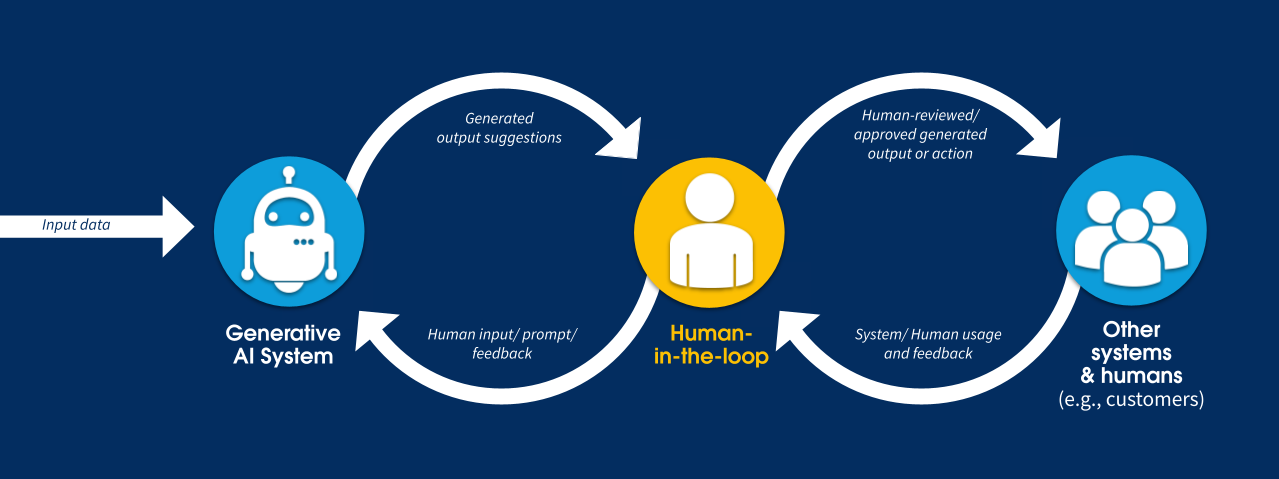
Human-in-the-loop production AI is a system design where an AI agent executes routine actions on its own but pauses and hands control to a person at defined checkpoints, usually high-risk, low-confidence, or irreversible ones, before anything real happens to a customer, payment, or record. It is not a Slack notification bolted onto a workflow after launch.
It is a set of decisions made before you build: which actions the AI can take alone, which ones need a person, and who that person is when the moment arrives. Most teams get this wrong not because the concept is hard, but because they treat "human in the loop" as a safety net instead of an architecture choice.
What human-in-the-loop production AI actually means
The one-sentence definition without the jargon
An AI agent handles the routine cases and stops to ask a person when a decision is risky, uncertain, or hard to undo. That's the whole idea. Everything else is implementation detail: where you put the checkpoint, who has authority to approve or reject, and how fast that person has to respond.
Why 'in the loop' only counts if the human has authority to stop the action
A lot of systems we've inspected for clients have a human "reviewing" outputs after the action has already fired, an invoice already sent, a refund already processed, a WhatsApp message already delivered to a customer. That's not human-in-the-loop. That's a human reading a log. Real HITL means the action is paused, not completed, until someone with actual authority says yes or no. If the person can't stop it before it happens, they're not in the loop, they're downstream of it.
Training-time HITL vs runtime HITL, and why people conflate them
There are two completely different things wearing the same name. Training-time HITL is what happens when humans label data, rank model outputs, or do reinforcement learning from human feedback (RLHF) to make a model better before it ships. Runtime HITL is what happens after the model is live, when a human checks a specific decision in a specific workflow before it executes. A model can have excellent training-time HITL and zero runtime HITL, which means it was well-trained but still unsupervised in production. Most vendor marketing talks about the first kind. Most operational risk lives in the second.
Human-in-the-loop vs human-on-the-loop vs human-over-the-loop
In the loop: approve before it happens
The AI drafts the action, a person approves or rejects it, and only then does it execute. This is the slowest of the three models but the safest for irreversible actions, refunds, contract terms, anything touching money or legal exposure.
On the loop: monitor while it happens, intervene if needed
The AI acts autonomously in real time, but a person is watching a dashboard or queue and can intervene, override, or roll back. This is what most WhatsApp support automations should run on for medium-risk actions. It keeps throughput high while keeping a person close enough to catch problems fast. This is also where escalation design matters most, and it's the model behind how human handoff actually works on WhatsApp when an AI agent can't resolve something confidently.
Over the loop: governance and audit after the fact
No real-time intervention. A person or team reviews logs, decisions, and outcomes periodically to check the system is behaving as intended and to feed corrections back into the design. This is compliance and audit work, not operational control.
Most production systems use all three at once, not one
A well-built system doesn't pick one mode. Low-risk, high-confidence actions run fully autonomous with over-the-loop audit later. Medium-risk actions run on-the-loop with a person watching live. High-risk or irreversible actions run strictly in-the-loop with approval required before execution. Mixing these deliberately, by risk tier, is the actual design work. Treating HITL as a single on/off switch is where most builds go wrong.

Why pure automation breaks down once agents can act
The shift from chatbots that answer to agents that execute
A chatbot that answers a question carries almost no operational risk. Worst case, it gives a wrong answer and a person corrects it. An agent that can act, send a payment, cancel a booking, update a record, carries a different category of risk entirely, because the mistake is now a completed transaction, not a misplaced sentence. This is the real difference between a chatbot and an agentic assistant, and it's why the same governance rules don't apply to both.
What changes when an LLM can send a payment, cancel a booking, or reply on WhatsApp without review
Once an LLM has tool access, permission is no longer a UX detail, it's a liability boundary. A model that hallucinates a wrong refund amount and has payment API access will actually send that amount. A model that misreads a booking cancellation request and has calendar write access will actually cancel it. The failure mode moves from "annoying" to "operational and financial." This is exactly the boundary that separates what should stay rule-based versus what AI should touch in any hybrid WhatsApp deployment.
Confidence-score routing: how most real systems decide when to ask a human
In practice, most production HITL systems use a confidence score attached to the model's output. Above a set threshold, the action runs autonomously. Below it, the action routes to a human queue instead of executing. The threshold isn't arbitrary, it should be set per action type based on the cost of being wrong, not a single global number applied to everything the AI does.
Where HITL actually gets used in South African business systems
WhatsApp support escalation from AI to a human agent
A customer asks something outside the bot's confidence range, a complaint, a legal question, an unusual request, and the conversation routes to a human agent with full context attached, not a cold handoff. This is standard in well-built WhatsApp Business API deployments and is the single most common HITL pattern we implement for clients.
Payment and refund approvals in PayFast and Yoco flows
Any refund, dispute, or payment adjustment processed through PayFast or Yoco should have a human approval step before the transaction fires, not after. We've seen systems where an AI agent had authority to auto-refund based on customer sentiment analysis, which sounds efficient until it refunds the wrong amount to the wrong person with no one checking first. Approving payments through PayFast or Yoco on WhatsApp needs a defined approval checkpoint, every time, with no exceptions for "small" amounts, because small amounts at scale are how fraud goes unnoticed.
Document and invoice automation with sign-off before it ships
Invoice generation, contract drafts, and compliance documents can be fully AI-drafted, but should not leave the building without a sign-off step. The AI does the drafting work, a person does the fifteen-second check before it goes to a client or supplier.
Appointment booking exceptions and edge cases
Standard bookings run autonomously. Anything that doesn't fit the standard pattern, a cancellation within a cancellation-fee window, a double-booking conflict, a VIP client request, routes to a person. The AI handles volume, the human handles exceptions.
The POPIA angle nobody writes about
POPIA doesn't mention AI, but its accountability principle demands exactly this
POPIA was written before generative AI agents existed in South African business workflows, so it never uses the word "AI." But its accountability principle requires that whoever processes personal data can account for how a decision affecting that data was made. If your AI agent auto-approves a refund, changes a customer record, or sends a message containing personal information, and nobody can explain why that specific action happened, you have an accountability gap under POPIA regardless of whether the system technically "worked."
Why a human must be able to explain the decision is a POPIA requirement in disguise
This is the connection most compliance write-ups miss. POPIA doesn't say "have a human in the loop." It says you must be accountable for processing decisions and you must process data lawfully, and limit that processing to what's necessary. In practice, the only way to meet that standard once an AI agent is making live decisions about customer data is to have a defined human checkpoint that can explain, at any point, why an action happened. That's not a governance nicety layered on top of POPIA compliance. It's the same standard, applied to an AI-driven workflow instead of a manual one.
What this means for WhatsApp automation and customer data handling
If your WhatsApp automation touches personal data, phone numbers, order history, ID numbers, medical or financial details, and an AI agent is making decisions with that data, you need a documented HITL checkpoint for anything beyond routine, low-risk replies. This isn't about slowing down every message. It's about knowing exactly where the line sits and being able to show a regulator, or a customer, that a person was accountable for the decision that mattered.
How to actually design the checkpoints, not just add a human
Why someone in the loop without training is a liability, not oversight
This is the failure mode we see most often in client builds, and it's worth naming directly: a team adds a "human in the loop" as a Slack notification, with no defined authority over the action, no training on what qualifies as an approval versus a rejection, and no escalation SLA for how fast they need to respond. That setup is worse than having no review at all, because it creates false confidence. Everyone believes there's oversight. There isn't. There's a notification nobody's accountable for actioning within any defined window.
Setting confidence thresholds that route to a person
Before you build, define per action: what confidence score triggers autonomous execution, what score triggers human review, and what happens if the human doesn't respond within the SLA (does it fail safe and hold, or fail open and execute anyway). Most production incidents we've diagnosed trace back to this last question never being answered.
Defining escalation rules before you build, not after something breaks
Write the escalation rules down before a single line of workflow gets built: which actions require approval, who the approver is, what information they see when the escalation reaches them, and what the fallback is if they're unavailable. If this is designed after an incident, you're doing incident response, not system design.
Does human review slow the system down
Why it doesn't reduce throughput when designed as on-the-loop supervision
The perception that HITL kills speed comes from designing it as in-the-loop approval for everything, which is the wrong default. When the majority of actions are low-risk and run autonomously, and only the risky minority route to a person, throughput barely changes. A well-tuned confidence threshold means most volume never touches a human queue at all.
The real cost of skipping HITL: silent failures and irreversible actions
The actual cost isn't the seconds a human review adds. It's what happens when you skip it: a wrong refund that's already gone out, a cancelled booking that can't be un-cancelled, a message sent to the wrong customer with someone else's personal information in it. These aren't slow failures you catch in a weekly report. They're silent until a customer complains, and by then the damage is done. A missing HITL checkpoint is a specific type of silent failure in production workflows.
How Sagentics builds HITL into production systems
n8n error handling and human-review nodes
We build human-review checkpoints directly into n8n workflows as explicit nodes, not afterthoughts. An action either meets its confidence and risk threshold and proceeds, or it routes to a review queue with full context attached: what the AI decided, why, and what data it used. Combined with proper error handling, this means nothing executes silently and nothing fails silently either.
Escalation logic on WhatsApp Business API
For client WhatsApp deployments, we design escalation logic around the specific risk profile of each business, not a generic template. A clinic's escalation rules around health information look different from a retailer's rules around refund approval. Both get a documented checkpoint, an assigned human owner, and a response SLA, agreed before launch.
What we tell clients before they automate anything customer-facing
We tell every client the same thing before we build: decide what you're comfortable letting an AI do without you, and what you're not, before we write a single workflow. That decision shapes the whole system. It's also the conversation that usually clarifies the honest build versus buy decision for AI software, because off-the-shelf tools rarely let you set these checkpoints where your risk actually sits, and they rarely make clear what an AI customer service agent actually costs to run once proper review checkpoints are included.
Common questions
What is human-in-the-loop AI? It's a system design where an AI agent handles routine decisions autonomously but pauses at defined checkpoints, high-risk, low-confidence, or irreversible actions, to get human approval before the action executes. The human has actual authority to stop or approve it, not just visibility after the fact.
What is the difference between human-in-the-loop and human-on-the-loop? In-the-loop means a person approves an action before it executes. On-the-loop means the action runs autonomously in real time while a person monitors and can intervene or roll back. In-the-loop is safer for irreversible actions; on-the-loop preserves speed for medium-risk, real-time workflows like WhatsApp support.
Does human-in-the-loop slow down AI systems? Not when designed correctly. If only high-risk, low-confidence actions route to a human and the rest run autonomously, throughput barely changes. It only slows systems down when teams make every action require approval instead of tiering checkpoints by actual risk level.
Is human-in-the-loop required by regulation in South Africa or under POPIA? POPIA doesn't mention AI explicitly, but its accountability principle requires that data processing decisions can be explained and justified. Once an AI agent is making live decisions involving personal data, a human checkpoint is effectively the only practical way to meet that accountability standard.
When should an AI feature require human review vs run autonomously? Base it on confidence score and reversibility. High-confidence, low-risk, reversible actions can run autonomously. Low-confidence, high-risk, or irreversible actions, payments, refunds, legal or health data, cancellations, should require review before execution, defined before launch, not after an incident.
How much should an AI agent be allowed to do on its own? As much as fits within a clearly defined, tested confidence threshold and risk tier, and no more. This should be decided per action type, not as a blanket permission. Start conservative, expand autonomy as the system proves reliable in production, not based on assumption.
What are examples of human-in-the-loop in customer service and business automation? WhatsApp escalation from AI to a human agent for complex queries, refund and payment approvals before PayFast or Yoco transactions fire, invoice sign-off before documents ship to clients, and manual review of booking exceptions like cancellations inside fee windows or VIP requests.
What's the difference between HITL in model training and HITL in live workflow execution? Training-time HITL involves humans labeling data or ranking outputs to improve a model before deployment, like RLHF. Runtime HITL involves a human checking specific live decisions in a production workflow before they execute. A model can be well-trained but still run fully unsupervised in production if runtime HITL isn't built in.
If you're building or fixing a customer-facing AI system and want a second opinion on where your checkpoints should sit, message Sagentics on WhatsApp. No pitch, just a straight conversation about what should run autonomously and what shouldn't.
Common questions
What is human-in-the-loop AI?
It's a system design where an AI agent handles routine decisions autonomously but pauses at defined checkpoints, high-risk, low-confidence, or irreversible actions, to get human approval before the action executes. The human has actual authority to stop or approve it, not just visibility after the fact.
What is the difference between human-in-the-loop and human-on-the-loop?
In-the-loop means a person approves an action before it executes. On-the-loop means the action runs autonomously in real time while a person monitors and can intervene or roll back. In-the-loop is safer for irreversible actions; on-the-loop preserves speed for medium-risk, real-time workflows like WhatsApp support.
Does human-in-the-loop slow down AI systems?
Not when designed correctly. If only high-risk, low-confidence actions route to a human and the rest run autonomously, throughput barely changes. It only slows systems down when teams make every action require approval instead of tiering checkpoints by actual risk level.
Is human-in-the-loop required by regulation in South Africa or under POPIA?
POPIA doesn't mention AI explicitly, but its accountability principle requires that data processing decisions can be explained and justified. Once an AI agent is making live decisions involving personal data, a human checkpoint is effectively the only practical way to meet that accountability standard.
When should an AI feature require human review vs run autonomously?
Base it on confidence score and reversibility. High-confidence, low-risk, reversible actions can run autonomously. Low-confidence, high-risk, or irreversible actions, payments, refunds, legal or health data, cancellations, should require review before execution, defined before launch, not after an incident.
How much should an AI agent be allowed to do on its own?
As much as fits within a clearly defined, tested confidence threshold and risk tier, and no more. This should be decided per action type, not as a blanket permission. Start conservative, expand autonomy as the system proves reliable in production, not based on assumption.
What are examples of human-in-the-loop in customer service and business automation?
WhatsApp escalation from AI to a human agent for complex queries, refund and payment approvals before PayFast or Yoco transactions fire, invoice sign-off before documents ship to clients, and manual review of booking exceptions like cancellations inside fee windows or VIP requests.
What's the difference between HITL in model training and HITL in live workflow execution?
Training-time HITL involves humans labeling data or ranking outputs to improve a model before deployment, like RLHF. Runtime HITL involves a human checking specific live decisions in a production workflow before they execute. A model can be well-trained but still run fully unsupervised in production if runtime HITL isn't built in.
About Sagentics
Sagentics is an AI systems studio based in South Africa. We design and build WhatsApp automation, n8n workflows, and custom AI products for local and international clients. We write from systems we have actually shipped.
Start a WhatsApp conversation with SagenticsRelated reading
- Build vs buy AI software: the honest answer for South African businesses
- Building a custom AI product: what it actually takes, what it costs, and why most of the work isn't the AI
- How to choose a real AI development partner in South Africa
- MVP scoping for AI SaaS: how to define the build before you pay for it
- how human handoff actually works on WhatsApp
- what POPIA actually requires from WhatsApp automation
- what should stay rule-based versus what AI should touch
- how to stop workflows failing silently in production
- the real difference between a chatbot and an agentic assistant
- what an AI customer service agent actually costs to run
- the honest build versus buy decision for AI software
- approving payments through PayFast or Yoco on WhatsApp