

 Start a conversation
Custom AI product and SaaS development
Building a custom AI product: what it actually takes, what it costs, and why most of the work isn't the AI
Building a custom AI product means picking one business workflow, wiring it into your real systems and data, and shipping a working version in weeks, not starting with a model and hoping a use case appears. Most of the effort has nothing to do with prompting or model selection. It's integration engineering: getting the AI to read your calendar, write to your CRM, send a WhatsApp template message that Meta actually approves, and reconcile a PayFast payment without a human checking a spreadsheet afterward. In South Africa specifically, that plumbing is 80% of the job. The model is the other 20%.
That ratio is the opposite of what most agency content implies, and it's the reason so many "AI strategy" engagements produce a slide deck instead of a working product.
What building a custom AI product actually involves
Scoping one workflow instead of an AI strategy
The single biggest mistake we see is starting with "we need an AI strategy" instead of "we need to stop manually processing 40 WhatsApp orders a day." A strategy has no deadline and no owner. A workflow has both.
A real build starts with one process: quote generation, lead qualification, booking confirmations, invoice reconciliation, customer support triage. You pick the workflow that currently costs the most staff hours or loses the most revenue to delay, and you build for that one thing first. Everything else gets bolted on later, once the first piece is live and trusted.
This is also why "AI strategy" workshops tend to stall. They try to map every possible use case before building anything, which means nothing ships for months. A working product scoped to one workflow can go live in two to four weeks. A strategy document rarely goes live at all.
Where the model fits vs where the integration work actually lives
The model, whether it's GPT-4, Claude, or a smaller open model, handles language understanding and generation. That part is largely solved and getting cheaper every quarter. What isn't solved, and what actually differentiates a working product from a demo, is everything around the model:
- Authentication into your existing systems (CRM, accounting software, booking calendars)
- Handling WhatsApp Business API's message template approval process and 24-hour session windows
- Reconciling payments from PayFast or Yoco against orders taken through a chat interface
- Error handling when an API times out, a webhook fails, or a customer sends a voice note instead of text
- Logging and audit trails for POPIA accountability
- Fallback to a human when the AI isn't confident
None of that is model work. It's systems integration, and it's where 80% of build time actually goes. If you read US-focused content on "building an AI product," this part is almost invisible, because in a market where every SaaS tool has a clean REST API and payment rails are standardized, the plumbing is trivial. In South Africa, it isn't.
Prototype, build, deploy, support: the realistic pipeline
A realistic build has four stages, and skipping any of them is how projects fail quietly.
Prototype (3-7 days): a working proof of concept against real data, not sample data, so you can see actual failure modes early. This is not a demo script, it's the real workflow with real edge cases.
Build (2-6 weeks depending on complexity): the integrations, the error handling, the retry logic, the admin dashboard if you need one, and testing against the messy inputs real customers actually send.
Deploy: rollout to a subset of real traffic first, monitoring closely, before switching over fully. Load-shedding tolerance gets tested here too, not assumed.
Support: ongoing monitoring, prompt and logic updates as your business changes, and token cost tracking. AI products are never "done" the way a static website is done. They need someone watching them.
If you want the fuller breakdown of this pipeline and how we scope it for South African clients, we've written it up in detail on custom AI development in South Africa.
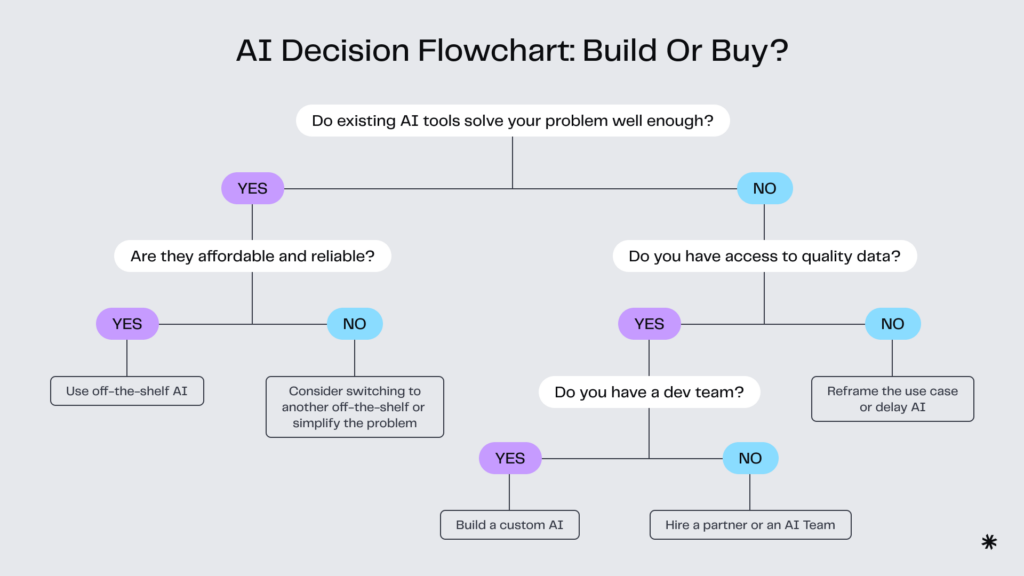
Custom AI vs off-the-shelf tools: the real decision rule
When ChatGPT or a SaaS tool is genuinely enough
If your problem is "I need to draft emails faster" or "I need help brainstorming marketing copy," you don't need a custom build. Pay the twenty dollars a month for ChatGPT Plus or Claude Pro and move on. The same goes for well-scoped SaaS tools: if a $50/month customer support widget already does what you need, buying it is cheaper and faster than building it.
The decision rule is simple: off-the-shelf works when your workflow is generic, doesn't touch sensitive customer data, and doesn't need to talk to your other systems. The moment any of those three conditions breaks, off-the-shelf starts costing you more than it saves, usually in manual workarounds nobody accounts for.
When you need custom: permissions, internal systems, WhatsApp Business API, PayFast/Yoco
Custom becomes necessary the moment the AI needs to do more than generate text. If it needs to check stock levels in your inventory system before confirming an order, verify a payment cleared through PayFast before releasing a booking, or send a WhatsApp message using an approved business template with your own branding and phone number, no off-the-shelf tool does that out of the box.
Permissions matter too. A generic chatbot tool that stores customer conversations on a US server with no data processing agreement is a POPIA problem waiting to surface. A custom build lets you control exactly where data lives, who can access it, and how long it's retained.
Why the global 'it depends' framing misses South African constraints
Most content on this decision says "it depends on your use case," which is true but unhelpfully vague. In South Africa, three constraints tip the decision toward custom far more often than global content suggests:
First, WhatsApp is the default channel for customer communication here, not email or a website chat widget, and WhatsApp Business API integration is not something generic SaaS tools handle well. Second, PayFast and Yoco are the payment rails that actually matter locally, and reconciling AI-driven transactions against them requires custom logic, not a Stripe webhook tutorial. Third, POPIA imposes data residency and accountability obligations that many US-based SaaS products simply aren't built to satisfy.
Add load-shedding to that list. A product that assumes 24/7 uptime on a single server breaks in ways US-built tools never had to plan for. These four constraints, not model choice, are usually what push a South African business from "just use ChatGPT" to "we need something built for us." For a deeper look at how these tradeoffs play out, see custom AI development in South Africa.
What it costs to build a custom AI product
Rough USD/ZAR ranges by build complexity
Pricing varies enormously depending on scope, but rough bands help set expectations.
Simple single-workflow bot (WhatsApp order-taking, FAQ answering, appointment booking): roughly R25,000 to R60,000 (about $1,300 to $3,200) for initial build, plus monthly hosting and token costs.
Mid-complexity integration (CRM sync, payment reconciliation via PayFast or Yoco, multi-step workflows with human handoff): roughly R80,000 to R200,000 (about $4,300 to $10,800).
Full agentic system (multiple integrated workflows, custom dashboard, ongoing learning loops, multi-channel support): R250,000 and up, often R400,000-R600,000 for genuinely complex builds spanning several departments.
These are directional, not quotes. The variance inside each band is driven almost entirely by how messy the existing systems are, not by how sophisticated the AI needs to be.
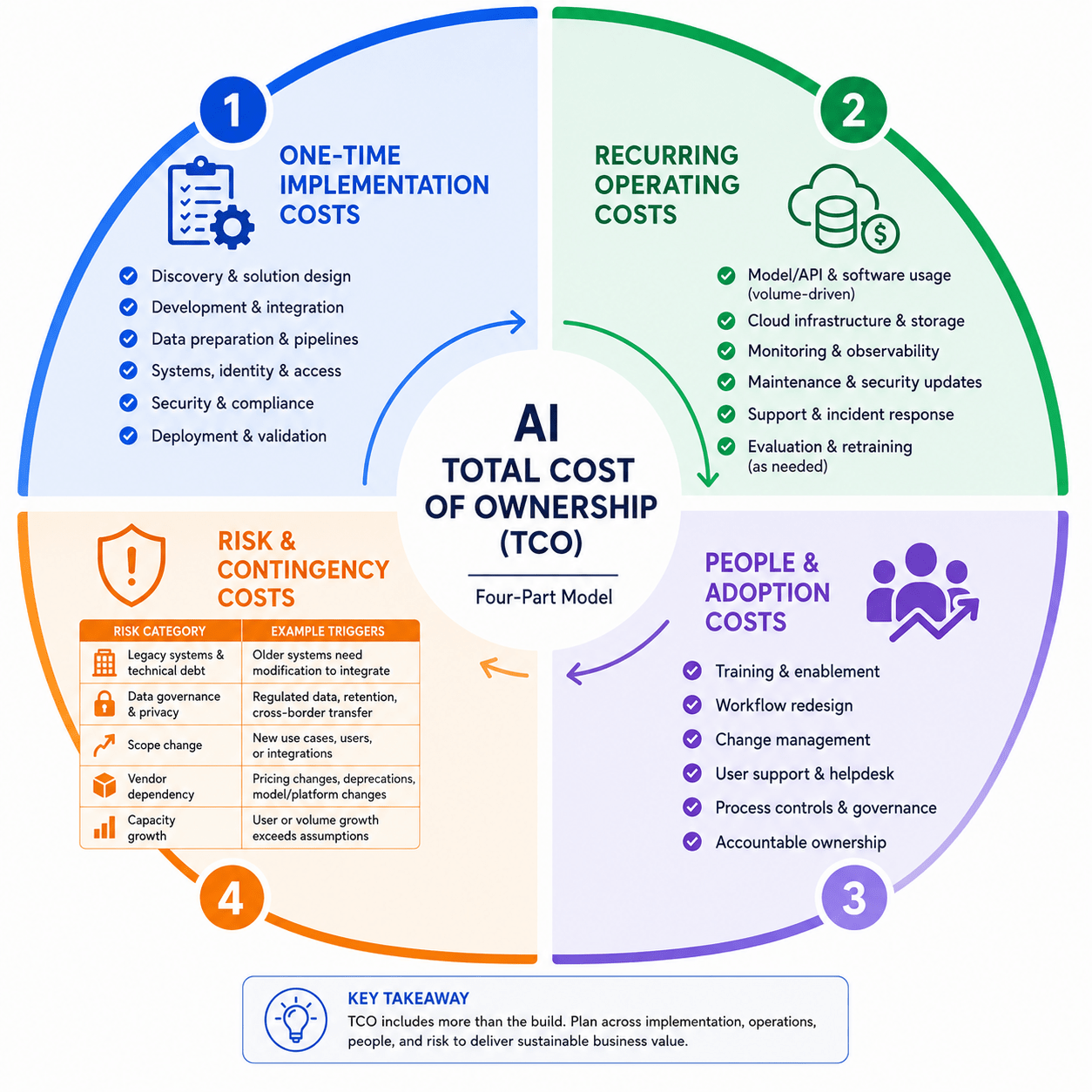
Ongoing costs: tokens, hosting, monitoring, maintenance
The build cost is only part of the picture. Ongoing costs typically run:
- Token/API costs: R500 to R5,000+ per month depending on volume, higher for high-traffic customer-facing bots
- Hosting and infrastructure: R300 to R2,000 per month for most small-to-mid builds
- Monitoring and maintenance: either an internal hour or two a week, or a retainer with your build partner, typically R3,000 to R15,000 per month depending on system complexity
Businesses that budget only for the build and not for the maintenance are the ones who end up with a bot that quietly breaks three months in and nobody notices until a customer complains.
Why three quotes for the same brief can differ by 10x
If you send the same brief to three studios and get quotes of R30,000, R150,000, and R500,000, that's not necessarily one studio ripping you off. It usually means the three studios scoped different things.
The cheap quote often assumes an existing no-code template with minimal customization, no error handling, and no ongoing support. The expensive quote often includes months of "AI strategy" work, unnecessary custom infrastructure, or padding for a big-agency overhead structure. The right quote is the one that matches the actual complexity of your workflow, including realistic error handling and a maintenance plan, without either stripping out necessary robustness or adding scope you don't need.
Ask every quote to itemize: what's included in error handling, what happens when an API fails, who maintains it after launch, and what the token cost estimate is based on. If a quote can't answer those four questions, it's not a real quote.
Why most AI projects fail (and how to not be one)
The 70-85% failure stat, sourced and explained
Industry research, including surveys from RAND Corporation and Gartner, consistently puts AI project failure rates between 70% and 85%, meaning most AI initiatives never make it to production or get abandoned within a year of launch. That's a striking number, but the reasons behind it are mundane, not mysterious.
Projects fail because they're scoped as experiments with no clear owner, built on data nobody cleaned first, or designed to replace a job function rather than fix a specific bottleneck. None of that is an AI problem. It's a project management problem wearing an AI costume.
Poor data, no clear business outcome, no workflow redesign
Three failure patterns show up repeatedly:
Poor data. If your customer records are scattered across three spreadsheets, two inboxes, and someone's memory, no AI model fixes that. The AI will confidently generate wrong answers from wrong data, which is worse than no automation at all.
No clear business outcome. "We want to use AI" is not a success metric. "We want to cut average response time from 4 hours to 15 minutes" is. Projects without a measurable target drift indefinitely and get quietly cancelled when budget gets reviewed.
No workflow redesign. Bolting an AI chatbot onto a broken process just automates the breakage faster. If your current WhatsApp order process requires three manual handoffs between staff, automating one of those handoffs without fixing the other two just moves the bottleneck, it doesn't remove it.
Proof of value over proof of concept
A proof of concept proves the AI can technically do the thing, in a demo, with clean sample data, in front of a decision-maker. A proof of value proves the thing is worth doing, with real customer data, real edge cases, and a measured before-and-after outcome.
Most failed projects stopped at proof of concept and declared victory. The demo worked, everyone was impressed, and the project got shelved because nobody ran it against messy reality. The fix is straightforward: run every pilot against live data for two to four weeks and measure a real number, whether that's hours saved, response time cut, or orders processed without a manual touch. If the number doesn't move, the project isn't ready to scale, no matter how good the demo looked.
Do you need to code? The no-code reality in 2026
What n8n and Custom GPTs can and can't do alone
No-code tools have gotten genuinely good. n8n can wire together dozens of services, trigger workflows off webhooks, and handle branching logic without a single line of custom code. Custom GPTs and similar tools let you build a scoped assistant with specific instructions and knowledge in an afternoon.
These tools are enough for a real chunk of use cases: internal FAQ bots, simple lead-capture flows, basic scheduling assistants, straightforward data lookups. If your workflow fits inside what the platform's native nodes support, you genuinely don't need custom code, and paying for custom development would be wasteful.
Where no-code stops and custom integration work starts
The limits show up fast once you need anything the platform doesn't have a pre-built node for. WhatsApp Business API's template approval quirks, PayFast's specific webhook signature verification, an older internal system with no modern API, or complex conditional logic that no-code branching gets clumsy handling, all of these push you into custom code territory, usually a custom node in n8n or a standalone service the workflow calls out to.
The honest answer is that most real South African business builds end up as a hybrid: n8n for the orchestration and simple logic, custom code for the parts that touch WhatsApp, payments, or a legacy system. Trying to force 100% no-code onto a workflow with real integration needs usually means brittle workarounds that break the first time an API changes. For the actual decision framework, including when to walk away from no-code entirely, see n8n vs custom code for South African builds.
Building AI products in South Africa specifically
POPIA and data residency in the build itself
POPIA compliance isn't a checkbox you add after the build, it's a design decision made before you write the first integration. Where does customer data get stored? Who has access to it? How long is it retained? Can a customer request deletion, and does your system actually support that?
A custom build lets you answer these questions deliberately: choosing hosting providers with appropriate data protection agreements, encrypting data at rest and in transit, and building audit logs that show who accessed what and when. Off-the-shelf tools built for a US or EU market often can't answer these questions at all, because they weren't designed with POPIA's specific accountability requirements in mind. For the specifics of what actually needs to be true for a WhatsApp-based build to be compliant, see POPIA compliance for WhatsApp automation.
Local adoption numbers and what they mean for timing
South African businesses are adopting AI automation faster than general sentiment suggests, particularly in customer-facing roles where WhatsApp is already the default channel. The businesses moving first are gaining a real service-speed advantage over competitors still running manual WhatsApp desks with a person typing every reply.
That timing matters. The businesses that build now, while adoption is still uneven, are the ones setting customer expectations for response speed in their category. The ones that wait until "everyone's doing it" will be automating just to catch up, not to get ahead.
Why WhatsApp-first beats generic chatbot builds here
Building a generic web chatbot for a South African audience misreads the market. WhatsApp has near-universal penetration here in a way that website chat widgets never achieved, because customers already live in WhatsApp for everything from ordering groceries to paying a plumber. A custom AI product that lives inside WhatsApp meets customers where they already are, with no new app to download and no new habit to build.
This is also where the payment side closes the loop. A WhatsApp-first build that can also handle payment, through PayFast or Yoco, means a customer can discover, ask questions, and pay without ever leaving the chat thread. See accepting payments through WhatsApp with PayFast and Yoco for the mechanics, and it's consistently the feature that turns a support bot into a genuine revenue channel. For a real example of what this looks like shipped and running, see the MerchLab case study.
In-house build vs hiring a specialist studio
The 67% vs 33% vendor-vs-internal success gap
Industry data on enterprise AI implementations shows a consistent pattern: projects built with an experienced external vendor succeed at roughly double the rate of projects built entirely in-house by teams without prior AI deployment experience, figures cited in enterprise research put vendor-led success around 67% against roughly 33% for inexperienced internal builds. The gap isn't about talent. It's about having already made, and fixed, the expensive mistakes once before on someone else's project.
An in-house team building their first AI product will hit the same scoping mistakes, integration surprises, and data-quality problems that an experienced studio already solved on a previous client's build. That learning curve costs time and money regardless of who pays for it, the only question is whether you pay for someone else's mistakes as billable hours, or pay for your own team's first attempt as sunk cost.
What to check before you hire an agency
If you do decide to hire, a few checks separate a real build partner from a slide-deck vendor:
Ask to see a working product they've shipped, not a mockup. Ask what happens when the integration fails, if they can't answer specifically, they haven't built enough real systems. Ask about their maintenance model, a partner with no plan for what happens after launch is planning to disappear after invoice. Ask specifically about their WhatsApp Business API and payment gateway experience if that's part of your build, generic "we do AI" agencies frequently have no direct experience with either.
Look for a partner who talks about your workflow specifically rather than AI capabilities generally. A studio that starts the conversation with "here's what large language models can do" instead of "tell me about your current process" is selling technology, not solving your problem. For a broader look at what agencies in this space actually deliver and what fair pricing looks like, see what AI automation agencies actually build and what it costs. If you want to see the difference between a scripted chatbot and something that actually reasons through a workflow, it's worth understanding the real difference between a chatbot and an agentic assistant before you brief anyone.
Common questions
How much does it cost to build a custom AI solution? Simple single-workflow builds (WhatsApp bots, booking assistants) typically run R25,000 to R60,000. Mid-complexity integrations with CRM sync or payment reconciliation run R80,000 to R200,000. Full agentic systems across multiple workflows start around R250,000. Budget separately for ongoing tokens, hosting, and maintenance, usually R3,000 to R15,000 per month.
What's the difference between custom AI and off-the-shelf AI tools? Off-the-shelf tools handle generic tasks like drafting text or answering FAQs without touching your internal systems. Custom AI is built to integrate with your specific CRM, payment gateway, and communication channels, with permissions, data handling, and error logic designed around your actual workflow rather than a generic use case.
Is custom AI worth it for a small business or should I just use ChatGPT? If your need is generic content help, ChatGPT is enough. If the AI needs to check stock, confirm a payment through PayFast or Yoco, or send WhatsApp messages under your business number, off-the-shelf tools can't do that, and custom becomes worth the investment once manual workarounds start costing more than the build.
How long does it take to build a custom AI product? A working prototype against real data takes 3-7 days. A full single-workflow build typically takes 2-6 weeks depending on integration complexity. Multi-workflow or full agentic systems can take 2-4 months. Timelines stretch mainly because of messy existing data or unclear scope, not model complexity.
Do I need to know how to code to build an AI agent? Not always. Tools like n8n and Custom GPTs handle a real range of use cases with no coding. But WhatsApp Business API quirks, payment gateway webhooks, and legacy system integrations usually require custom code. Most real South African builds end up hybrid, no-code orchestration with custom code for the parts that touch payments or messaging.
What's the difference between an AI MVP/proof-of-concept and a full production build? A proof of concept shows the AI can technically perform the task, usually in a demo with clean sample data. A production build handles real customer data, error cases, retries, monitoring, and human handoff. Skipping straight from concept to full rollout without testing against messy live data is a leading cause of failed launches.
Why do most AI projects fail? Research puts AI project failure between 70-85%. The causes are rarely technical: poor underlying data, no measurable business outcome defined upfront, and automating a broken workflow instead of redesigning it first. Projects that stop at a proof of concept and skip testing against real, messy data are especially likely to fail after launch.
What's the ROI of custom AI vs SaaS fees over time? SaaS subscriptions scale with usage and rarely fit your exact workflow, so costs and workarounds both grow over time. A custom build has a higher upfront cost but a flatter ongoing cost curve, since it's designed around your workflow from the start. Break-even typically lands within 6-12 months for businesses handling meaningful WhatsApp or customer service volume.
Should I build in-house or hire an agency for AI? Vendor-led AI builds succeed at roughly double the rate of first-time internal builds, largely because experienced studios have already made and fixed the common mistakes. In-house makes sense if you have prior deployment experience and ongoing capacity to maintain the system. Otherwise, an experienced partner reduces the risk of an expensive, abandoned first attempt.
What tech stack do you actually need for a custom AI product? There's no single required stack, but common components include a language model API (OpenAI, Anthropic, or similar), an orchestration layer like n8n for workflow logic, a database for customer and transaction data, WhatsApp Business API for messaging, and PayFast or Yoco integration for payments. The specific stack should follow the workflow, not the other way round.
How do you keep data private and POPIA compliant when building custom AI in South Africa? Compliance has to be designed in from the start: choosing hosting with appropriate data protection agreements, encrypting data in transit and at rest, logging access for accountability, and building in deletion capability for customer requests. Off-the-shelf tools built for other markets often can't meet these requirements, which is one reason custom builds are common here.
If you're weighing up whether to build, and what it would actually cost for your specific workflow, we're happy to talk it through. Message Sagentics on WhatsApp and we'll give you a straight answer, no deck required.
Common questions
How much does it cost to build a custom AI solution?
Simple single-workflow builds (WhatsApp bots, booking assistants) typically run R25,000 to R60,000. Mid-complexity integrations with CRM sync or payment reconciliation run R80,000 to R200,000. Full agentic systems across multiple workflows start around R250,000. Budget separately for ongoing tokens, hosting, and maintenance, usually R3,000 to R15,000 per month.
What's the difference between custom AI and off-the-shelf AI tools?
Off-the-shelf tools handle generic tasks like drafting text or answering FAQs without touching your internal systems. Custom AI is built to integrate with your specific CRM, payment gateway, and communication channels, with permissions, data handling, and error logic designed around your actual workflow rather than a generic use case.
Is custom AI worth it for a small business or should I just use ChatGPT?
If your need is generic content help, ChatGPT is enough. If the AI needs to check stock, confirm a payment through PayFast or Yoco, or send WhatsApp messages under your business number, off-the-shelf tools can't do that, and custom becomes worth the investment once manual workarounds start costing more than the build.
How long does it take to build a custom AI product?
A working prototype against real data takes 3-7 days. A full single-workflow build typically takes 2-6 weeks depending on integration complexity. Multi-workflow or full agentic systems can take 2-4 months. Timelines stretch mainly because of messy existing data or unclear scope, not model complexity.
Do I need to know how to code to build an AI agent?
Not always. Tools like n8n and Custom GPTs handle a real range of use cases with no coding. But WhatsApp Business API quirks, payment gateway webhooks, and legacy system integrations usually require custom code. Most real South African builds end up hybrid, no-code orchestration with custom code for the parts that touch payments or messaging.
What's the difference between an AI MVP/proof-of-concept and a full production build?
A proof of concept shows the AI can technically perform the task, usually in a demo with clean sample data. A production build handles real customer data, error cases, retries, monitoring, and human handoff. Skipping straight from concept to full rollout without testing against messy live data is a leading cause of failed launches.
Why do most AI projects fail?
Research puts AI project failure between 70-85%. The causes are rarely technical: poor underlying data, no measurable business outcome defined upfront, and automating a broken workflow instead of redesigning it first. Projects that stop at a proof of concept and skip testing against real, messy data are especially likely to fail after launch.
What's the ROI of custom AI vs SaaS fees over time?
SaaS subscriptions scale with usage and rarely fit your exact workflow, so costs and workarounds both grow over time. A custom build has a higher upfront cost but a flatter ongoing cost curve, since it's designed around your workflow from the start. Break-even typically lands within 6-12 months for businesses handling meaningful WhatsApp or customer service volume.
Should I build in-house or hire an agency for AI?
Vendor-led AI builds succeed at roughly double the rate of first-time internal builds, largely because experienced studios have already made and fixed the common mistakes. In-house makes sense if you have prior deployment experience and ongoing capacity to maintain the system. Otherwise, an experienced partner reduces the risk of an expensive, abandoned first attempt.
What tech stack do you actually need for a custom AI product?
There's no single required stack, but common components include a language model API (OpenAI, Anthropic, or similar), an orchestration layer like n8n for workflow logic, a database for customer and transaction data, WhatsApp Business API for messaging, and PayFast or Yoco integration for payments. The specific stack should follow the workflow, not the other way round.
How do you keep data private and POPIA compliant when building custom AI in South Africa?
Compliance has to be designed in from the start: choosing hosting with appropriate data protection agreements, encrypting data in transit and at rest, logging access for accountability, and building in deletion capability for customer requests. Off-the-shelf tools built for other markets often can't meet these requirements, which is one reason custom builds are common here.
About Sagentics
Sagentics is an AI systems studio based in South Africa. We design and build WhatsApp automation, n8n workflows, and custom AI products for local and international clients. We write from systems we have actually shipped.
Start a WhatsApp conversation with SagenticsRelated reading
- Build vs buy AI software: the honest answer for South African businesses
- How to choose a real AI development partner in South Africa
- MVP scoping for AI SaaS: how to define the build before you pay for it
- Next.js + Supabase for SaaS: what it gets you and what it doesn't
- custom AI development in South Africa
- what custom AI actually costs and how to choose a partner
- the honest decision rule between n8n and custom code
- what AI automation agencies actually build and what it costs
- what actually needs to be true for POPIA compliance
- the real difference between a chatbot and an agentic assistant
- whether n8n automations actually pay for themselves
- accepting payments through WhatsApp with PayFast or Yoco
- a custom build we shipped for Antistatic
- the MerchLab case study