

 Start a conversation
Commercial SEO
Custom AI development in South Africa: what it means, what it costs, and how to choose a partner
Custom AI development in South Africa means building systems tailored to a specific business's data, workflows, and compliance requirements, not deploying a generic ChatGPT wrapper or a no-code template with your logo on it. It costs more upfront than off-the-shelf tools, but it pays back through fewer manual hours and an automation that still works six months from now instead of one your team quietly stopped using. This article breaks down what that actually looks like, what it should cost in ZAR, and what to check before you sign with anyone.
What custom AI development actually means (and what it isn't)
Custom AI development is a system built around how your business actually operates: your CRM, your WhatsApp number, your pricing rules, your compliance obligations. It's not a chatbot plugin bolted onto your website, and it's not a subscription to a tool that fifty other businesses in your industry are also using with the same prompts and the same limitations.
Custom build vs off-the-shelf tools and ChatGPT wrappers
Off-the-shelf tools work when your workflow is generic enough to fit someone else's template. Most South African businesses don't fit that mould, because their operations involve local payment rails, WhatsApp-first customer bases, load-shedding schedules, and compliance rules that a US-built SaaS product was never designed around. A ChatGPT wrapper answers questions. A custom system checks stock, books appointments, processes a Yoco payment, updates your CRM, and escalates to a human when it hits a decision it isn't allowed to make on its own.
Where 'AI strategy' decks end and shipped systems begin
A lot of agencies sell a discovery phase, a strategy document, a roadmap, and a slide about "AI transformation." Then the project stalls because nobody actually builds anything. Sagentics doesn't sell that. We ship the system, then show you what it changed in your operations, not what it might change in a hypothetical future state.
Why South African businesses need this now
South African businesses need custom AI now because the labour cost savings and customer response times are becoming a competitive baseline, not a nice-to-have, and the gap between businesses that automate and businesses that don't is widening every quarter.
AI adoption numbers in South Africa (Microsoft, BCG, Sage data)
Microsoft and BCG research on African markets has repeatedly flagged that South African businesses lag global AI adoption rates, even as local business leaders report strong intent to adopt. Sage's SME research shows a similar pattern: high awareness, low deployment, mostly because owners don't know who to trust to build it properly or what a fair price looks like. That gap between intent and execution is exactly where custom builders should be adding value, not selling another slide deck.
Where the country sits globally, and why that gap is closing
South Africa sits behind markets like the UK, US, and UAE on AI deployment, but the gap is closing fast because WhatsApp penetration here is already near-universal and mobile-first commerce is the default, not the exception. That's a structural advantage most Western markets don't have. A South African business building WhatsApp-native AI today is building on top of the channel its customers already use, which shortens the adoption curve considerably.
What to look for in a custom AI development partner in South Africa
Look for proof of shipped work, real POPIA specifics rather than a mention of the word, local payment integration experience, and pricing in ZAR that matches the actual complexity of your project rather than a flat hourly rate.
POPIA compliance, not just a mention of it
Plenty of agencies put "POPIA compliant" on their homepage without explaining what that means for an AI system specifically. Ask what actually needs to be true for that to hold: how is personal information stored, who can access conversation logs, is there a lawful basis for processing, and can a customer request their data be deleted. If the answer is vague, that's your signal.
Local payment rails: PayFast, Yoco, Ozow, ZAR pricing
If your automation touches money, it needs to talk to the payment processors your customers actually use. That means PayFast, Yoco, or Ozow integration, not a Stripe-only build that assumes a US customer base. Pricing should be quoted in ZAR from the start, not converted awkwardly from a dollar rate card that was built for a different market.
Load-shedding and connectivity resilience
Ask directly whether the system keeps working during load-shedding or on patchy connectivity. Cloud-hosted automations built properly should run independently of your local power and internet, since the logic lives on servers, not on a machine in your office. But queuing, retry logic, and offline message handling need to be designed in, not assumed. A system that drops messages every time Stage 4 hits isn't production-ready.
Proof of shipped systems, not just proposals
Ask for real examples: the Antistatic case study, the MerchLab case study, the executive candidate assessment case study. If a partner can't point you to systems that are live, in production, being used by real customers right now, treat every other claim in their pitch with suspicion.
POPIA and automated decision-making: the part most agencies skip
Most South African AI vendors never mention POPIA Section 71 at all, let alone explain what it restricts. This is the single biggest gap between agencies that understand South African compliance and agencies that just say the word POPIA to sound credible.
What Section 71 actually restricts
Section 71 of POPIA restricts decisions based solely on automated processing where that decision has legal consequences for a person or affects them significantly, unless specific conditions are met. In plain terms: if your AI system is making a decision that meaningfully affects someone's rights, money, or opportunities without human involvement, you're likely in breach unless you've built in the right safeguards.
Where this matters most: lending, insurance, hiring, credit checks
This shows up most in lending decisions, insurance underwriting, hiring shortlists, and credit checks. If your AI system rejects a loan application, screens out a job candidate, or adjusts an insurance premium without a human reviewing that outcome, you need a documented process that satisfies Section 71's conditions, including the right for the affected person to request human intervention.
Building human-in-the-loop checkpoints into the system
The fix isn't complicated, it just needs to be designed in from the start. Automated systems should flag decisions above a certain risk threshold for human review before they're actioned, log the reasoning behind each recommendation, and give affected individuals a clear path to contest an outcome.

Where custom AI shows up in real South African businesses
Custom AI shows up wherever a South African business has repetitive customer interactions, manual data entry, or decision workflows that eat staff time without needing genuine human judgement every single time.
WhatsApp-based customer service and support agents
WhatsApp is where most South African customers already are, which makes it the natural front door for automation. Building an AI customer service agent on WhatsApp that handles order status, FAQs, and booking changes removes the bulk of first-line support volume, freeing your team for the conversations that actually need a person. The difference between a scripted chatbot and an agentic assistant that can actually reason through multi-step requests is significant.
Booking, payments, and onboarding automation
Booking systems that confirm a slot, send a reminder, and collect a deposit through Yoco or PayFast without a staff member touching a spreadsheet are one of the highest-ROI builds we see. Onboarding flows that collect documents, verify details, and populate your CRM automatically cut admin hours dramatically, and if payments are part of the flow, accepting payments through WhatsApp using PayFast or Yoco is usually simpler to set up than most business owners expect.
Internal tools: reporting, assessment, and data platforms
Not every custom AI build is customer-facing. Internal reporting dashboards, candidate assessment tools, and data platforms that turn scattered spreadsheets into a single source of truth are just as valuable, sometimes more so, because they touch every department rather than just the support desk.
What custom AI development costs in South Africa
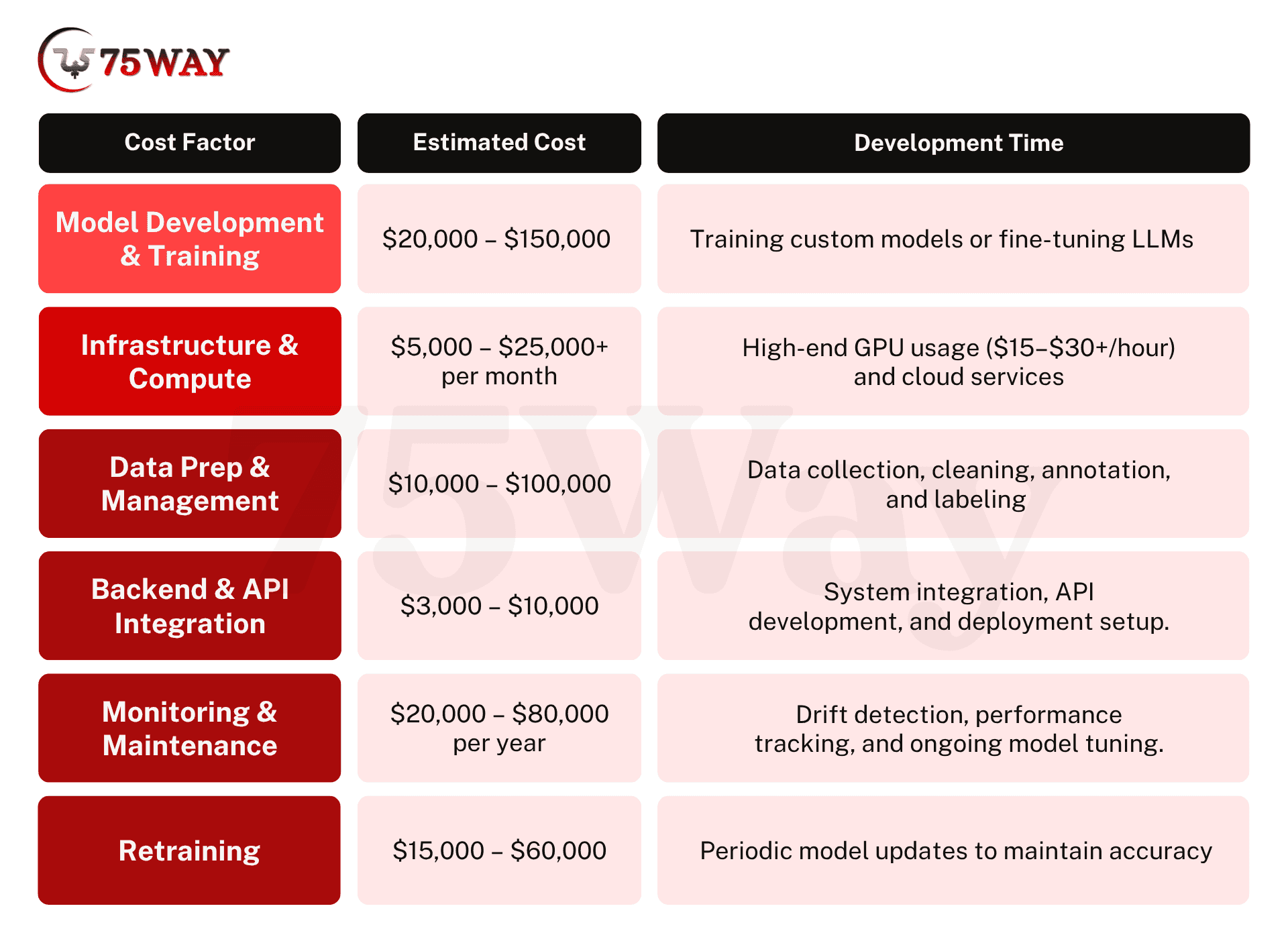
Custom AI development in South Africa typically runs from the low tens of thousands of rand for a focused single-workflow build to R150,000 or more for a multi-system integration involving payments, CRM sync, and compliance logging, with ongoing hosting and maintenance costs on top.
Build cost vs ongoing running cost
The build cost covers design, development, testing, and deployment. The running cost covers hosting, API usage (including WhatsApp Business API messaging fees), monitoring, and periodic updates as your business processes change. Any quote that only mentions the build cost and skips the running cost is an incomplete quote.
Why hourly-rate quotes (e.g. 'R350/hr') miss the real cost driver
An hourly rate tells you nothing about the actual cost of the project, because the real cost driver is scope and integration complexity, not hours logged. A system that connects to three separate tools with inconsistent APIs will cost more than a simple single-purpose chatbot, regardless of what the hourly rate looks like on paper. Ask for a fixed-scope quote tied to specific deliverables, not an open-ended hourly arrangement.
How to sanity-check a quote against expected ROI
Before accepting a quote, calculate what the automation should save you: hours of manual work per week, reduction in missed leads, faster response times that improve conversion. If the quoted cost doesn't pay itself back within six to twelve months based on realistic savings, question the scope before you question the price.
How Sagentics approaches custom AI development
We build the system first and explain it in plain terms, priced in ZAR, designed around WhatsApp where that's where your customers already are, and built with POPIA's actual requirements in mind rather than a checkbox mention of the word.
Plain builder voice, no strategy decks
We don't run discovery workshops that end in a 40-slide roadmap nobody implements. We scope the build, quote it, and ship it. If you want to understand what these agencies build and what it costs before you talk to anyone, that's a reasonable first step, but the conversation with us starts with your actual workflow, not a generic framework.
WhatsApp-first, POPIA-aware, ZAR-priced systems
This is the overlap most vendors don't cover properly. Some agencies specialise in offshore dev-shop scale and treat South Africa as an afterthought. Some sell local compliance checklists without ever building anything complex. Some only do WhatsApp automation and stop there. Sagentics as an AI automation agency South Africa businesses can actually vet sits at the intersection: plain-spoken builds, hard POPIA specifics including Section 71, and deep WhatsApp automation experience, all priced and delivered in ZAR for businesses that operate under load-shedding and variable connectivity every day. If you're evaluating custom AI development in South Africa as an option, that combination is worth checking any vendor against, including us.
Case studies: what got shipped and what it changed
The Antistatic case study shows a WhatsApp-based operational build cutting manual admin time. The MerchLab case study shows automation handling order and customer workflows at scale. The executive candidate assessment case study shows a custom internal tool replacing a manual, error-prone hiring process. In each case, the measure of success is what changed in the business, not what was proposed on paper.
Common questions
What should South African businesses look for in an AI development partner? Look for proof of shipped, live systems rather than proposals, specific POPIA knowledge including Section 71, local payment integration experience (PayFast, Yoco, Ozow), ZAR-based fixed-scope pricing, and confirmation the system runs reliably through load-shedding and variable connectivity. Ask for references and working examples before signing anything.
How does WhatsApp Business API work in South Africa? The WhatsApp Business API connects your business to WhatsApp's messaging infrastructure through an approved provider, allowing automated, templated, and AI-driven conversations at scale. Unlike the consumer app, it supports multiple users, integrates with CRMs and payment systems, and requires Meta business verification plus a registered South African business entity to set up properly.
How much does WhatsApp Business API and custom AI development cost in South Africa? WhatsApp Business API setup typically costs a few thousand rand plus per-message fees, while a full custom AI build integrating it with your CRM and payments ranges from roughly R20,000 for a focused workflow to R150,000+ for multi-system builds. Ongoing hosting and messaging costs sit on top of the initial build.
Is custom AI automation POPIA compliant, and what actually needs to be true for that to hold? It can be, but compliance depends on specifics: a lawful basis for processing personal information, secure storage, clear data retention and deletion policies, and human review for any automated decision with significant effect on a person under Section 71. "POPIA compliant" on a website means nothing without these details built into the actual system.
What's the difference between WhatsApp Business App and the WhatsApp Business API for AI automation? The Business App is a free single-device app for small operations with manual replies. The API is built for automation and scale, supporting multiple agents, CRM integration, AI-driven responses, and higher message volumes. Custom AI automation requires the API, since the free app has no mechanism for connecting external systems or bots.
Can custom AI systems integrate with local payment gateways like PayFast, Yoco, and Ozow? Yes, and this is one of the clearest advantages of a custom build over an off-the-shelf tool. A properly built system can trigger a PayFast or Yoco payment link inside a WhatsApp conversation, confirm payment automatically, and update your records in real time, without a staff member manually reconciling anything.
Does AI automation keep working during load-shedding or poor connectivity? Yes, if it's hosted properly. Since the automation logic runs on cloud servers rather than a device in your office, load-shedding at your premises doesn't take the system offline. What matters is whether the build includes retry logic and message queuing for customers on patchy mobile connections, which needs to be designed in deliberately.
What is POPIA Section 71 and how does it restrict automated decision-making? Section 71 restricts decisions based solely on automated processing when those decisions have legal or significant effects on a person, such as loan approvals, insurance terms, or hiring outcomes. Businesses must build in safeguards, including human review options, unless specific exemptions apply. Most South African AI vendors never mention this requirement at all.
Is custom AI development worth it compared to off-the-shelf tools or no-code platforms? It depends on how specific your workflow is. Off-the-shelf tools work for generic, simple use cases. Custom development is worth the higher upfront cost when your business has local payment rails, compliance obligations, or multi-system workflows that generic tools can't handle, because the payback comes from fewer manual hours over the system's lifespan.
How is custom AI development different from a generic offshore dev shop bolting AI onto existing services? Generic offshore shops often add AI features to existing software products without understanding South African compliance, payment rails, or WhatsApp-first customer behaviour. Custom development built for the local market starts with those specifics: POPIA, ZAR pricing, PayFast and Yoco integration, and load-shedding resilience, rather than retrofitting a foreign product to fit local conditions.
If you're weighing up whether to build this properly, message Sagentics on WhatsApp and we'll talk through what your specific workflow would actually need.
Common questions
What should South African businesses look for in an AI development partner?
Look for proof of shipped, live systems rather than proposals, specific POPIA knowledge including Section 71, local payment integration experience (PayFast, Yoco, Ozow), ZAR-based fixed-scope pricing, and confirmation the system runs reliably through load-shedding and variable connectivity. Ask for references and working examples before signing anything.
How does WhatsApp Business API work in South Africa?
The WhatsApp Business API connects your business to WhatsApp's messaging infrastructure through an approved provider, allowing automated, templated, and AI-driven conversations at scale. Unlike the consumer app, it supports multiple users, integrates with CRMs and payment systems, and requires Meta business verification plus a registered South African business entity to set up properly.
How much does WhatsApp Business API and custom AI development cost in South Africa?
WhatsApp Business API setup typically costs a few thousand rand plus per-message fees, while a full custom AI build integrating it with your CRM and payments ranges from roughly R20,000 for a focused workflow to R150,000+ for multi-system builds. Ongoing hosting and messaging costs sit on top of the initial build.
Is custom AI automation POPIA compliant, and what actually needs to be true for that to hold?
It can be, but compliance depends on specifics: a lawful basis for processing personal information, secure storage, clear data retention and deletion policies, and human review for any automated decision with significant effect on a person under Section 71. 'POPIA compliant' on a website means nothing without these details built into the actual system.
What's the difference between WhatsApp Business App and the WhatsApp Business API for AI automation?
The Business App is a free single-device app for small operations with manual replies. The API is built for automation and scale, supporting multiple agents, CRM integration, AI-driven responses, and higher message volumes. Custom AI automation requires the API, since the free app has no mechanism for connecting external systems or bots.
Can custom AI systems integrate with local payment gateways like PayFast, Yoco, and Ozow?
Yes, and this is one of the clearest advantages of a custom build over an off-the-shelf tool. A properly built system can trigger a PayFast or Yoco payment link inside a WhatsApp conversation, confirm payment automatically, and update your records in real time, without a staff member manually reconciling anything.
Does AI automation keep working during load-shedding or poor connectivity?
Yes, if it's hosted properly. Since the automation logic runs on cloud servers rather than a device in your office, load-shedding at your premises doesn't take the system offline. What matters is whether the build includes retry logic and message queuing for customers on patchy mobile connections, which needs to be designed in deliberately.
What is POPIA Section 71 and how does it restrict automated decision-making?
Section 71 restricts decisions based solely on automated processing when those decisions have legal or significant effects on a person, such as loan approvals, insurance terms, or hiring outcomes. Businesses must build in safeguards, including human review options, unless specific exemptions apply. Most South African AI vendors never mention this requirement at all.
Is custom AI development worth it compared to off-the-shelf tools or no-code platforms?
It depends on how specific your workflow is. Off-the-shelf tools work for generic, simple use cases. Custom development is worth the higher upfront cost when your business has local payment rails, compliance obligations, or multi-system workflows that generic tools can't handle, because the payback comes from fewer manual hours over the system's lifespan.
How is custom AI development different from a generic offshore dev shop bolting AI onto existing services?
Generic offshore shops often add AI features to existing software products without understanding South African compliance, payment rails, or WhatsApp-first customer behaviour. Custom development built for the local market starts with those specifics: POPIA, ZAR pricing, PayFast and Yoco integration, and load-shedding resilience, rather than retrofitting a foreign product to fit local conditions.
About Sagentics
Sagentics is an AI systems studio based in South Africa. We design and build WhatsApp automation, n8n workflows, and custom AI products for local and international clients. We write from systems we have actually shipped.
Start a WhatsApp conversation with SagenticsRelated reading
- AI automation agency south africa: what these agencies build, what it costs, and whether it's POPIA compliant
- WhatsApp automation agency South Africa: what they do, what it costs, and how to check they're legit
- AI performance media platform build: what it actually takes
- custom AI development in South Africa
- AI automation agency South Africa
- WhatsApp automation South Africa
- what actually needs to be true for POPIA compliance
- what these agencies build and what it costs
- how to check a WhatsApp automation agency is legit
- WhatsApp Business API vs the app
- accepting payments through WhatsApp using PayFast or Yoco
- an AI customer service agent on WhatsApp
- the real ROI formula for WhatsApp support agents
- the actual difference between a chatbot and an agentic assistant
- Antistatic case study
- MerchLab case study
- executive candidate assessment case study
- Sagentics