

 Start a conversation
Custom AI product and SaaS development
Build vs buy AI software: the honest answer for South African businesses
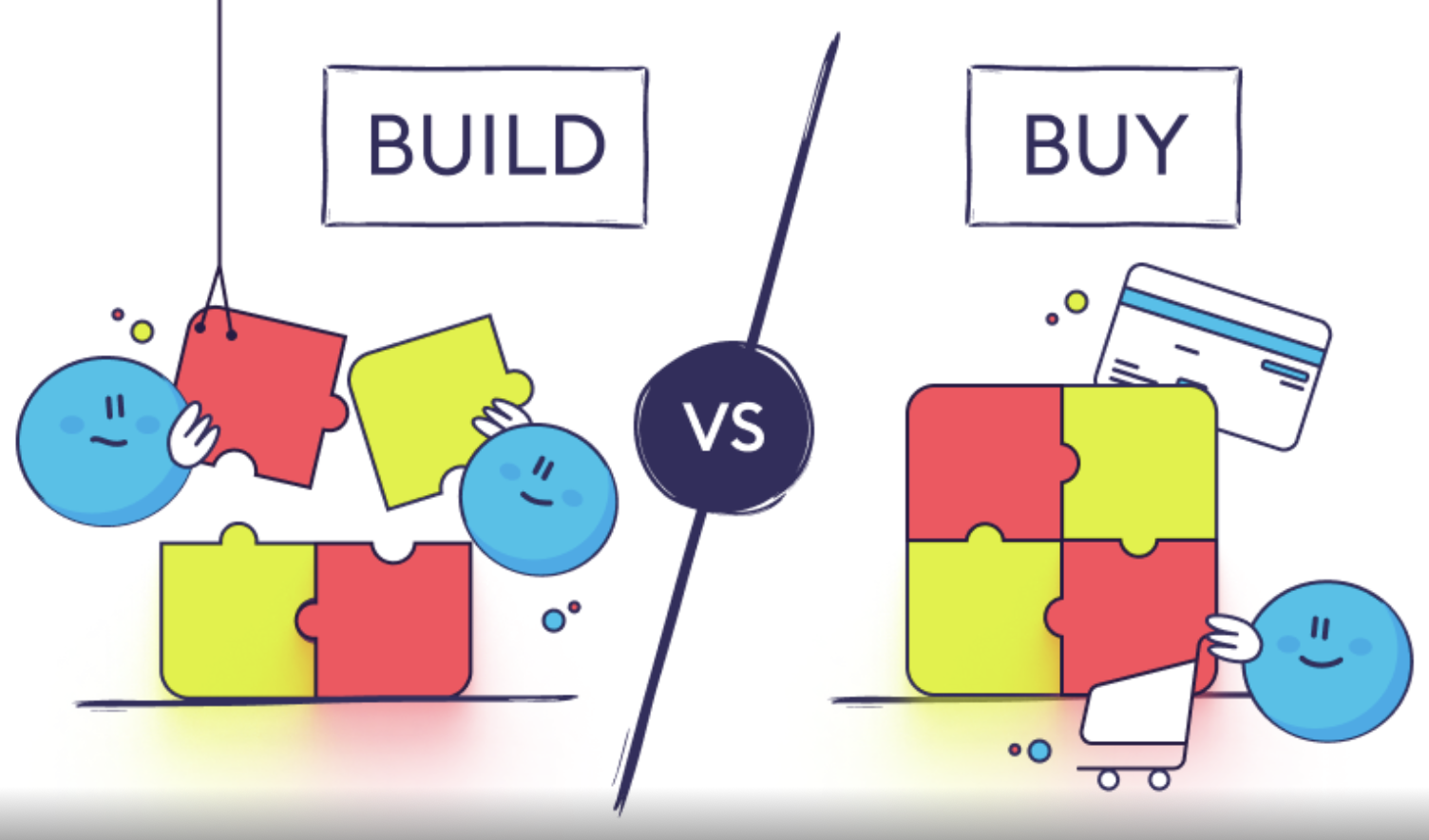
Buy the foundation model, build only the thin workflow layer that connects it to WhatsApp and your systems, and go fully custom only once volume or data uniqueness actually justifies it. That's the answer for most South African SMEs, and it's rarely the one you get from a SaaS vendor's sales deck or a dev shop's pitch, because both have a reason to push you toward the extreme they sell. This article walks through the real costs, the real timelines, and the questions that actually decide which path makes sense for you.
Why build vs buy is the wrong first question
The real decision is build, buy, or partner
Most businesses frame this as a binary: build your own AI system or buy a subscription. That framing skips the option that works for the majority of SA companies, which is partnering with a team that combines off-the-shelf models with custom workflow automation. You're not choosing between two poles. You're choosing between owning everything, renting everything, or owning the parts that matter while renting the parts that don't.
Own vs rent: a better mental model
Think of it like property. Renting an office gets you working fast with no capital outlay, but you're stuck with the landlord's rules. Owning gives you control but ties up capital and time you might not have. AI software works the same way. SaaS platforms are rented infrastructure with someone else's roadmap. Custom builds are owned infrastructure with your roadmap, your data, and your maintenance bill. Most businesses need a mix, not a religious commitment to one side.
Why most South African businesses default to buy without realising it
Every WhatsApp chatbot tool, every AI email assistant, every CRM add-on with "AI" in the name is a buy decision made by default, often before anyone in the business has actually compared it to building. That's not wrong on its own. Buying is frequently the right call. The problem is doing it without checking what you're giving up in flexibility, data control, and long-term cost.
What buying AI actually costs in South Africa
SaaS pricing in ZAR: per-seat vs per-message models
AI SaaS tools sold into South Africa are usually priced in USD and converted to ZAR at checkout, which means your costs move with the exchange rate whether or not your usage changes. Per-seat pricing (R500 to R3,000 per user per month) suits small teams with predictable headcount. Per-message or per-conversation pricing suits customer-facing bots but scales badly once volume grows, which is exactly when you can least afford surprises.
Hidden costs: vendor lock-in, data export, and API rate changes
The subscription fee is the cheapest part of buying AI software. The real cost shows up later: data export fees when you want to leave, integration work every time the vendor changes their API, and rate hikes once you're dependent enough that switching feels too risky. We've seen SA businesses locked into platforms charging 3x their original quote after two years, because migrating customer conversation history and workflow logic out of a proprietary system is expensive and slow.
When buying wins outright (under R100k budgets, under 400 calls/day)
If your budget is under R100,000 and your AI usage is under roughly 400 calls a day, buying wins outright almost every time. At that volume, the fixed costs of building (development time, infrastructure, ongoing maintenance) can't be justified by the savings on a subscription fee. Buy first, and revisit the decision only when volume or complexity genuinely outgrows what the platform offers.

What building custom AI actually costs and takes
Realistic timelines: 12-20 weeks minimum for a working build
A working custom AI build, not a proof of concept, takes 12 to 20 weeks minimum for most SA SMEs. That includes discovery, integration with your existing systems (CRM, payment gateway, WhatsApp Business API), testing against real conversation data, and a stabilisation period after launch. Anyone quoting four weeks for a production system handling real customer data is quoting a demo, not a product.
SME-scale cost ranges vs enterprise ranges
For an SME, a genuinely custom AI system (not a no-code wrapper) typically runs R150,000 to R600,000 depending on integration complexity and the number of systems it needs to talk to. Enterprise builds with compliance requirements, multiple business units, and dedicated infrastructure run well into seven figures. If you're being quoted enterprise numbers for an SME problem, someone is scoping it wrong, deliberately or not.
Ongoing costs nobody budgets for: monitoring, evals, retraining
The build cost is the easy number to get. The number that gets missed is the ongoing cost: monitoring model outputs for drift, running evaluations when you update prompts or swap underlying models, and retraining or re-tuning as your business changes. Budget 15 to 20% of the initial build cost per year for this, or you'll be running a system nobody is watching.
The break-even math: when custom pays for itself
Month 12-24 is the usual break-even window for a 20-person team
For a 20-person team with moderate customer volume, custom AI typically breaks even against an equivalent SaaS subscription somewhere between month 12 and month 24. Before that point, you're paying more to own the system than you would to rent it. After that point, the SaaS fees you'd have kept paying start to exceed what you spent building and maintaining your own.
Why the old build-vs-buy cost assumption has flipped since 2023
The old assumption was that building always cost more upfront and buying always cost less over time. That's flipped for a specific reason: foundation model APIs got dramatically cheaper and more capable, which means the expensive part of building custom AI (training your own models) has largely disappeared. What's left to build is the workflow layer, which is far cheaper than it used to be. This is exactly why the n8n vs custom code decision rule matters more now than it did two years ago.
A worked ZAR example for a SA SME
Take a 20-person retail business handling 300 WhatsApp support conversations a day. A SaaS chatbot platform costs roughly R8,000/month, or R96,000/year. A partner-built system on n8n plus a foundation model API costs around R180,000 upfront and R2,500/month in running costs. Break-even against the SaaS option lands at month 14, matching what we've seen on actual client builds when we scope against real message volume instead of a vendor's generic ROI slide.

Why most AI projects fail regardless of build or buy
The 95% no-ROI statistic and what it actually measures
Widely cited research on enterprise AI adoption found that roughly 95% of generative AI pilots fail to show measurable ROI. That statistic measures pilots that never made it past the proof-of-concept stage, not production systems that were properly scoped against a real business problem. The failure isn't usually the technology. It's projects launched without a clear metric for what success looks like before anyone wrote a line of code.
Vendor-led implementations vs pure internal builds
Data from the same research shows implementations led by an external partner with production experience succeed roughly twice as often as pure internal builds run without outside expertise. That's not an argument against building in-house. It's an argument against building in-house without anyone on the team who has shipped a production AI system before.
What separates the 5% that work
The projects that work share three traits: they solved one narrow, well-defined problem instead of "adding AI" broadly, they measured a specific business metric (response time, conversion rate, support cost per ticket) before and after, and they had someone accountable for the system after launch, not just at launch. None of that depends on whether you built or bought.
The decision framework: four questions that actually matter
Is this capability core to your competitive advantage?
If the AI system touches something that differentiates you from competitors, like a proprietary pricing model or a unique service workflow, it's worth owning. If it's a commodity function like answering FAQs or booking appointments, buying or partnering makes more sense. Competitive advantage is rare. Most AI use cases in SA SMEs aren't it.
How unique is your data?
Building only pays off when your data is genuinely proprietary and hard to replicate. If your data looks like every other business in your sector, an off-the-shelf model trained on similar patterns will perform just as well. Unique data (years of customer interaction history, specialised technical documentation, industry-specific compliance records) is the strongest argument for custom.
What's your time-to-value requirement?
If you need something live in weeks, buy or partner. If you can wait months for a system that fits your exact workflow, building starts to make sense. Most SA businesses under-budget the time cost of building and only discover the real timeline once they're three months into a project that was quoted at six weeks.
How exposed is client data under POPIA?
Any AI system handling customer conversations, whether built or bought, processes personal information under POPIA. The question isn't whether you build or buy. It's whether the platform or partner you choose gives you the data residency, consent handling, and deletion controls POPIA requires. This matters more than most build-vs-buy comparisons acknowledge.
The middle path most SA businesses actually need
Buy the model, build the workflow: how n8n changes the calculus
The middle path is buying the foundation model (OpenAI, Anthropic, or similar via API) and building a thin, custom workflow layer on a tool like n8n that connects it to WhatsApp, your CRM, and your payment system (PayFast or Yoco). You get the reasoning power of a frontier model without the cost of training one, and you get workflow logic that fits your business exactly, without paying enterprise custom-build prices. This is what most requests for custom AI development in South Africa actually turn into once we scope them properly.
What a partner-led build looks like in practice
A partner-led build starts with mapping your actual conversation volume and business logic, not a generic template. It usually means connecting WhatsApp Business API to n8n, wiring in your existing systems, and using an off-the-shelf model for the language understanding. That's what an AI automation agency actually builds for most SA clients, and it's a fraction of the cost of a from-scratch custom system.
When to graduate from partner to in-house team
Graduate to a fully in-house team only once your AI usage is core to daily operations, your volume justifies a dedicated engineer, and you've validated the workflow logic through real usage over 12+ months. Before that point, an in-house AI team is an expensive way to relearn lessons a partner has already worked through.
POPIA and data control: the question buy-side pitches skip
What POPIA requires regardless of who built the system
POPIA requires that you know where customer data is processed and stored, that you have a lawful basis for processing it, and that customers can request deletion. This applies identically whether you built the system or bought it off the shelf. Buying doesn't transfer your compliance obligation to the vendor.
Data residency and third-party AI platforms
Many international AI SaaS platforms process and store data outside South Africa by default. That's not automatically non-compliant, but it means you need a documented basis for the transfer and confirmation that the vendor meets equivalent protection standards. This is one of the most overlooked questions in build vs buy conversations, and it directly affects whether WhatsApp automation is POPIA compliant on any given platform.
Questions to ask any vendor or agency before signing
Ask where data is stored, how long conversation logs are retained, whether you can export everything on exit, and who is liable if the platform has a breach. If a vendor can't answer these clearly, that's your answer about whether to sign.
Common questions
Should I build or buy AI software / an AI agent? Buy for anything that isn't core to your competitive edge. Build only when your data is genuinely unique and volume justifies the investment. For most SA SMEs, the honest answer is neither extreme: partner with a team that buys the foundation model and builds a custom workflow layer around it.
What is the total cost of ownership of custom AI vs buying an AI platform? Custom AI's TCO includes build cost (R150k-R600k for SMEs), ongoing monitoring and retraining (15-20% of build cost yearly), and infrastructure. SaaS TCO includes subscription fees plus hidden costs like data export fees and rate hikes. Custom usually costs more upfront but less over 2+ years at meaningful volume.
How long does it take to build custom AI software? A working, production-ready custom AI system takes 12 to 20 weeks minimum for an SME, covering discovery, integration, testing, and post-launch stabilisation. Shorter timelines usually describe a demo or proof of concept, not something ready to handle real customer data and traffic reliably.
What are the hidden costs of AI SaaS tools? The main hidden costs are vendor lock-in, data export fees when leaving, integration rework every time the vendor updates their API, and exchange rate exposure since most pricing is USD-based. Rate increases once you're dependent are common. The subscription fee is rarely the full cost of ownership.
When does a custom AI build break even versus a SaaS subscription? For a typical 20-person SA business with moderate volume, break-even against an equivalent SaaS subscription usually lands between month 12 and month 24. It depends heavily on real message volume, not vendor ROI slides. We've scoped builds that break even at month 14 using actual client usage data.
Build vs buy vs partner for AI, which is right for my business? Partner is right if you need speed without losing flexibility. Buy is right under R100k budget or under 400 daily interactions. Build is right only when your data is proprietary and volume is high enough to justify ownership costs. Most SA SMEs land on partner, not either extreme.
Is buying AI cheaper than building it in-house? Initially, yes, almost always. Over time, it depends on volume. Below roughly 400 interactions a day, buying stays cheaper indefinitely. Above that, custom or partner-built systems typically become cheaper within 12-24 months because subscription costs scale with usage while a workflow layer's running costs don't scale the same way.
What percentage of enterprise AI projects fail? Roughly 95% of generative AI pilots fail to show measurable ROI, according to widely cited industry research. This mostly reflects pilots that never reached production, not properly scoped systems. Vendor-led or partner-led implementations succeed roughly twice as often as pure internal builds without outside production experience.
Should a small business build its own chatbot or use an off-the-shelf tool? Use an off-the-shelf tool first, especially under 400 daily conversations. Off-the-shelf platforms cover the majority of common use cases at a fraction of custom-build cost. Only consider a custom or partner-built option once you hit the limits of what the tool can do or your workflow needs don't fit its template.
Is WhatsApp automation compliant with POPIA if built on a third-party AI platform? It can be, but compliance depends on your setup, not the platform alone. You need to know where data is stored, confirm a lawful basis for processing, and ensure customers can request deletion.
If you're weighing this decision for your own business, it's worth talking it through before committing budget. Message Sagentics on WhatsApp and we'll give you a straight read on whether you should buy, build, or partner, no sales pitch attached.
Common questions
Should I build or buy AI software / an AI agent?
Buy for anything that isn't core to your competitive edge. Build only when your data is genuinely unique and volume justifies the investment. For most SA SMEs, the honest answer is neither extreme: partner with a team that buys the foundation model and builds a custom workflow layer around it.
What is the total cost of ownership of custom AI vs buying an AI platform?
Custom AI's TCO includes build cost (R150k-R600k for SMEs), ongoing monitoring and retraining (15-20% of build cost yearly), and infrastructure. SaaS TCO includes subscription fees plus hidden costs like data export fees and rate hikes. Custom usually costs more upfront but less over 2+ years at meaningful volume.
How long does it take to build custom AI software?
A working, production-ready custom AI system takes 12 to 20 weeks minimum for an SME, covering discovery, integration, testing, and post-launch stabilisation. Shorter timelines usually describe a demo or proof of concept, not something ready to handle real customer data and traffic reliably.
What are the hidden costs of AI SaaS tools?
The main hidden costs are vendor lock-in, data export fees when leaving, integration rework every time the vendor updates their API, and exchange rate exposure since most pricing is USD-based. Rate increases once you're dependent are common. The subscription fee is rarely the full cost of ownership.
When does a custom AI build break even versus a SaaS subscription?
For a typical 20-person SA business with moderate volume, break-even against an equivalent SaaS subscription usually lands between month 12 and month 24. It depends heavily on real message volume, not vendor ROI slides. We've scoped builds that break even at month 14 using actual client usage data.
Build vs buy vs partner for AI, which is right for my business?
Partner is right if you need speed without losing flexibility. Buy is right under R100k budget or under 400 daily interactions. Build is right only when your data is proprietary and volume is high enough to justify ownership costs. Most SA SMEs land on partner, not either extreme.
Is buying AI cheaper than building it in-house?
Initially, yes, almost always. Over time, it depends on volume. Below roughly 400 interactions a day, buying stays cheaper indefinitely. Above that, custom or partner-built systems typically become cheaper within 12-24 months because subscription costs scale with usage while a workflow layer's running costs don't scale the same way.
What percentage of enterprise AI projects fail?
Roughly 95% of generative AI pilots fail to show measurable ROI, according to widely cited industry research. This mostly reflects pilots that never reached production, not properly scoped systems. Vendor-led or partner-led implementations succeed roughly twice as often as pure internal builds without outside production experience.
Should a small business build its own chatbot or use an off-the-shelf tool?
Use an off-the-shelf tool first, especially under 400 daily conversations. Off-the-shelf platforms cover the majority of common use cases at a fraction of custom-build cost. Only consider a custom or partner-built option once you hit the limits of what the tool can do or your workflow needs don't fit its template.
Is WhatsApp automation compliant with POPIA if built on a third-party AI platform?
It can be, but compliance depends on your setup, not the platform alone. You need to know where data is stored, confirm a lawful basis for processing, and ensure customers can request deletion.
About Sagentics
Sagentics is an AI systems studio based in South Africa. We design and build WhatsApp automation, n8n workflows, and custom AI products for local and international clients. We write from systems we have actually shipped.
Start a WhatsApp conversation with SagenticsRelated reading
- Building a custom AI product: what it actually takes, what it costs, and why most of the work isn't the AI
- How to choose a real AI development partner in South Africa
- MVP scoping for AI SaaS: how to define the build before you pay for it
- Next.js + Supabase for SaaS: what it gets you and what it doesn't
- custom AI development in South Africa
- what a custom AI product actually costs and takes
- n8n vs custom code decision rule
- what an AI automation agency actually builds
- whether WhatsApp automation is POPIA compliant
- what WhatsApp automation really costs in ZAR
- whether n8n automations actually pay for themselves
- the real ROI formula for a WhatsApp support agent
- the difference between a chatbot and an agentic assistant
- Sagentics custom AI development
- Sagentics AI automation services