

 Start a conversation
WhatsApp and conversational AI automation
WhatsApp automation cost in South Africa: what it really costs in ZAR (2026 update)

WhatsApp automation in South Africa typically costs between R500 and R25,000 a month. Most properly running SMB setups land at R2,500 to R12,000 once you add up the BSP platform fee, Meta's per-message charges, and setup or agency costs. The exact number depends on message volume, how much of your workflow is templated versus AI-driven, and whether you're building in-house or paying someone else to run it.
This article breaks down where that money actually goes, what changes on 1 October 2026 that most pricing pages haven't caught up with yet, and how to cut the bill without cutting functionality. For the full breakdown of what South African businesses actually pay, including line-by-line invoices from real setups, see our detailed cost guide.
What you're actually paying for (three or four cost layers)
There's no single "WhatsApp automation fee." You're stacking up to four separate costs, and vendors rarely show you all four on one page.
BSP or platform fee (R500 to R4,000/month)
A Business Solution Provider is the company that gives you access to the WhatsApp Business API. Meta doesn't sell API access directly to most businesses, you go through a BSP like Twilio, 360dialog, Wati, or a local reseller. This fee covers the number, the inbox, template management, and usually some basic automation tools. Entry-level plans start around R500 to R1,000 a month; anything with multi-agent support or CRM integration climbs to R2,000 to R4,000.
Meta's per-conversation or per-message fees
Separate from the BSP fee, Meta charges per message sent, billed in ZAR through your BSP. This is usage-based, so it scales with your volume. A quiet month with 200 conversations costs a fraction of a busy month with 5,000. We cover the exact rate structure below.
Setup and integration cost (once-off)
Getting a number verified, templates approved, and your CRM or order system wired in isn't instant. Simple setups (a single flow, one integration) run R3,000 to R8,000 once-off. Custom builds with n8n, AI agents, or payment integrations run R15,000 to R60,000+ depending on scope.
Optional agency or automation management fee
If you're not running this in-house, someone needs to monitor templates, tweak flows, and handle escalations. Agencies charge R1,500 to R10,000 a month for this depending on how hands-on the management is.
Realistic monthly cost tiers for South African businesses
Strip away the vagueness and here's what real businesses actually pay, tier by tier.
Small business or solo operator (R500 to R2,500/month)
A single number, a handful of templates (order confirmation, appointment reminder, basic FAQ bot), low volume (under 500 conversations a month). This tier suits a salon, a small retailer, or a solo consultant. BSP fee plus Meta charges, no agency, DIY management.
Growing SME with automation and templates (R3,000 to R12,000/month)
Most SA businesses with real e-commerce or service volume land here. You've got multiple flows, a proper CRM sync, maybe an AI-driven FAQ layer, and 1,000 to 10,000 conversations a month. Some agency support is common here, even if it's just a few hours a month for template updates and flow tweaks.
Managed, high-volume programme (R8,000 to R25,000/month)
Call centres, national retailers, fintechs running authentication flows at scale. High message volume, dedicated account management, custom AI agents handling tier-one support, and integration with multiple backend systems. If you're running an AI customer service agent on WhatsApp and what it costs is worth reading before you commit at this tier, since the AI layer itself adds a separate cost curve on top of messaging fees.
How Meta actually charges you in 2026 (and what changes in October 2026)
This is the part almost every South African pricing article gets wrong, because it was written before Meta's confirmed changes locked in.
Per-message pricing replaced conversation-based pricing on 1 July 2025
Until mid-2025, Meta billed per 24-hour conversation window, one fee covered unlimited messages inside that window. That model is gone. Since 1 July 2025, Meta charges per message sent, not per conversation. This actually helps low-message, high-window use cases and hurts high-frequency messaging within a single window, so your cost structure has shifted even if your volume hasn't.
Service conversations are free now, but not after 1 October 2026
Here's the detail almost nobody is flagging correctly. Right now, service replies (customer-initiated support conversations) inside the 24-hour window are free. Every competitor guide still leans on "service conversations are free" as a core cost-saving pillar, and that's accurate today. But Meta has confirmed that from 1 October 2026, service and utility messages inside that window stop being free. If your whole ROI case for a WhatsApp support bot rests on free service replies, that math changes in less than a year. Budget for it now rather than getting surprised by an invoice increase later.
Marketing, utility, authentication and service rates in ZAR
Rates vary by category and by whether the recipient is in South Africa or abroad. As a rough guide for 2026: marketing messages run roughly R0.50 to R1.20 per message, utility messages (order updates, reminders) sit lower at R0.20 to R0.60, and authentication messages (OTPs, login codes) vary widely depending on destination country. These numbers move with Meta's published rate card, so always check your BSP's current sheet before budgeting a campaign.
Why authentication-international rates hit SA fintechs harder
South African fintechs and apps sending OTPs to international numbers (diaspora customers, cross-border users) pay meaningfully more per authentication message than for local SA numbers. If you're a fintech doing KYC or login verification via WhatsApp, this line item alone can dwarf your marketing spend. Model this separately, don't lump it into a general "messaging cost" estimate.
Where the hidden costs come from
The invoice you expect and the invoice you get are rarely the same number. Here's why.
BSP markup that isn't itemised
Some BSPs bundle Meta's per-message cost into a flat "package" rate that's higher than Meta's actual charge, without breaking out the markup. You end up paying a premium without knowing it. Ask your BSP directly for the split between their platform fee and Meta's pass-through cost. We've seen one Johannesburg-based agency bill clients R1.50 per marketing message when Meta's actual rate was R0.65, pocketing R0.85 per message without transparency.
Blocked or spam-flagged messages you still pay for
If your template gets flagged as spam or your number gets a quality rating downgrade, messages can fail to deliver, but you've often already been billed for the send attempt. Poor template hygiene and blind broadcast sends are the most common cause. A business sending 10,000 messages to cold contacts with no consent can watch 20 to 30% fail delivery while paying for all of them.
Template approval delays that cost you time, not just money
Meta can take anywhere from a few hours to several days to approve a new template. If you launch a campaign assuming same-day approval and it doesn't land, that's lost revenue during the delay, not a line item on an invoice, but a real cost. Retailers launching Black Friday campaigns have lost entire promotional windows waiting for template approval.
How to cut your WhatsApp automation bill by 40 to 60%
Most of the savings here come from structure, not from switching providers.
Keep the 24-hour service window open
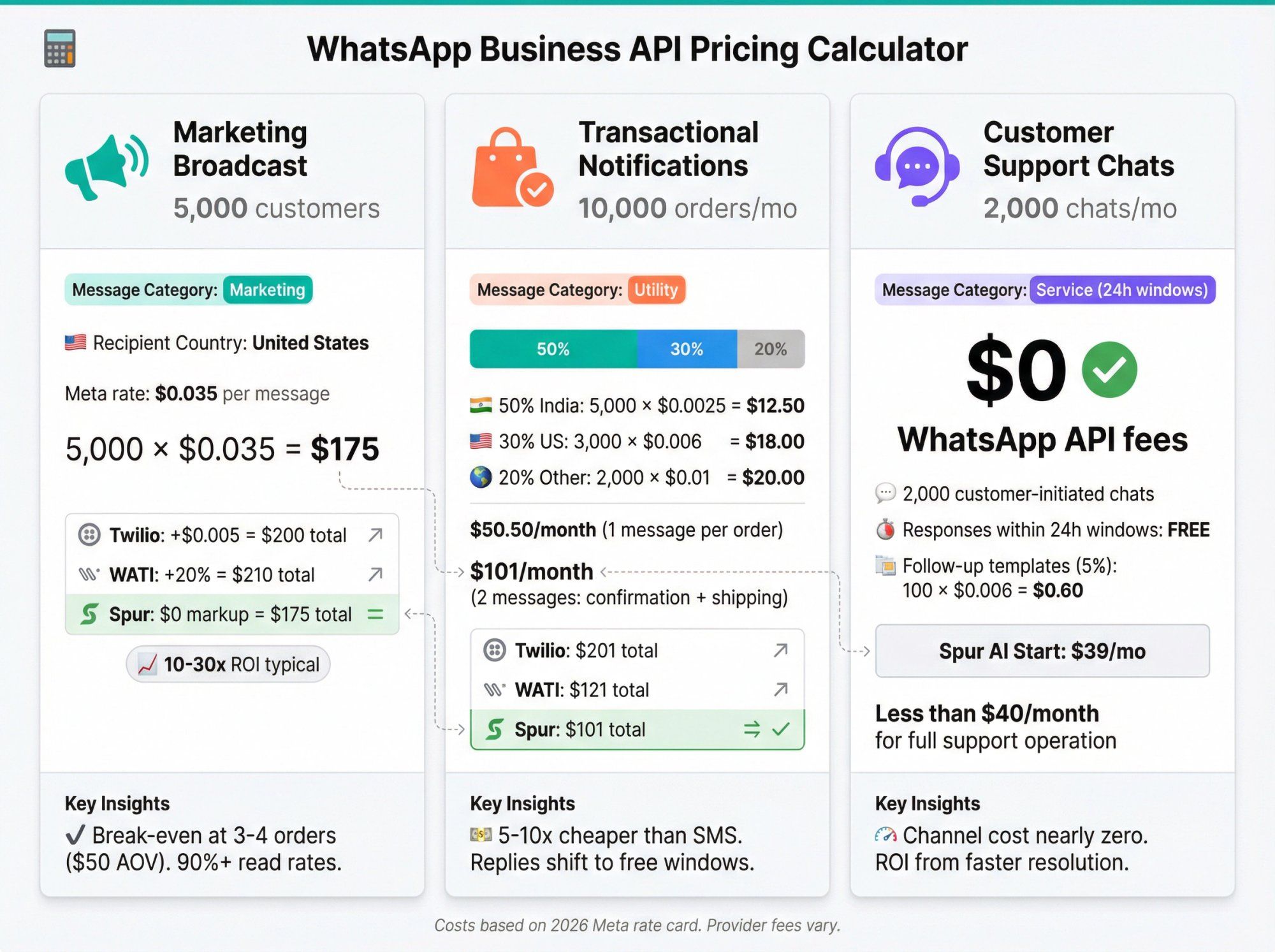
If a customer messages you first, you get a 24-hour window to reply for free (today, before the October 2026 change). Structuring your flows so replies happen inside that window instead of triggering new template-based conversations saves real money at volume. A business handling 5,000 conversations a month can save R2,000 to R4,000 monthly by routing follow-ups into service windows instead of sending new marketing-tier templates.
Use the 72-hour click-to-WhatsApp ad window
If a customer clicks through from a Facebook or Instagram ad into WhatsApp, you get an extended window (up to 72 hours in some configurations) to message them without incurring marketing-tier charges. Businesses running paid ad campaigns should route customers through this path deliberately rather than sending a separate marketing broadcast afterward.
Design broadcasts around reply-triggered follow-ups, not blind sends
Instead of blasting a marketing template to your whole list, send a lighter opener that invites a reply, then handle the rest of the conversation inside the free service window. This cuts your marketing-tier message count significantly, since the bulk of the conversation shifts to a cheaper billing category.
Buy a SaaS tool, hire an agency, or build it custom (the real trade-off)
There isn't a universally "cheapest" option, there's a cheapest option for your volume and complexity.
SaaS chatbot tools: cheap monthly, but capped and generic
Tools like Wati or generic chatbot builders charge R500 to R3,000 a month and get you running fast. The trade-off is you're locked into their flow builder, their integrations list, and their rate limits. Fine for simple FAQ bots, limiting for anything involving custom logic, AI reasoning, or deep CRM sync.
Full-service BSP/agency: fast to launch, higher recurring cost
An agency handles setup, templates, and ongoing management for you. You launch faster, but you're paying R5,000 to R15,000+ a month indefinitely, and you don't own the underlying automation logic. If the agency disappears or raises prices, you're stuck rebuilding.
Custom n8n build, self-hosted: higher setup, lower long-term cost, full data control
Building on n8n (open-source workflow automation) means a higher once-off setup cost, typically R15,000 to R50,000 depending on complexity, but no per-task SaaS fees afterward. You pay Meta's message costs and your BSP's API fee, nothing else recurring beyond hosting. Over 12 to 18 months this usually beats agency or SaaS pricing for any business doing meaningful volume. One Cape Town e-commerce retailer moved from a R4,500/month SaaS chatbot setup to a custom n8n build in 8 weeks, recovered the R28,000 setup cost in 7 months, and now runs their entire order-to-delivery WhatsApp flow for under R1,000/month in infrastructure and BSP fees.
Why self-hosted n8n changes the ZAR maths (and the POPIA angle)
This is the option most pricing guides skip entirely, because most of them are written by SaaS vendors with a product to sell.
No per-task pricing, no BSP markup on the automation layer
When you self-host n8n, you're not paying a per-workflow-run fee or a per-seat SaaS charge on top of your BSP costs. The automation logic runs on infrastructure you control. At scale, this is the single biggest lever for cutting your recurring bill.
Data residency and POPIA compliance when you control the server
Running your own instance means you decide where customer data lives, which matters directly for POPIA compliance. Many SaaS chatbot tools store conversation data on servers outside South Africa by default, which complicates your compliance story. If you're not sure where your current setup stands, it's worth checking whether your WhatsApp automation is POPIA compliant before you scale it further.
Connecting WhatsApp to Yoco, PayFast, and your CRM in one workflow
A self-hosted n8n build lets you wire WhatsApp directly into your payment stack and CRM without needing three separate SaaS subscriptions. Customers can get an order confirmation, pay via a link, and land in your CRM as a tagged contact, all from one workflow. If you want the specifics, our guide on accepting payments through WhatsApp with Yoco or PayFast covers the actual setup. And when a query goes beyond what the bot can handle, how human handoff works on WhatsApp determines whether that moment feels smooth or frustrating to the customer.
Common questions
How much does WhatsApp Business API cost in South Africa? Expect R500 to R4,000 a month for BSP access alone, plus Meta's per-message charges on top, which scale with volume. Once-off setup runs R3,000 to R60,000 depending on complexity. Most SMEs running a proper automated setup land at R2,500 to R12,000 total per month once every cost layer is included.
What's the difference between the WhatsApp Business app and the WhatsApp Business API? The free app is a single-device inbox for small businesses handling manual chats. The API is the paid, developer-level access point that enables automation, multi-agent support, and integration with CRMs or payment systems. If you need bots, broadcasts, or workflow automation, you need the API, not the app. See WhatsApp Business API vs the free app for a full comparison.
Can I send bulk WhatsApp messages in South Africa legally under POPIA? Yes, but only with proper consent and an approved marketing template. You need documented opt-in, a clear opt-out mechanism, and secure handling of any personal data collected through the conversation. POPIA doesn't ban WhatsApp marketing, it requires you to handle consent and data storage correctly, which most default SaaS tools don't fully cover out of the box.
Is WhatsApp automation free or does every message cost money? Customer-initiated service replies inside the 24-hour window are currently free, but that changes on 1 October 2026. Business-initiated messages (marketing, utility, authentication) always cost money per message. There's no fully free automation tier once you're using the API, only free reply windows under specific conditions.
What happens to WhatsApp pricing in South Africa after October 2026? Service and utility messages sent inside the 24-hour customer-initiated window stop being free. Businesses that built their cost model around "free support replies" will see a real increase in their monthly bill. Budget for this now if you run a support-heavy WhatsApp setup, since the change is confirmed, not speculative.
How do BSP fees differ from Meta's own charges? The BSP fee pays for platform access, the inbox, template tools, and support. Meta's charge is the per-message cost billed separately (or bundled invisibly by some BSPs) for every business-initiated message sent. Always ask your BSP to itemise these two so you know what's markup and what's Meta's actual rate.
Is it cheaper to build a custom WhatsApp automation system or buy a SaaS tool? SaaS is cheaper short-term (R500 to R3,000/month, fast to launch) but costs more over 12 to 18 months at real volume and locks you into their feature set. Custom n8n builds cost more upfront (R15,000 to R50,000) but eliminate ongoing SaaS fees and give you full control over data and logic.
How much does a WhatsApp chatbot cost per month in ZAR? A basic FAQ chatbot on a SaaS platform runs R500 to R2,500 a month. An AI-driven chatbot with CRM integration and escalation logic runs R3,000 to R12,000 a month depending on volume and complexity. Fully custom, self-hosted AI agents cost more to build once but often cost less to run monthly at scale.
If you want a straight answer on what your specific setup would actually cost in ZAR, message Sagentics WhatsApp automation on WhatsApp and we'll walk through the numbers with you.
Common questions
How much does WhatsApp Business API cost in South Africa?
Expect R500 to R4,000 a month for BSP access alone, plus Meta's per-message charges on top, which scale with volume. Once-off setup runs R3,000 to R60,000 depending on complexity. Most SMEs running a proper automated setup land at R2,500 to R12,000 total per month once every cost layer is included.
What's the difference between the WhatsApp Business app and the WhatsApp Business API?
The free app is a single-device inbox for small businesses handling manual chats. The API is the paid, developer-level access point that enables automation, multi-agent support, and integration with CRMs or payment systems. If you need bots, broadcasts, or workflow automation, you need the API, not the app.
Can I send bulk WhatsApp messages in South Africa legally under POPIA?
Yes, but only with proper consent and an approved marketing template. You need documented opt-in, a clear opt-out mechanism, and secure handling of any personal data collected through the conversation. POPIA doesn't ban WhatsApp marketing, it requires you to handle consent and data storage correctly, which most default SaaS tools don't fully cover out of the box.
Is WhatsApp automation free or does every message cost money?
Customer-initiated service replies inside the 24-hour window are currently free, but that changes on 1 October 2026. Business-initiated messages (marketing, utility, authentication) always cost money per message. There's no fully free automation tier once you're using the API, only free reply windows under specific conditions.
What happens to WhatsApp pricing in South Africa after October 2026?
Service and utility messages sent inside the 24-hour customer-initiated window stop being free. Businesses that built their cost model around 'free support replies' will see a real increase in their monthly bill. Budget for this now if you run a support-heavy WhatsApp setup, since the change is confirmed, not speculative.
How do BSP fees differ from Meta's own charges?
The BSP fee pays for platform access, the inbox, template tools, and support. Meta's charge is the per-message cost billed separately (or bundled invisibly by some BSPs) for every business-initiated message sent. Always ask your BSP to itemise these two so you know what's markup and what's Meta's actual rate.
Is it cheaper to build a custom WhatsApp automation system or buy a SaaS tool?
SaaS is cheaper short-term (R500 to R3,000/month, fast to launch) but costs more over 12 to 18 months at real volume and locks you into their feature set. Custom n8n builds cost more upfront (R15,000 to R50,000) but eliminate ongoing SaaS fees and give you full control over data and logic.
How much does a WhatsApp chatbot cost per month in ZAR?
A basic FAQ chatbot on a SaaS platform runs R500 to R2,500 a month. An AI-driven chatbot with CRM integration and escalation logic runs R3,000 to R12,000 a month depending on volume and complexity. Fully custom, self-hosted AI agents cost more to build once but often cost less to run monthly at scale.
About Sagentics
Sagentics is an AI systems studio based in South Africa. We design and build WhatsApp automation, n8n workflows, and custom AI products for local and international clients. We write from systems we have actually shipped.
Start a WhatsApp conversation with SagenticsRelated reading
- WhatsApp automation in South Africa: what it costs and whether you need it
- WhatsApp Business API vs the app: which one your business actually needs
- AI customer service agent on WhatsApp: what it is, how it works, and what it costs in South Africa
- How to accept payments through WhatsApp in South Africa using PayFast or Yoco
- full breakdown of what South African businesses actually pay
- WhatsApp Business API vs the free app
- whether your WhatsApp automation is POPIA compliant
- AI customer service agent on WhatsApp and what it costs
- accepting payments through WhatsApp with Yoco or PayFast
- how human handoff works on WhatsApp
- Sagentics WhatsApp automation
- how MerchLab automated their WhatsApp workflow