

 Start a conversation
Workflow automation with n8n
Do n8n automations actually pay for themselves?

Yes, but not on the timeline most agencies advertise. An n8n automation pays for itself when the hours or errors it removes are worth more per month than its full real cost: the platform fee, hosting, maintenance time, and the extra build time South African businesses need to wire up local tools like PayFast and Yoco. Most straightforward workflows clear that bar in two to three months. The 20 to 50x ROI numbers plastered across SEO blogs assume a fantasy version of automation where nothing breaks, nothing needs updating, and every tool you use already has a native integration.
This article gives you the real math, using ZAR figures and the build-time cost that almost nobody selling n8n mentions.
The formula everyone uses, and why it's incomplete
Hours saved times hourly rate minus tool cost
The standard pitch goes like this: if a workflow saves you 10 hours a month and your time is worth R500 an hour, that's R5,000 saved. Subtract n8n's R500 subscription and you've "made" R4,500 a month. This formula is technically correct and almost useless, because it treats the subscription as the only cost.
Why this ignores hosting, maintenance and build time
Real automations need someone to build them, test them, host them, and fix them when an API changes or a workflow silently stops running. None of that shows up in the hours-saved formula. A workflow that took 20 hours to build and needs 2 hours of maintenance a month has a cost structure the marketing math never accounts for.
What a real breakeven calculation looks like in ZAR
Here's a version that holds up: (hours saved per month × hourly value) minus (subscription cost + hosting cost + monthly maintenance hours × hourly rate + build cost amortised over 12 months). If a workflow costs R8,000 to build, R150 a month to host, and saves R3,000 a month in labour, it breaks even in just under three months once you account for the build cost properly instead of pretending it was free.
Is n8n actually free? What it costs to run in production
No. n8n is open source, which means the software itself is free, but running it in production always costs something, whether that's a subscription, a server bill, or your own time.
n8n Cloud pricing vs self-hosted infrastructure cost
n8n Cloud starts at a monthly fee based on execution volume, which is predictable but scales with usage. Self-hosting on a small VPS in South Africa or on a cloud provider typically runs R150 to R400 a month depending on workflow volume and whether you need redundancy. Self-hosting is cheaper on paper, but it shifts the cost from a subscription line item to your own time, which brings us to the part most comparisons skip.
DevOps and maintenance hours you have to budget for
Someone has to patch the server, monitor uptime, handle failed executions, and update nodes when APIs change. Budget at least 2 to 4 hours a month for a handful of active workflows. This is the piece our guide to what n8n actually costs to run breaks down in more detail, because it's the number every "n8n is free" claim conveniently leaves out.
The honest total cost of ownership, not just the subscription
Add it up properly: subscription or hosting, maintenance hours, occasional debugging when a third-party API changes without warning, and the amortised cost of the original build. For a small business running three or four active workflows, realistic monthly TCO sits between R800 and R2,500, not the R0 the word "open source" implies.

n8n vs Zapier vs Make: cost at scale
n8n is usually cheaper at scale because it prices by workflow execution rather than per task, but Zapier and Make can be cheaper for very low-volume, simple automations where you'd never hit n8n's server costs anyway.
Execution-based pricing vs per-task pricing
Zapier and Make charge per task, meaning every single action inside a workflow counts against your quota. A five-step workflow that runs 500 times a month can burn through a plan fast. n8n charges per workflow execution regardless of how many steps are inside it, which makes complex multi-step automations dramatically cheaper as volume grows.
Where n8n wins and where it doesn't
n8n wins once you're running high-volume or multi-step workflows, need custom logic, or want to self-host for data control. It doesn't win if you need something running in an afternoon with zero setup and you're only automating one or two simple triggers a month. Our full breakdown on n8n vs Zapier vs Make pricing at scale walks through the actual cost curves at different volumes.
When self-hosting actually makes sense
Self-hosting makes sense once your execution volume would put you into a higher n8n Cloud tier, or once data residency matters more than convenience. If you're running under a few thousand executions a month, cloud hosting is usually not worth the operational overhead.
The South Africa problem competitors don't mention
Here's the part that changes the entire ROI calculation for South African businesses, and it's the part almost nobody writing about n8n ROI bothers to mention.
PayFast, Yoco and local CRMs have no native nodes
n8n has a large library of native integrations, but almost none of them are built for South African tools. PayFast, Yoco, and most local CRMs and accounting platforms don't have pre-built nodes. Every "this automation pays for itself in a month" case study you read online is almost certainly using Stripe, HubSpot, or Salesforce, tools with mature native nodes that click together in minutes.
Budgeting extra build time for HTTP Request and webhook workarounds
For South African businesses, connecting PayFast or Yoco means building custom HTTP Request nodes, setting up webhook listeners, and handling authentication manually. This isn't a dealbreaker, but it adds real hours to a build that international blog posts assume takes 20 minutes. Expect an extra 4 to 10 hours of build time for any workflow that needs to handle accepting payments through WhatsApp using PayFast or Yoco, and factor that into your breakeven math, not around it.
POPIA and why self-hosted appeals to local businesses
POPIA compliance is a real consideration once customer data starts flowing through automated workflows, especially anything touching WhatsApp messages, payment confirmations, or personal details. Self-hosted n8n keeps data on infrastructure you control, which is why many South African businesses lean toward it once volume justifies the setup. Read what POPIA compliance actually requires before assuming a cloud-hosted workflow is automatically fine.
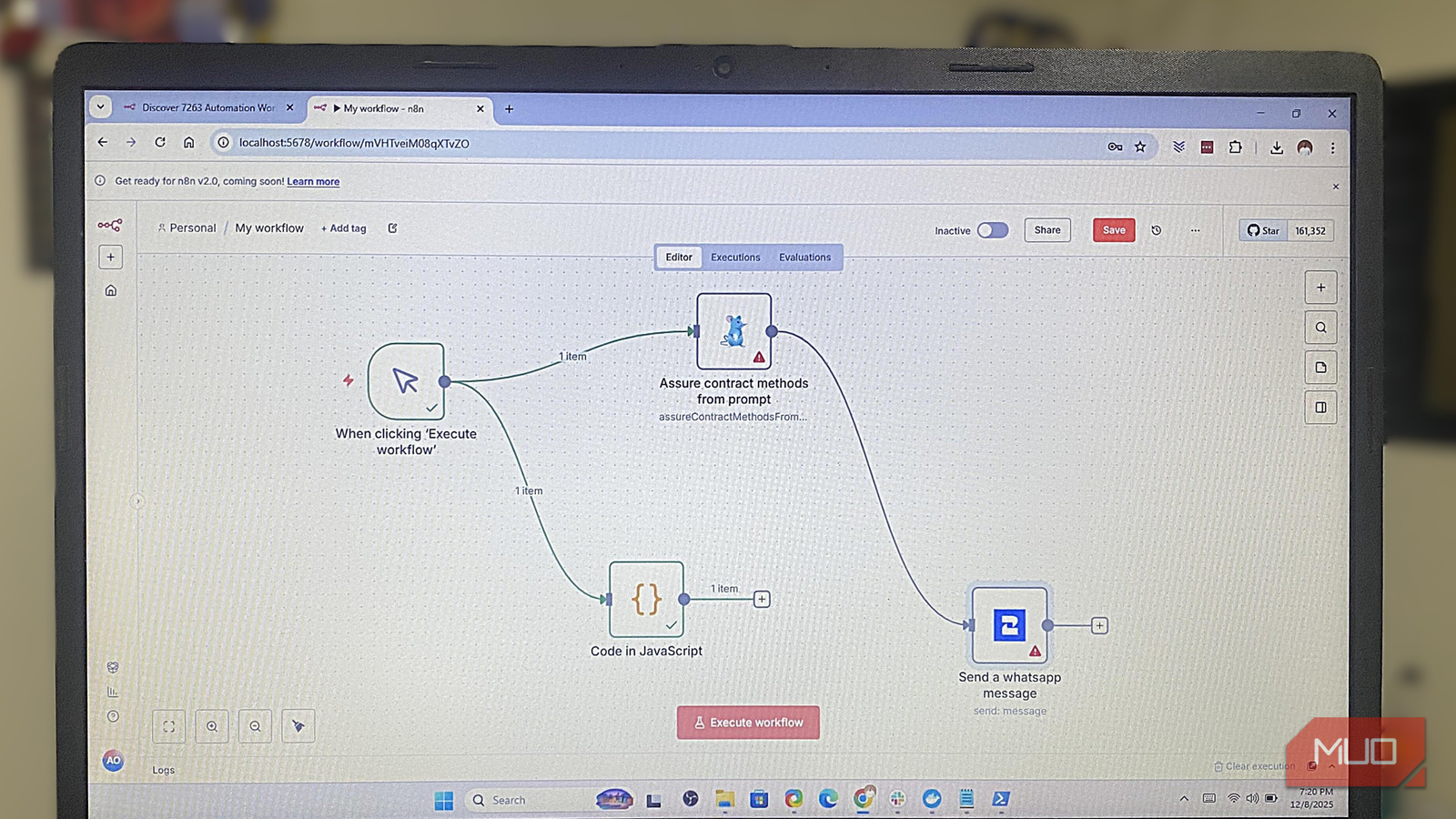
Real workflow examples with real numbers
Generic ROI claims fall apart the moment you look at an actual build. Here are three common workflows with honest numbers attached.
WhatsApp order confirmation and payment automation
A small retailer automating WhatsApp order confirmations and payment links typically spends 15 to 25 hours on the initial build, including connecting WhatsApp to n8n via the WhatsApp Business API and wiring up a payment gateway manually. At an internal build cost of R500 an hour, that's R7,500 to R12,500 upfront. If the workflow saves 8 hours a month of manual order processing at R300 an hour, that's R2,400 a month, putting breakeven at roughly three to five months once hosting and maintenance are included.
Invoice chasing and quote-to-invoice automation
Automating quote generation, invoice sending, and payment follow-ups usually takes 20 to 30 hours to build properly, including error handling for failed sends. If it saves a bookkeeper or admin 10 hours a month and reduces late payments by even a few thousand rand through faster follow-up, the ROI case is strong. See automating quotes and invoices end to end for the full build breakdown and timing.
Lead capture and CRM sync
Syncing web form leads or WhatsApp inquiries into a CRM automatically is one of the fastest-paying-off workflows because it's low complexity and prevents leads from being lost, which has a direct revenue impact rather than just a time-saving one. A build like this, covered in our guide to lead capture automation built for South African businesses, often breaks even in under a month once you factor in even one recovered lead. For support-heavy businesses, the numbers work differently again; our piece on the real ROI formula for WhatsApp support automation covers that case specifically.
How long it actually takes to break even
Breakeven time depends almost entirely on workflow complexity and how much of it touches South African tools without native support.
Low-complexity workflows (days to weeks)
Simple single-trigger workflows, like syncing a form to a spreadsheet or sending a WhatsApp notification, can break even inside days to a few weeks because build time is low and the time saved is immediate and repeated.
Multi-step workflows with error handling (1-3 months)
Anything with multiple steps, conditional logic, and proper error handling takes longer to build and longer to pay off, typically one to three months. This is also where most workflows fail if they're built without safeguards. Our guide on stopping workflows from failing silently in production covers why skipping error handling to save build time almost always costs more later in silent failures and manual fixes.
When an automation never pays for itself
Some automations never break even, usually because the task they're automating happens too rarely to justify the build, or because the underlying process is broken and automation just makes the broken process run faster. Before building, it's worth asking when n8n makes sense versus custom code, since sometimes a simple script is cheaper than a full workflow platform for a task that never changes.
Common questions
Is n8n actually free, or what does it really cost to run? The software is free and open source, but running it in production isn't. You'll pay either a Cloud subscription or hosting costs if self-hosted, plus maintenance time for updates, error monitoring, and fixing broken integrations. Realistic monthly cost for a small business running a handful of workflows is R800 to R2,500 once everything is counted.
How long does it take for an n8n automation to pay for itself? Simple single-step workflows can break even within days to a few weeks. Multi-step workflows with error handling and South African integrations like PayFast typically take one to three months once you include real build time, hosting, and maintenance rather than just the subscription cost.
n8n vs Zapier vs Make: which is cheaper at scale? n8n is generally cheaper at higher volumes because it charges per workflow execution, not per task. Zapier and Make charge per task, which gets expensive fast on multi-step workflows. For low-volume, simple automations, Zapier or Make can still be cheaper since you avoid hosting overhead entirely.
Do I need a developer to build n8n workflows, or can I do it no-code? Simple workflows connecting supported apps can often be built no-code. But anything involving South African tools like PayFast or Yoco needs custom HTTP Request nodes and webhook handling, which requires technical skill. Most production-grade workflows benefit from developer involvement even if the platform itself is visual.
What's the ROI of automating a specific task like invoicing, lead follow-up, or WhatsApp support? It depends on volume and current manual cost. Lead capture often pays off fastest because it prevents lost revenue, not just saved time. Invoice chasing pays off through faster payment cycles. WhatsApp support automation pays off through reduced staffing hours, typically breaking even within one to three months.
Is self-hosted n8n worth it versus n8n Cloud? It's worth it once your execution volume would push you into a higher Cloud pricing tier, or if data residency and POPIA considerations matter more than convenience. For low-volume use, Cloud is simpler and the operational overhead of self-hosting isn't worth the savings.
Can n8n integrate with South African tools like PayFast, Yoco, or local CRMs? Yes, but not natively. There are no pre-built nodes for most South African payment and CRM tools, so integration requires custom HTTP Request nodes and webhook setups. Budget extra build time for this, since it's the hidden cost most international n8n content never accounts for.
Is n8n POPIA-compliant, and can I keep my data in South Africa? n8n itself is a tool, not a compliance certification, so compliance depends on how you configure it. Self-hosting on South African or properly configured infrastructure gives you control over data residency, which is often the deciding factor for businesses handling customer data through automated workflows.
If you want a straight answer on whether a specific automation would actually pay for itself in your business, message Sagentics on WhatsApp and we'll walk through the real numbers with you.
Common questions
Is n8n actually free, or what does it really cost to run?
The software is free and open source, but running it in production isn't. You'll pay either a Cloud subscription or hosting costs if self-hosted, plus maintenance time for updates, error monitoring, and fixing broken integrations. Realistic monthly cost for a small business running a handful of workflows is R800 to R2,500 once everything is counted.
How long does it take for an n8n automation to pay for itself?
Simple single-step workflows can break even within days to a few weeks. Multi-step workflows with error handling and South African integrations like PayFast typically take one to three months once you include real build time, hosting, and maintenance rather than just the subscription cost.
n8n vs Zapier vs Make: which is cheaper at scale?
n8n is generally cheaper at higher volumes because it charges per workflow execution, not per task. Zapier and Make charge per task, which gets expensive fast on multi-step workflows. For low-volume, simple automations, Zapier or Make can still be cheaper since you avoid hosting overhead entirely.
Do I need a developer to build n8n workflows, or can I do it no-code?
Simple workflows connecting supported apps can often be built no-code. But anything involving South African tools like PayFast or Yoco needs custom HTTP Request nodes and webhook handling, which requires technical skill. Most production-grade workflows benefit from developer involvement even if the platform itself is visual.
What's the ROI of automating a specific task like invoicing, lead follow-up, or WhatsApp support?
It depends on volume and current manual cost. Lead capture often pays off fastest because it prevents lost revenue, not just saved time. Invoice chasing pays off through faster payment cycles. WhatsApp support automation pays off through reduced staffing hours, typically breaking even within one to three months.
Is self-hosted n8n worth it versus n8n Cloud?
It's worth it once your execution volume would push you into a higher Cloud pricing tier, or if data residency and POPIA considerations matter more than convenience. For low-volume use, Cloud is simpler and the operational overhead of self-hosting isn't worth the savings.
Can n8n integrate with South African tools like PayFast, Yoco, or local CRMs?
Yes, but not natively. There are no pre-built nodes for most South African payment and CRM tools, so integration requires custom HTTP Request nodes and webhook setups. Budget extra build time for this, since it's the hidden cost most international n8n content never accounts for.
Is n8n POPIA-compliant, and can I keep my data in South Africa?
n8n itself is a tool, not a compliance certification, so compliance depends on how you configure it. Self-hosting on South African or properly configured infrastructure gives you control over data residency, which is often the deciding factor for businesses handling customer data through automated workflows.
About Sagentics
Sagentics is an AI systems studio based in South Africa. We design and build WhatsApp automation, n8n workflows, and custom AI products for local and international clients. We write from systems we have actually shipped.
Start a WhatsApp conversation with SagenticsRelated reading
- Document automation for quotes and invoices: how to build the full loop in n8n
- n8n workflow automation guide: what it is, what it costs, and whether it's right for your business
- n8n vs Make vs Zapier: which one actually wins in 2026
- Self-hosting n8n vs cloud: what actually decides it
- what n8n actually costs to run
- n8n vs Zapier vs Make pricing at scale
- self-hosted n8n vs n8n Cloud
- when n8n makes sense versus custom code
- the real ROI formula for WhatsApp support automation
- automating quotes and invoices end to end
- lead capture automation built for South African businesses
- accepting payments through WhatsApp using PayFast or Yoco
- what POPIA compliance actually requires
- stopping workflows from failing silently in production
- connecting WhatsApp to n8n