

 Start a conversation
Workflow automation with n8n
n8n vs Make vs Zapier: which one actually wins in 2026
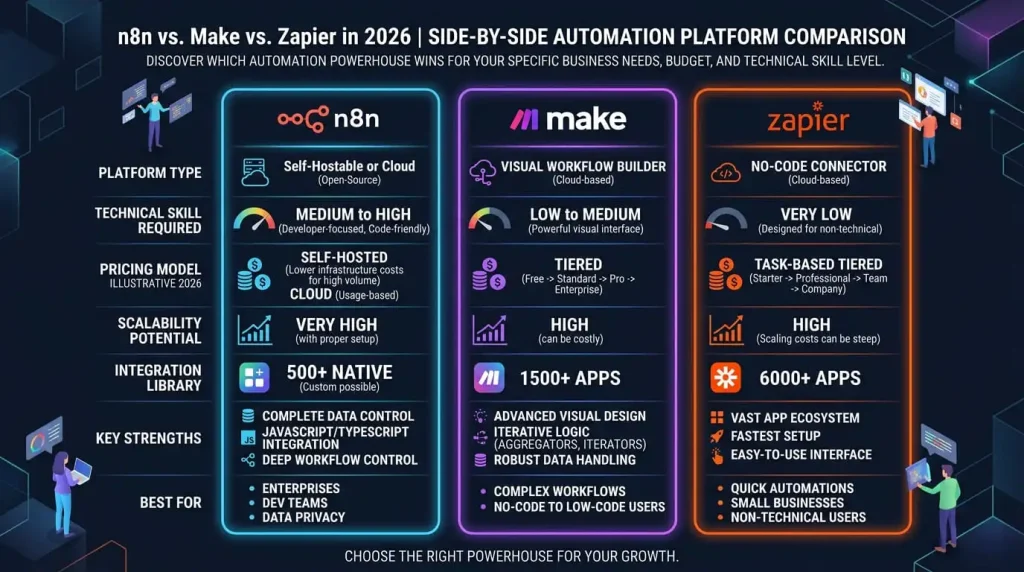
n8n wins on cost at scale and data control because it bills per workflow execution and can be self-hosted in South Africa, Make wins on balancing complex logic with usability, and Zapier wins on ease of use and integration count if your automation spend is under roughly R2,000 a month. Past that point, or the moment POPIA and data residency enter the conversation, the calculation changes completely. Here is the actual breakdown, not the marketing version.
The real difference is how each tool bills you
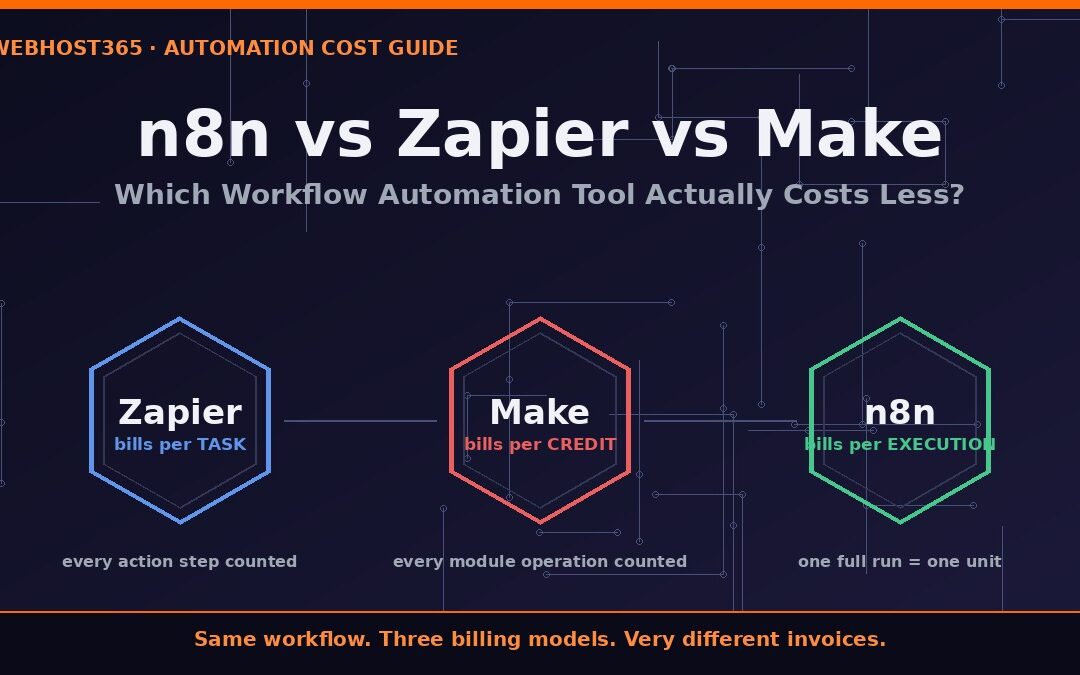
Every comparison article talks about "pricing tiers." Almost none explain the billing unit, which is the thing that actually determines your invoice.
Zapier: per task, every step counts
Zapier counts a "task" every time an action step runs. An 8-step Zap that fires 10,000 times a month isn't 10,000 tasks, it's closer to 70,000 to 80,000, because each action in the chain consumes its own task allowance. Triggers are usually free, but every downstream step bills. Teams get burned here because the pricing page shows "task" limits without explaining that a single automation run can eat 6 or 7 tasks.
Make: per operation, including empty polling checks
Make uses "operations" instead of tasks, and the logic is similar but slightly more forgiving because filters and router steps that don't produce output can cost less. The catch nobody mentions: polling triggers that check for new data still burn an operation even when there's nothing new. If you're polling a Google Sheet every 5 minutes, that's 8,640 operations a month before you've automated anything.
n8n: per workflow execution, regardless of step count
n8n counts one execution per workflow run, no matter how many nodes are inside it. An 8-node workflow that runs 10,000 times a month is 10,000 executions, full stop. This is the single biggest structural difference between n8n and the other two, and it's why the cost gap widens fast as workflows get more complex.
Worked example: a 10,000-run, 8-step workflow on all three
Run the same workflow, 10,000 times a month, 8 steps deep:
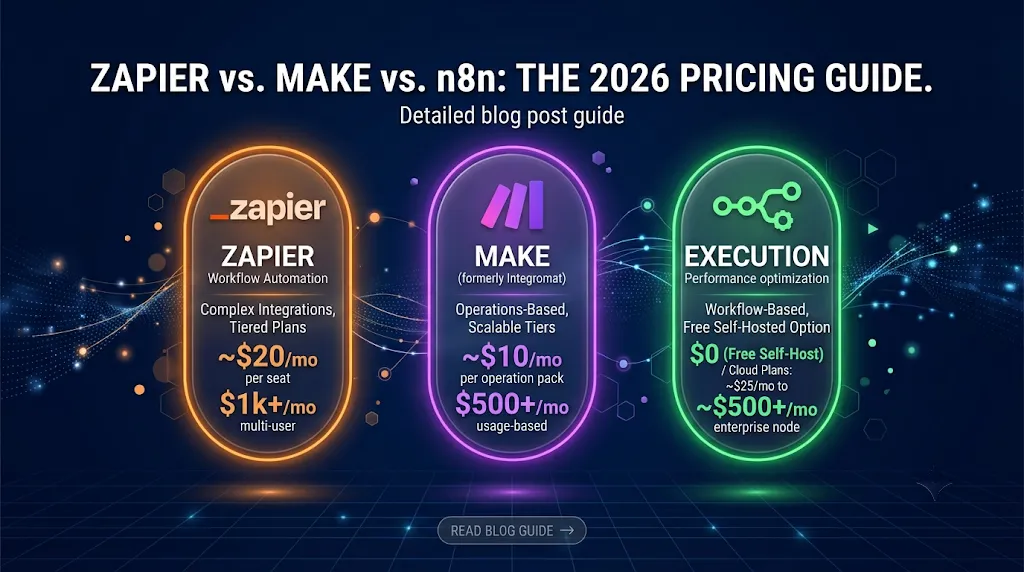
- Zapier: roughly 70,000 to 80,000 tasks, landing you in a R7,000 to R9,000+/month tier
- Make: roughly 60,000 to 70,000 operations, landing around R4,000 to R6,000/month
- n8n: 10,000 executions flat, comfortably inside n8n Cloud's mid tier, or effectively unlimited on a self-hosted server for the price of a VPS
The gap isn't marginal. It's the difference between an automation program that scales and one you have to keep shrinking to afford.
What each platform actually costs in ZAR
Zapier and Make cloud pricing at SMB volume
At low volume (a few hundred tasks a month), Zapier and Make are both cheap, often under R500/month, and genuinely easy to justify. The problem shows up as volume grows. By the time a South African SMB is running WhatsApp order confirmations, CRM syncs, and invoice automations across a few thousand runs a month, Zapier commonly lands in the R2,500 to R5,000/month range, and Make sits somewhat lower but still climbs steadily.
n8n cloud vs self-hosted on a local or Hetzner VPS
n8n Cloud starts cheaper than both and scales on execution count. Self-hosted n8n removes the execution ceiling entirely: you pay for a VPS, whether that's a Hetzner box in Germany or a local South African host, and you can run hundreds of thousands of executions a month for the price of server hosting, typically R200 to R600/month depending on specs. For a deeper breakdown of what this looks like in practice, see what WhatsApp automation really costs in ZAR.
The R3,500/month threshold where self-hosting starts winning
Once a business is spending more than about R3,500/month on Zapier or Make, the maths tips toward n8n self-hosted almost every time, even accounting for the setup and maintenance time. Below that threshold, the convenience of cloud tools can still be worth the premium, especially if there's no one in-house comfortable maintaining a server.
Integration counts, and why the numbers don't tell the full story
Zapier's 7,000-8,000+ app catalog
Zapier's headline number is real. It has the deepest native integration catalog of the three, which matters if you're connecting niche SaaS tools with no API documentation you want to touch yourself.
Make's 3,000+ apps and AI app library
Make sits in the middle, with a smaller but still substantial catalog, plus a growing set of AI-specific app modules for LLM providers and vector databases.
n8n's smaller native list offset by HTTP node and custom code
n8n has fewer pre-built native integrations, but its HTTP Request node and JavaScript/Python code nodes mean it can talk to almost any API that exists, including ones Zapier and Make have never heard of. This matters more than the raw integration count suggests: South African tools like PayFast, Yoco, and local CRM systems often lack polished native connectors anywhere, so the ability to hit a REST endpoint directly is what actually gets the job done. To understand the mechanics, read how n8n workflows actually work.
Self-hosting and data control: the POPIA angle nobody else covers
Zapier and Make: cloud-only, data leaves South Africa
Neither Zapier nor Make offers a self-hosted option. Every workflow, every piece of customer data that passes through them, runs on infrastructure in the US or EU. There is no configuration that keeps that data inside South African borders.
n8n: fair-code license, self-hostable on local infrastructure
n8n is fair-code licensed and can be deployed on any server you control, including infrastructure physically located in South Africa. This is the part every international "n8n vs Make vs Zapier" article treats as a footnote for developers who like tinkering. For South African businesses handling customer data under POPIA, it isn't a footnote. It's the decision driver.
Why this matters for POPIA and client contracts requiring data residency
We've rebuilt more than one client's Zapier workflow into n8n purely to move their WhatsApp conversation data off US servers, not to save a single rand. When a client contract specifies data residency, or a POPIA compliance officer asks where customer WhatsApp conversations are actually stored and processed, "on a server in Frankfurt owned by a US company" is not always an acceptable answer. "On a server we control, in South Africa" is. If you're unsure where your current setup stands, it's worth checking whether your automation setup is POPIA compliant before you scale it further.
Handling complexity: branching, loops, and who can actually maintain it
Zapier's linear model breaks down past a few conditions
Zapier was built for linear, trigger-to-action chains. Adding a few "Paths" (its conditional branching feature) works fine, but past 3 or 4 conditions, the interface becomes hard to reason about and even harder to hand off to a colleague.
Make's visual canvas for parallel paths
Make's node-based canvas handles branching and parallel execution far more visibly. You can see multiple paths running side by side, which makes debugging a multi-condition workflow much easier than in Zapier's list-based view.
n8n's code nodes for logic Zapier and Make can't express
n8n goes a step further with actual code nodes, letting you write custom logic, loops, and data transformations that neither Zapier nor Make can express natively. For workflows with real business logic, like calculating loyalty discounts, deduplicating leads across three systems, or handling multi-step WhatsApp conversation state, this is often the deciding factor regardless of cost.
The 2026 AI feature race
Zapier Agents
Zapier has pushed hard into "Agents," pre-built AI workers that chain tasks together using natural language setup. It's approachable, but still constrained by Zapier's per-task billing underneath.
Make's Maia and beta agent builder
Make's Maia assistant helps build scenarios conversationally, and its beta agent builder is catching up fast, though it's still less mature than n8n's AI tooling for anyone wanting fine control over model behaviour.
n8n 2.0: native LangChain, 70+ AI nodes, self-hosted LLM support
n8n has gone furthest here, with native LangChain integration, over 70 AI-specific nodes, and support for self-hosted LLMs, meaning a business can run AI agents without sending prompts and customer data to a third-party API at all. For teams building anything beyond simple chatbot replies, this is where n8n's technical ceiling matters most. See our custom AI development for South African businesses work for examples of what this looks like when it's built properly.
Which tool fits which business
Non-technical teams and simple workflows
If your team has no developer and your workflows are genuinely simple (one trigger, one or two actions), Zapier's interface and support documentation make it the least frustrating starting point.
Teams needing complex logic with moderate technical skill
If you need branching logic, parallel paths, or multiple data transformations but don't have engineering resources, Make's visual canvas hits the sweet spot between power and usability.
Engineering-led teams, high volume, or compliance requirements
If you're running high volumes, need custom logic, or have any compliance requirement around data residency, n8n self-hosted is the only option of the three that satisfies all three conditions at once.
The hidden costs comparison pages don't mention
Vendor lock-in and workflow migration cost
Zaps and Make scenarios don't export cleanly to each other, or to n8n. Migrating a mature automation setup between platforms is real engineering work, which is exactly why it's worth choosing carefully upfront rather than switching later under pressure.
API changes and connector breakage
Third-party APIs change without warning. Native connectors on Zapier and Make get updated by the vendor, sometimes slowly. Self-hosted n8n gives you the option to patch a broken HTTP call yourself the same day, rather than waiting on someone else's release cycle.
Who fixes it when something breaks at 2am
This is the real hidden cost. Cloud tools mean someone else's infrastructure team handles uptime. Self-hosted n8n means you (or whoever you've contracted) owns that responsibility. It's a fair trade for control and cost, but it needs to be budgeted honestly, not assumed away.
n8n and WhatsApp for South African businesses
Native WhatsApp Trigger and WhatsApp Business Cloud nodes
n8n ships with native nodes for the WhatsApp Business Cloud API, letting you trigger workflows on incoming messages and send replies, templates, and media without custom code. It's worth understanding the difference between the WhatsApp Business API vs the app before building on top of either.
Connecting CRM, PayFast, Yoco, and spreadsheets in one workflow
A typical South African setup: a customer messages on WhatsApp, n8n checks the CRM for their order history, generates a payment link through PayFast or Yoco, and logs the interaction to a spreadsheet or database, all in one workflow. See accepting payments through WhatsApp with PayFast or Yoco for how this is typically structured.
When to self-host locally vs use n8n cloud
Use n8n Cloud for speed of setup and lower operational overhead. Self-host locally the moment customer data residency, POPIA compliance, or high execution volume becomes a factor in the business.
Our take, built from actual client workflows
We've built and rebuilt automation on all three platforms for South African clients, and the pattern is consistent: businesses start on Zapier because it's the easiest on-ramp, hit a cost or compliance wall within 6 to 18 months, and move to n8n once the volume or the data residency requirement becomes non-negotiable. Make sits well for teams in between who need more logic than Zapier offers but aren't ready to self-host. None of these tools is universally "best." The right one depends on your volume, your technical capacity, and whether POPIA-grade data control is a real requirement or a nice-to-have. This is the core of what we build day to day as an AI automation agency: matching the tool to the actual constraint, not the trend.
For more on how we approach this across client projects, see our AI automation services.
Common questions
Which is cheaper: n8n, Make, or Zapier? n8n is cheapest at scale because it bills per workflow execution rather than per step. At low volume, Zapier and Make can be similarly priced or even cheaper upfront. Once you're past a few thousand runs a month with multi-step workflows, n8n, especially self-hosted, pulls ahead significantly on cost.
Can n8n replace Zapier? Yes, in almost all cases. n8n covers everything Zapier does through its HTTP node and code nodes, plus custom logic Zapier can't express. The main tradeoff is setup time: n8n has a steeper initial learning curve, though most workflows migrate over within a few days of focused work.
Is n8n free to use? Yes, if self-hosted. n8n's fair-code license allows free self-hosting on your own infrastructure, with only enterprise features gated behind a paid tier. n8n Cloud is not free but offers a trial and low-cost entry tiers, priced separately from the self-hosted option.
Which automation tool is best for non-technical users? Zapier, for genuinely simple workflows. Its interface and documentation are the most approachable of the three for someone without technical background. Make is a close second if some branching logic is needed. n8n's power comes with a real learning curve that non-technical teams usually need support to climb.
Which is better for AI agents and AI workflows in 2026? n8n, by a clear margin. Its native LangChain support, 70+ AI-specific nodes, and ability to run self-hosted LLMs give it technical depth Zapier's Agents and Make's Maia haven't matched yet, particularly for businesses that don't want customer data sent to third-party AI APIs.
Does Zapier or Make support self-hosting? No. Both are cloud-only platforms with no self-hosted deployment option. All data processed through them runs on Zapier's or Make's own infrastructure, located outside South Africa, regardless of where your business or customers are based.
What happens to pricing when you scale past a few thousand tasks a month? Zapier and Make costs climb steeply because both bill per step or operation, not per workflow run. n8n's cost stays flat relative to execution count, and self-hosted n8n cost barely moves at all since you're paying for server capacity, not per-run fees.
Which tool is best for small business automation in South Africa? For simple, low-volume needs, Zapier or Make cloud tiers work fine. For businesses handling customer data under POPIA, running WhatsApp automation, or scaling past a few thousand runs a month, n8n self-hosted on local or Hetzner infrastructure is the more sustainable long-term choice.
Does n8n or Zapier have more integrations? Zapier has more native integrations, with a catalog of 7,000 to 8,000+ apps versus n8n's smaller native list. n8n compensates through its HTTP Request node and code nodes, which can connect to virtually any API, including South African tools like PayFast and Yoco that lack polished native connectors elsewhere.
Is n8n more POPIA-friendly than Zapier or Make because it can be self-hosted? Yes. Self-hosting n8n on South African infrastructure means customer data never leaves the country, which directly supports POPIA data residency requirements. Zapier and Make are cloud-only, processing data on servers based in the US or EU, with no configuration available to change that.
If you're weighing these options for your own business and want a straight answer on what fits your volume, budget, and compliance needs, send us a message on WhatsApp and we'll talk it through.
Common questions
Which is cheaper: n8n, Make, or Zapier?
n8n is cheapest at scale because it bills per workflow execution rather than per step. At low volume, Zapier and Make can be similarly priced or even cheaper upfront. Once you're past a few thousand runs a month with multi-step workflows, n8n, especially self-hosted, pulls ahead significantly on cost.
Can n8n replace Zapier?
Yes, in almost all cases. n8n covers everything Zapier does through its HTTP node and code nodes, plus custom logic Zapier can't express. The main tradeoff is setup time: n8n has a steeper initial learning curve, though most workflows migrate over within a few days of focused work.
Is n8n free to use?
Yes, if self-hosted. n8n's fair-code license allows free self-hosting on your own infrastructure, with only enterprise features gated behind a paid tier. n8n Cloud is not free but offers a trial and low-cost entry tiers, priced separately from the self-hosted option.
Which automation tool is best for non-technical users?
Zapier, for genuinely simple workflows. Its interface and documentation are the most approachable of the three for someone without technical background. Make is a close second if some branching logic is needed. n8n's power comes with a real learning curve that non-technical teams usually need support to climb.
Which is better for AI agents and AI workflows in 2026?
n8n, by a clear margin. Its native LangChain support, 70+ AI-specific nodes, and ability to run self-hosted LLMs give it technical depth Zapier's Agents and Make's Maia haven't matched yet, particularly for businesses that don't want customer data sent to third-party AI APIs.
Does Zapier or Make support self-hosting?
No. Both are cloud-only platforms with no self-hosted deployment option. All data processed through them runs on Zapier's or Make's own infrastructure, located outside South Africa, regardless of where your business or customers are based.
What happens to pricing when you scale past a few thousand tasks a month?
Zapier and Make costs climb steeply because both bill per step or operation, not per workflow run. n8n's cost stays flat relative to execution count, and self-hosted n8n cost barely moves at all since you're paying for server capacity, not per-run fees.
Which tool is best for small business automation in South Africa?
For simple, low-volume needs, Zapier or Make cloud tiers work fine. For businesses handling customer data under POPIA, running WhatsApp automation, or scaling past a few thousand runs a month, n8n self-hosted on local or Hetzner infrastructure is the more sustainable long-term choice.
Does n8n or Zapier have more integrations?
Zapier has more native integrations, with a catalog of 7,000 to 8,000+ apps versus n8n's smaller native list. n8n compensates through its HTTP Request node and code nodes, which can connect to virtually any API, including South African tools like PayFast and Yoco that lack polished native connectors elsewhere.
Is n8n more POPIA-friendly than Zapier or Make because it can be self-hosted?
Yes. Self-hosting n8n on South African infrastructure means customer data never leaves the country, which directly supports POPIA data residency requirements. Zapier and Make are cloud-only, processing data on servers based in the US or EU, with no configuration available to change that.
About Sagentics
Sagentics is an AI systems studio based in South Africa. We design and build WhatsApp automation, n8n workflows, and custom AI products for local and international clients. We write from systems we have actually shipped.
Start a WhatsApp conversation with SagenticsRelated reading
- Document automation for quotes and invoices: how to build the full loop in n8n
- n8n workflow automation guide: what it is, what it costs, and whether it's right for your business
- Self-hosting n8n vs cloud: what actually decides it
- n8n lead capture CRM automation: how to build it right for a South African business
- how n8n workflows actually work
- whether your automation setup is POPIA compliant
- what WhatsApp automation really costs in ZAR
- WhatsApp Business API vs the app
- accepting payments through WhatsApp with PayFast or Yoco
- custom AI development for South African businesses
- our AI automation agency work
- what an AI automation agency actually builds