

 Start a conversation
Workflow automation with n8n
Self-hosting n8n vs cloud: what actually decides it

Self-host n8n if you need POPIA-aligned data residency, run more than roughly 10,000 executions a month, or need custom code and shell access. Use n8n Cloud if you want zero maintenance and sit below that volume. The real cost of self-hosting isn't the R100-200/month VPS, it's the engineering hours to patch, back up, and monitor it. Get that part wrong and you'll pay more in DevOps time than you'd ever spend on a Cloud subscription.
Cloud vs self-hosted isn't the real question, staffing is
Why pricing pages alone are misleading
n8n's pricing page shows you a monthly number for Cloud and lets you assume self-hosting is "free" because the software is open source. Both framings are incomplete. Cloud pricing scales with execution volume in ways that get expensive fast. Self-hosting looks free until you account for who keeps the server alive.
What a VPS bill hides (backups, patching, monitoring)
A VPS invoice covers compute and storage. It doesn't cover backup configuration, security patching, SSL renewal, monitoring for downtime, log review, or the 2am page when a workflow silently stops firing because a dependency broke. None of that shows up on the hosting bill, but all of it costs real hours.
The $150/hr DevOps math and what it looks like in ZAR
If a contractor or ops hire spends even two hours a month maintaining a self-hosted instance at $150/hour (roughly R2,800/hour at current exchange rates), that's R5,600/month in labor against a VPS that costs R150-250/month. Compare that to an n8n Cloud Pro plan sitting in a similar price range with zero maintenance hours. The infrastructure was never the expensive part. Staffing time was.
n8n Cloud pricing in 2026
Starter, Pro, and Business tiers explained
n8n Cloud runs three main tiers. Starter suits solo builders and small teams testing workflows, with limited executions and a handful of active workflows. Pro raises execution ceilings and adds more concurrent workflows, aimed at small businesses running automation in production. Business adds SSO, higher execution volumes, and priority support for teams with governance requirements. Each tier steps up in price as execution allowances grow.
What counts as an execution
An execution is one full run of a workflow, start to finish, regardless of how many nodes it touches internally. A WhatsApp message that triggers a lookup, a CRM update, and a reply is still one execution. This matters because it changes how you estimate cost against other platforms, and against your own usage patterns.
Where Cloud pricing breaks down at scale
Cloud pricing holds up fine at low to moderate volume. Once you reach a few hundred thousand executions a month or need multiple production environments and dedicated workers, the per-execution cost curve starts working against you. This is the point where self-hosting's fixed infrastructure cost, however you get there, stops being a maintenance headache and starts being a straightforward saving.
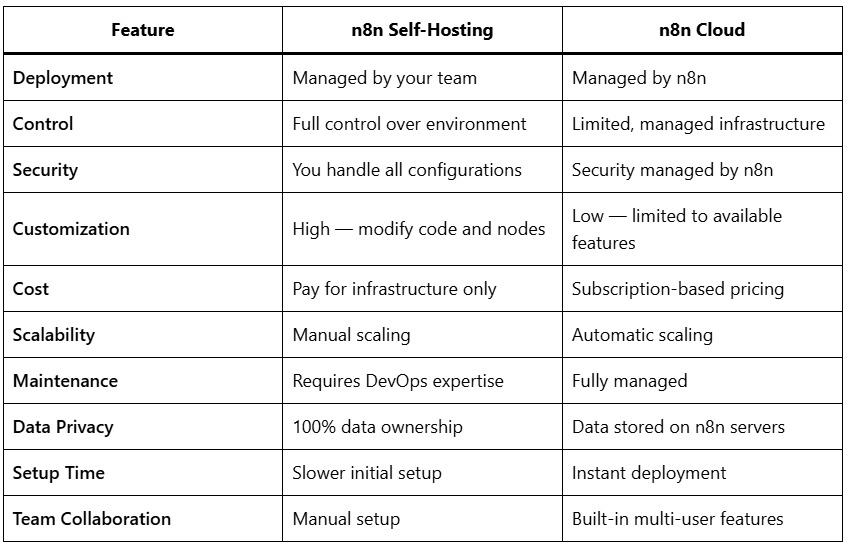
Self-hosting costs: the VPS plus the hidden hours
What a small VPS actually costs after the 2026 Hetzner price hike
A small VPS capable of running n8n comfortably (2 vCPU, 4GB RAM) now runs roughly R150-300/month on Hetzner or DigitalOcean-equivalent providers, after the 2026 pricing adjustments pushed rates up across the board. That's the easy number. The hard number is the maintenance time layered on top, which is where most DIY self-hosting plans quietly fail.
Update cadence: n8n ships every 1-2 weeks
n8n releases updates every one to two weeks, sometimes faster when security patches are involved. Self-hosted instances don't update themselves. Someone has to review release notes, test the update against existing workflows, and apply it without breaking production automations that a client depends on.
What happens when you fall behind on updates
Instances that go months without updating accumulate two problems: security exposure from unpatched vulnerabilities, and compatibility drift, where community nodes or integrations stop working against an outdated core version. We've inherited client instances that were 8+ months behind, and the fix wasn't a simple upgrade, it was a careful staged migration to avoid breaking live workflows. That's exactly the kind of hidden hour cost that doesn't show up on a VPS invoice.
The break-even point: when self-hosting actually wins
Below 10,000 executions a month, Cloud wins outright
Below roughly 10,000 executions a month, n8n Cloud's Starter or Pro tier will almost always cost less than the combined infrastructure and labor cost of self-hosting, even at a modest DevOps rate. If you're testing an idea, running a handful of internal workflows, or serving one or two clients with light automation needs, don't self-host yet.
At 200,000+ executions a month, the math flips hard
Once you're running 200,000 or more executions a month, Cloud's per-execution pricing at higher tiers starts costing significantly more than a well-run self-hosted setup, even with maintenance labor factored in. At this volume, the fixed cost of a decent VPS or managed Docker host plus a few maintenance hours a month is a fraction of what Cloud charges for equivalent throughput.
Working out your own break-even before you commit
Pull your actual or projected monthly execution count, price Cloud at that volume, then price a VPS or managed host at the spec you'd need plus realistic monthly maintenance hours at your actual labor cost, not a theoretical rate. Most teams land clearly on one side once they do this math honestly. For a deeper breakdown of how n8n's execution model compares to competitors, see how n8n compares to Make and Zapier in 2026.
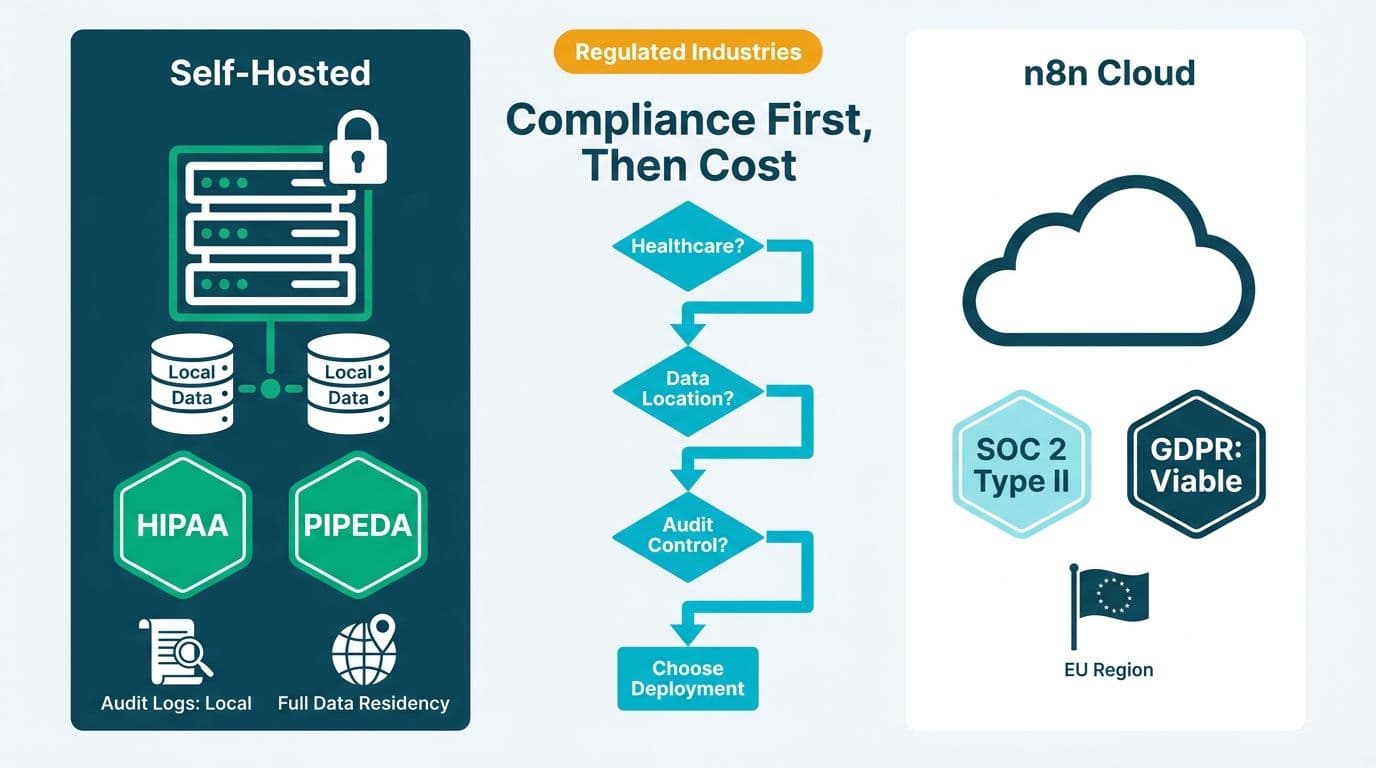
POPIA and data residency: the South Africa-specific case
Why n8n Cloud (EU/US-hosted) complicates cross-border transfer under POPIA s72
n8n Cloud runs on EU and US infrastructure. For South African businesses processing personal information, that means every workflow execution involving customer data is a cross-border transfer under POPIA section 72, which requires either adequate protection in the destination country, consent, or a contractual safeguard. It's not disqualifying, but it adds a compliance layer many businesses would rather avoid entirely.
Using AWS Cape Town, Azure Johannesburg, or local VPS providers for residency
Self-hosting on infrastructure physically located in South Africa, AWS's Cape Town region, Azure's Johannesburg region, or a local VPS provider keeps data resident and sidesteps the cross-border transfer question. For clients where data residency is a hard requirement rather than a nice-to-have, this is usually the deciding factor on its own, independent of the execution volume math.
Why regulated SA sectors (fintech, healthcare) default to self-hosted or hybrid
Fintech and healthcare clients we work with default to self-hosted or hybrid setups almost automatically, because their compliance obligations (POPIA plus sector-specific regulation) make EU/US-hosted Cloud a harder sell to their own risk and legal teams, regardless of cost. If you're in one of these sectors, start the infrastructure conversation with residency, not price. We've written more on what actually needs to be true for POPIA-compliant automation if you want the fuller compliance picture.
Three options, not two: VPS, managed Docker hosting, or Cloud
DIY VPS: cheapest, most work
Running n8n yourself on a bare VPS is the cheapest option on paper and the most demanding in practice. You handle Docker setup, reverse proxy configuration, SSL, backups, and every update yourself. It's a legitimate option if you already have DevOps capacity in-house. It's a trap if you're hoping to "figure it out as you go" while running client-facing workflows.
Managed Docker hosting (Sliplane, Elestio, Coolify, Railway): the middle ground
Managed Docker hosting platforms like Sliplane, Elestio, Coolify, and Railway sit between DIY and Cloud. You get a self-hosted n8n instance, meaning full data residency control and access to custom nodes, but the platform handles server provisioning, SSL, and often backups and updates through a dashboard. It's a real middle ground, not a marketing label. Costs typically run R300-800/month depending on resources, still well below Cloud's higher tiers at volume, with meaningfully less maintenance burden than raw VPS management.
Official n8n Cloud: least control, least maintenance
n8n Cloud remains the least-control, least-maintenance option. No server access, no custom npm packages, no shell access, but also nothing to patch or monitor. It's the right trade for teams that want automation without becoming infrastructure operators.
Technical differences that actually matter
Custom npm packages and shell access (self-hosted only)
Self-hosted instances let you install custom npm packages and community nodes, and give you shell access to the underlying server. This matters if your workflows need a library n8n doesn't ship natively, or if you need to run custom scripts alongside your automations. Cloud doesn't offer this at any tier. If your workflow design depends on it, self-hosting isn't optional.
Queue mode and worker scaling for high-volume workflows
Self-hosted n8n supports queue mode, which distributes execution across multiple worker processes instead of running everything on a single instance. For high-volume production workflows, this is the difference between a system that degrades under load and one that scales horizontally by adding workers. Cloud handles this scaling for you automatically, but only within its pricing tiers.
Update currency: Cloud is always current, self-hosted requires discipline
Cloud instances are always running the latest version, with no action required. Self-hosted instances are only as current as your update discipline allows. This isn't a minor detail, it's the single biggest operational difference between the two models, and the one most DIY setups underestimate.
Hybrid setups: what we actually run for clients
Self-hosted for internal and high-volume client automations
We run self-hosted n8n on local infrastructure for South African clients where POPIA data residency is a hard requirement, and for any client running high enough execution volume that Cloud pricing stops making sense. This is also where custom npm packages or queue mode scaling come into play.
Cloud for clients who don't want to manage infrastructure
For smaller clients who want automation without owning any infrastructure decisions, n8n Cloud is the right call. No server to maintain, no update schedule to track, and a predictable monthly bill that's easy to budget against. We're not precious about pushing everyone toward self-hosting just because it's more technically interesting.
How to decide which workflow goes where
The decision comes down to three questions: does this workflow touch personal information that triggers POPIA residency concerns, does the client's execution volume justify infrastructure investment, and does the client have any appetite for owning infrastructure decisions at all. Answer those honestly and the split becomes obvious. We cover the fuller build process in our full n8n workflow automation guide, and the broader service picture in Sagentics' AI automation work.
How to decide: a practical checklist
Questions to answer before choosing
Work through these before committing budget: What's your actual monthly execution volume, not your guess? Does any workflow touch personal data that makes POPIA residency a hard requirement rather than a preference? Do you need custom npm packages or shell-level access for any integration? Who, specifically, by name, will handle updates and monitoring if you self-host? What's that person's time actually worth per hour, and how many hours a month will this realistically take?
When to bring in a partner instead of DIY-ing it
If the answer to "who will handle updates and monitoring" is "we'll figure it out," that's the signal to bring in a partner rather than DIY it. Self-hosting done properly isn't hard, but it does require someone accountable for it, and most internal teams underestimate the ongoing time commitment until they're three months in and behind on updates. For context on how agencies price and scope this kind of work, see what AI automation agencies actually build and charge.
Common questions
Is n8n Cloud worth it compared to self-hosting? Yes, if you're below roughly 10,000 executions a month and don't have POPIA residency requirements or a need for custom npm packages. Cloud removes maintenance overhead entirely. Above that volume, or with data residency requirements, self-hosting or a managed Docker host usually costs less once you factor in labor.
How much does it cost to self-host n8n on a VPS? A capable VPS runs roughly R150-300/month after 2026 Hetzner-equivalent price increases. That's the visible cost. Add realistic maintenance time, patching, backups, monitoring, at your actual labor rate, and the true monthly cost is often two to five times the server bill alone.
Is self-hosted n8n free? The software itself is free and open source under n8n's fair-code license. The infrastructure to run it and the time to maintain it are not free. Treating self-hosted n8n as a zero-cost option is the most common mistake teams make before committing to it.
Can I self-host n8n for free on Oracle Cloud's free tier? Yes, technically. Oracle Cloud's Always Free tier offers enough compute to run a small n8n instance at no infrastructure cost. It's a reasonable option for testing or personal projects, but it's not a serious production choice for client work, since it lacks the reliability guarantees and support you'd want for business-critical automation.
What's the difference between n8n executions and Zapier tasks or Make operations? An n8n execution counts one full workflow run regardless of node count. Zapier counts each action step as a separate task, and Make counts each module operation. This means n8n's pricing often works out cheaper for complex, multi-step workflows, since you're not billed per step. See how n8n compares to Make and Zapier in 2026 for the full comparison.
Is self-hosting n8n secure, and do I need to be technical to run it? It can be as secure as any properly maintained server, but security depends entirely on your patching discipline, access controls, and backup practices. You don't need to be a senior engineer, but you do need someone comfortable with Docker, SSL, and basic Linux server administration, or a managed hosting platform that handles that layer for you.
Which option is better for POPIA, GDPR, or HIPAA-type compliance requirements? Self-hosted or hybrid setups using South African or in-region infrastructure are generally better for POPIA, since n8n Cloud runs on EU/US servers and triggers cross-border transfer rules. The same logic applies to GDPR and HIPAA in their respective jurisdictions, where data residency and processing location matter to compliance sign-off.
What is managed Docker hosting for n8n and is it a real middle ground? Platforms like Sliplane, Elestio, Coolify, and Railway host your self-hosted n8n instance while managing server provisioning, SSL, and often updates and backups through a dashboard. Yes, it's a genuine middle ground, giving you data control and custom node access with meaningfully less operational burden than raw VPS management.
How often does n8n release updates, and what happens if self-hosted instances fall behind? n8n ships updates every one to two weeks, including security patches. Instances left unpatched for months accumulate security exposure and compatibility issues with community nodes, and eventually require a careful staged migration rather than a simple upgrade, costing far more time than staying current would have.
Can you run n8n Cloud and self-hosted n8n in a hybrid setup at the same time? Yes, and it's a practical, common setup. There's no technical restriction preventing an organization from running Cloud instances for some workflows or clients and self-hosted instances for others. We run exactly this model in production, matching each workflow to the hosting option its data sensitivity and volume actually require.
If you're weighing this decision for your own business and want a straight answer based on your actual execution volume and compliance needs, message us on WhatsApp and we'll walk through the numbers with you. We also work on custom AI development for South African businesses beyond n8n hosting decisions, if that's the broader problem you're solving.
Common questions
Is n8n Cloud worth it compared to self-hosting?
Yes, if you're below roughly 10,000 executions a month and don't have POPIA residency requirements or a need for custom npm packages. Cloud removes maintenance overhead entirely. Above that volume, or with data residency requirements, self-hosting or a managed Docker host usually costs less once you factor in labor.
How much does it cost to self-host n8n on a VPS?
A capable VPS runs roughly R150-300/month after 2026 Hetzner-equivalent price increases. That's the visible cost. Add realistic maintenance time, patching, backups, monitoring, at your actual labor rate, and the true monthly cost is often two to five times the server bill alone.
Is self-hosted n8n free?
The software itself is free and open source under n8n's fair-code license. The infrastructure to run it and the time to maintain it are not free. Treating self-hosted n8n as a zero-cost option is the most common mistake teams make before committing to it.
Can I self-host n8n for free on Oracle Cloud's free tier?
Yes, technically. Oracle Cloud's Always Free tier offers enough compute to run a small n8n instance at no infrastructure cost. It's a reasonable option for testing or personal projects, but it's not a serious production choice for client work, since it lacks the reliability guarantees and support you'd want for business-critical automation.
What's the difference between n8n executions and Zapier tasks or Make operations?
An n8n execution counts one full workflow run regardless of node count. Zapier counts each action step as a separate task, and Make counts each module operation. This means n8n's pricing often works out cheaper for complex, multi-step workflows, since you're not billed per step.
Is self-hosting n8n secure, and do I need to be technical to run it?
It can be as secure as any properly maintained server, but security depends entirely on your patching discipline, access controls, and backup practices. You don't need to be a senior engineer, but you do need someone comfortable with Docker, SSL, and basic Linux server administration, or a managed hosting platform that handles that layer for you.
Which option is better for POPIA, GDPR, or HIPAA-type compliance requirements?
Self-hosted or hybrid setups using South African or in-region infrastructure are generally better for POPIA, since n8n Cloud runs on EU/US servers and triggers cross-border transfer rules. The same logic applies to GDPR and HIPAA in their respective jurisdictions, where data residency and processing location matter to compliance sign-off.
What is managed Docker hosting for n8n and is it a real middle ground?
Platforms like Sliplane, Elestio, Coolify, and Railway host your self-hosted n8n instance while managing server provisioning, SSL, and often updates and backups through a dashboard. Yes, it's a genuine middle ground, giving you data control and custom node access with meaningfully less operational burden than raw VPS management.
How often does n8n release updates, and what happens if self-hosted instances fall behind?
n8n ships updates every one to two weeks, including security patches. Instances left unpatched for months accumulate security exposure and compatibility issues with community nodes, and eventually require a careful staged migration rather than a simple upgrade, costing far more time than staying current would have.
Can you run n8n Cloud and self-hosted n8n in a hybrid setup at the same time?
Yes, and it's a practical, common setup. There's no technical restriction preventing an organization from running Cloud instances for some workflows or clients and self-hosted instances for others. We run exactly this model in production, matching each workflow to the hosting option its data sensitivity and volume actually require.
About Sagentics
Sagentics is an AI systems studio based in South Africa. We design and build WhatsApp automation, n8n workflows, and custom AI products for local and international clients. We write from systems we have actually shipped.
Start a WhatsApp conversation with SagenticsRelated reading
- Document automation for quotes and invoices: how to build the full loop in n8n
- n8n workflow automation guide: what it is, what it costs, and whether it's right for your business
- n8n vs Make vs Zapier: which one actually wins in 2026
- n8n lead capture CRM automation: how to build it right for a South African business
- our full n8n workflow automation guide
- how n8n compares to Make and Zapier in 2026
- what actually needs to be true for POPIA-compliant automation
- custom AI development for South African businesses
- Sagentics' AI automation work
- what AI automation agencies actually build and charge