

 Start a conversation
Custom AI product and SaaS development
MVP scoping for AI SaaS: how to define the build before you pay for it
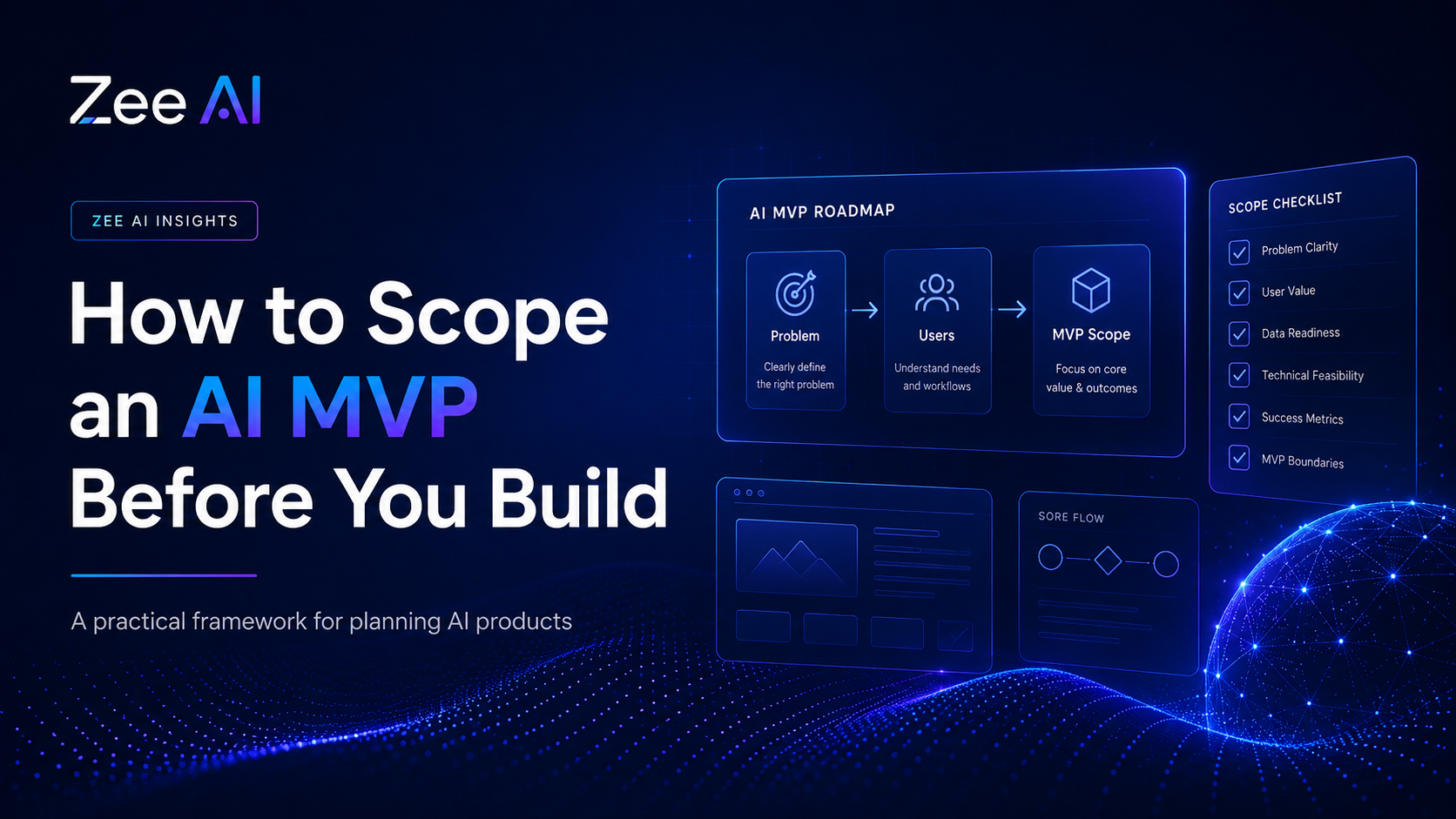
MVP scoping for an AI SaaS product means defining one complete workflow, the exact decision the AI is allowed to make inside it, and a written list of what you are not building yet. It should be run as a separate, paid phase before any build contract is signed. If a development partner offers to "scope it for free" on a discovery call and then hands you a build quote in the same breath, you haven't been scoped. You've been sold to.
This matters more for AI products than for standard software because the failure modes are different. A normal MVP can ship with a rough UI and fix it later. An AI MVP that hasn't had its decision boundary defined ships with a model doing things nobody agreed it should do, and unwinding that after launch costs far more than scoping it properly the first time.
What MVP scoping actually means for an AI SaaS product
Scoping is not a smaller version of the build
A lot of teams treat scoping as "build planning lite": take the full feature list, cut it in half, call the smaller half the MVP. That's not scoping, it's rationing. Real scoping starts from a different question: what is the single job this product has to do, end to end, for one type of user, before anyone touches a line of code.
The distinction matters because a feature-list MVP still tries to be a smaller version of everything. A workflow-scoped MVP does one thing completely. One is a compromise. The other is a decision.
The six things a proper scoping phase should produce
A scoping phase that's actually doing its job produces:
- One defined user workflow, start to finish, including the payment or conversion step
- A clear statement of what job the AI is doing (predicting, generating, classifying, or recommending) and nothing more
- A written exclusion list of everything explicitly out of scope for v1
- Data flow and storage decisions, including where data physically sits and who can access it
- The interface decision (dashboard, app, WhatsApp, API) and why it fits the user
- A go or no-go recommendation with a cost and timeline range for the actual build
If a scoping engagement doesn't end with all six of these in writing, it wasn't scoping. It was a conversation.
Why this should be a priced deliverable, not a free sales call
Free discovery calls have a structural conflict of interest: the person scoping your product is also the person who wants to sell you the build. Every incentive points toward a scope that's big enough to win the deal and vague enough to leave room for change orders. Paying for scoping as its own deliverable removes that conflict. You get a document you can take to another agency, another investor, or your own team, and it stands on its own regardless of who builds it.
Scope the workflow, not the feature list
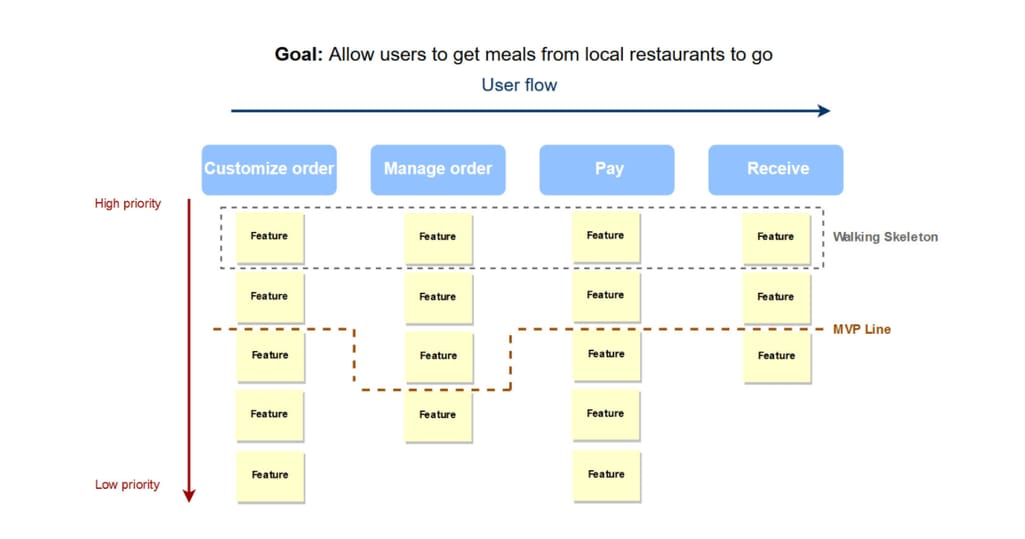
One user, one job, one path to payment
The test for a real MVP scope is whether you can describe it in one sentence that includes a user, a job, and a payment or conversion action. "A small accounting firm uploads a supplier invoice on WhatsApp, our AI extracts the line items and VAT, and the firm approves it before it syncs to their books" is a scope. "An AI bookkeeping platform for SMEs" is a category, not a scope.
Everything that doesn't sit inside that one sentence is a v2 conversation. This is the same discipline we apply when we talk through what a custom AI product actually costs and takes to build with clients before any commitment is made.
Why feature lists cause scope creep and workflows don't
Feature lists invite addition because features feel independent. "While we're at it, let's add a dashboard." "Can we also support bulk upload." Each addition seems small in isolation. A workflow doesn't have that problem, because a workflow is a chain. If a new feature doesn't sit inside the chain from first action to payment, it's visibly outside the scope, not a reasonable extra.
This is the practical reason workflow scoping beats feature scoping: it gives you a boundary that's obvious to point at, not a list that quietly grows.
What to put on the written 'not building yet' list
The exclusion list is the most underused document in software scoping. It should name, specifically:
Every integration you're deferring (accounting software, CRM, other payment rails). Every user type you're not serving yet (admin dashboards, multi-user permissions, roles). Every AI capability you're holding back (multi-language, voice input, proactive suggestions). Every reporting or analytics feature that isn't needed to run the core loop.
Writing these down isn't bureaucracy. It's the thing that lets you say "that's on the list, we agreed it's v2" three weeks into the build instead of relitigating scope every sprint.
Deciding what the AI is actually allowed to do
Predict, generate, classify, or recommend: pick one job for v1
Every AI feature reduces to one of a handful of jobs: it predicts an outcome, generates content, classifies an input, or recommends an action. A v1 that tries to do two or three of these at once is harder to scope, harder to test, and harder to explain to a user. Pick the one job that carries the core value of the product, and build the MVP around doing that one job well.
If your product's value depends on a model doing several of these jobs together, that's usually a sign the MVP is still too big, not a sign the model needs to be smarter.
Where human review sits in the loop and why that's a scoping decision, not a later fix
Whether a human checks the AI's output before it takes effect is not an implementation detail you settle during the build. It changes the architecture: what gets logged, what the UI needs to show, how errors get corrected, and what your liability looks like if the AI is wrong. Deciding "human approves every output for the first three months" versus "AI acts autonomously with an audit log" are two different products. Scoping is where that gets decided, not week six of development when the model does something nobody wanted.
The commoditisation test: will ChatGPT or Claude replace this in 12 months
Before locking the AI's job for v1, run it through one honest test: if a user could get the same output by pasting the same input into ChatGPT or Claude directly, what are you actually selling? The answer is usually the workflow around the model, not the model itself. The data connections, the domain-specific validation, the interface that fits how the user already works, the compliance layer. Scoping should name that differentiator explicitly, because it's the part that has to survive even as the underlying models get better and cheaper.
What MVP scoping costs and how long it takes
Typical scoping timelines vs full build timelines
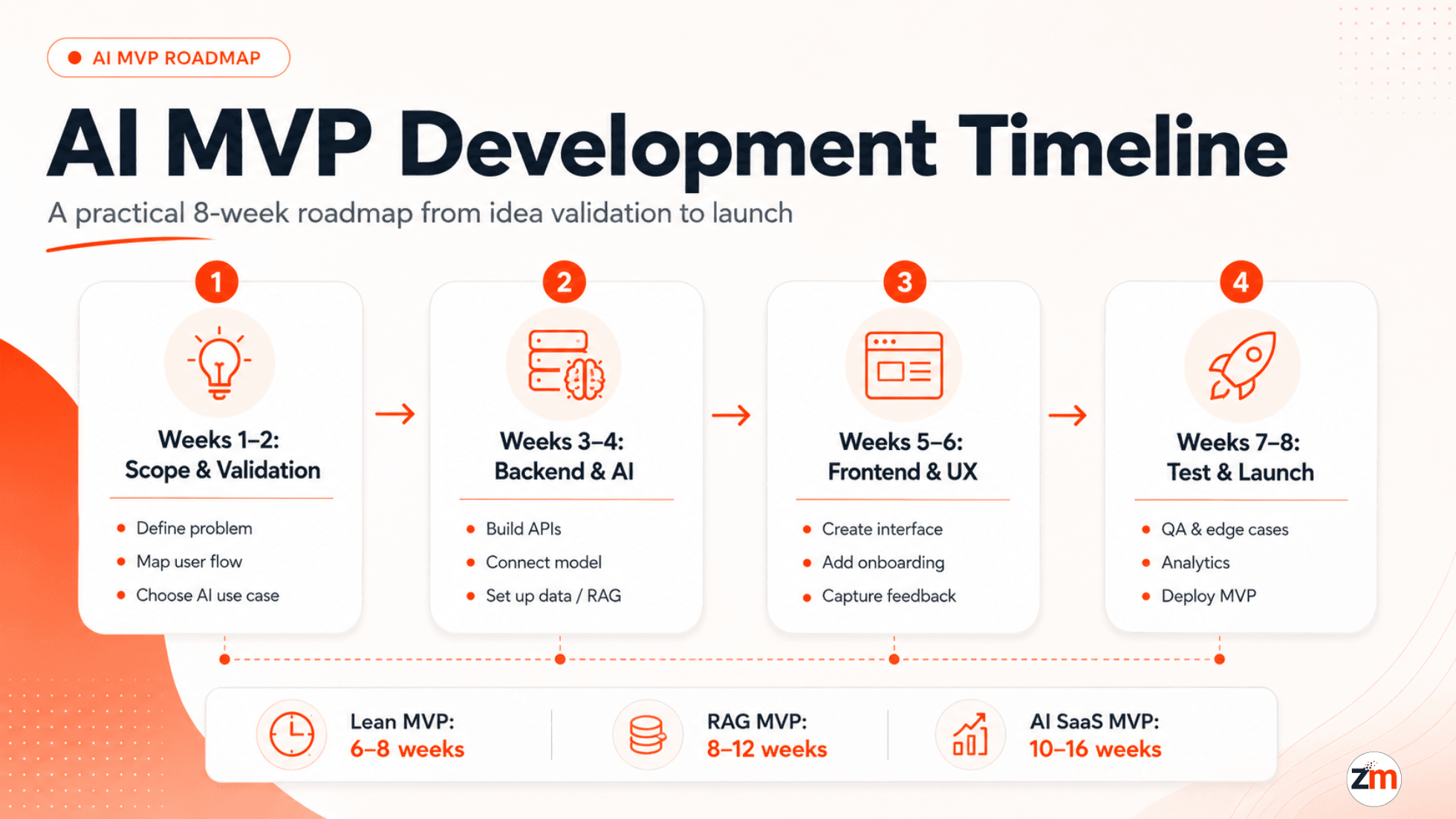
A properly run scoping phase for an AI SaaS MVP typically takes one to three weeks, depending on how many stakeholders need to be interviewed and how much existing process needs mapping. A full MVP build, once scope is locked, usually runs six to fourteen weeks depending on the complexity of the AI component and the number of integrations. Scoping is roughly 10-15% of the total project timeline but removes the majority of the risk that causes builds to run over.
What changes when the budget is in ZAR
South African founders scoping locally rather than through an offshore agency get a different cost structure, not just a different number. Local teams price in ZAR without the currency risk premium that offshore quotes often carry, and they scope with South African payment rails, hosting options, and compliance requirements already assumed rather than added as change requests later. It's worth reading the honest build vs buy decision for South African businesses before committing to either path, because the right call depends heavily on what you already have in-house.
Where AI tooling actually saves time and where it doesn't
AI coding tools speed up the build phase meaningfully: boilerplate, test scaffolding, first-draft integrations. They do almost nothing for scoping, because scoping is a set of decisions about tradeoffs, liability, and user behaviour that a model can't make for you. Teams that try to "AI-generate" a scoping document usually produce something that reads well and misses the actual constraints of their business. Scoping is still a human judgment exercise. Building is where the tooling pays off.
Scope creep in AI SaaS MVPs: why it happens and how to stop it
The five stakeholders protecting five different risks
Scope creep rarely comes from one person being unreasonable. It comes from five different people each protecting a different risk with a small addition: the founder protecting fundability ("investors will ask why we don't have X"), the salesperson protecting a specific deal ("this prospect needs Y to sign"), the engineer protecting code quality ("we should build this properly now"), the designer protecting the user experience ("this will feel incomplete without Z"), and the AI vendor protecting their own capability story ("our model can already do this"). None of them are wrong. All of them are expanding scope.
Why 'AI makes it easy to add' is the most dangerous sentence in scoping
Because a large language model can produce a plausible-looking feature in an afternoon, teams conflate "easy to prototype" with "cheap to ship." The prototype hides the real cost: testing edge cases, handling failure modes, writing the exclusion logic for when the AI shouldn't act, and maintaining it as the underlying model changes. "AI makes it easy" is true for demos and false for production. Treat it as a red flag in scoping conversations, not a green light.
How a written exclusion list holds the line
The exclusion list from the scoping phase is the tool that resolves these five competing pressures without a fight. When someone raises a valid addition mid-build, the answer isn't "no." It's "that's on the v2 list we agreed to, and it's still there." This turns scope discipline from a personality conflict into a reference to a shared document, which is a far easier conversation to have with a founder, a client, or your own team.
South African specifics that belong in the scoping phase
POPIA decisions you can't leave for later: data residency, consent, retention
Three POPIA decisions have to be made during scoping, not after launch: where the data physically sits (local hosting versus a foreign cloud region), what consent language the user sees before their data is processed by an AI model, and how long you retain personal information once it's no longer needed for the stated purpose. Retrofitting these after launch usually means rebuilding the data layer, not just updating a privacy policy. For a fuller breakdown, see what actually needs to be true for POPIA compliant automation.
Billing and payments: deciding on PayFast or Yoco before you scope the checkout flow
Whether you use PayFast or Yoco is not a detail to leave until the build. PayFast fits recurring SaaS billing with subscription management built in. Yoco fits card-present and once-off transactions. The choice determines how the checkout step in your core workflow gets built, so it has to be decided during scoping, not discovered mid-sprint. We cover the tradeoffs in detail in accepting payments through WhatsApp using PayFast or Yoco.
WhatsApp as the interface: what that changes about MVP scope
If WhatsApp is the primary interface, "complete workflow" means something different than it does for a dashboard product, because the customer never logs into anything. The entire user journey, from first message to payment confirmation, has to happen inside a chat thread with no visual layout to lean on. This changes what counts as MVP-complete: a WhatsApp-first product needs its conversation flow, fallback messages, and human handoff points scoped as carefully as a dashboard product scopes its screens.
How Sagentics runs MVP scoping
What we deliver before we quote a build
We run scoping as a standalone, priced engagement that produces the workflow definition, the AI decision boundary, the exclusion list, the data and payments decisions, and a cost and timeline range, before we quote anything. You can see the shape of this in how we scoped and built a profile intelligence platform and in our AdLynx case study, both of which started as separate scoping engagements, not free discovery calls.
Why we won't scope and quote in the same call
Scoping and quoting in the same conversation creates the exact conflict of interest this article opened with. We keep them separate because a scope written by someone who isn't also trying to win the build tends to be smaller, more honest, and easier to defend to a board or investor. It's the same reason we recommend founders read how to choose a real AI development partner in South Africa before signing with anyone, us included.
What a go or no-go memo actually contains
Every scoping engagement ends with a written memo: the recommended v1 scope, the exclusion list, the identified risks (technical, compliance, and market), a cost range in ZAR, and an honest recommendation on whether to proceed, adjust the scope, or hold. Sometimes the memo says wait. We'd rather tell a founder that in a scoping document than three months into a build. You can see how this plays out in practice in our social reporting platform case study, and get a fuller picture of our approach at Sagentics custom AI development, or read more on custom AI development in South Africa generally.
Common questions
What is MVP scoping for an AI SaaS product? It's the process of defining one complete user workflow, the specific decision the AI is allowed to make within it, and a written list of everything excluded from v1. It happens before any build contract is signed and produces a document, not just a conversation, that guides the actual development phase.
How much does AI SaaS MVP scoping cost? Scoping typically runs 10-15% of the total project budget, often a fixed fee agreed upfront rather than hourly billing. For a South African AI SaaS MVP, this usually falls in the tens of thousands of rand depending on the number of stakeholders interviewed and how much existing process needs mapping.
How long does MVP scoping take before a full build starts? One to three weeks for most AI SaaS products, depending on stakeholder availability and how well-defined the existing business process already is. Rushing this to a few days usually means the exclusion list and AI decision boundary get skipped, which is where most scope creep later comes from.
What's the difference between MVP scoping and MVP development? Scoping decides what gets built and what doesn't. Development builds it. Scoping produces a workflow definition, an AI decision boundary, and an exclusion list. Development turns that into working software. Skipping scoping doesn't save time, it just moves the scoping decisions into the build phase where they cost more to change.
Should the same team do scoping and the build? It can work, but only if scoping is priced and delivered as its own output before the build is quoted. If scoping and quoting happen in the same conversation, the incentive to inflate scope to win the deal undermines the whole exercise. A written scope you could hand to a different team is the real test of whether it was done properly.
What causes MVP scope creep in AI startups? Five stakeholders each protecting a different risk: the founder worried about fundability, sales worried about a specific deal, engineering wanting to build things properly, design wanting a complete feel, and AI vendors overselling model capability. None of them are being unreasonable individually. A written exclusion list is what stops their combined pressure from expanding the build.
Do you need AI in the MVP or can it wait? Not always. If the core value of your product can be proven with a rules-based workflow first, validate that before adding AI, since AI adds cost, latency, and failure modes that a simpler MVP doesn't need. AI belongs in v1 only when it's doing the one job that makes the product's value proposition true.
How much does an AI SaaS MVP cost to build in South Africa (ZAR)? Costs vary widely by scope, but a properly scoped MVP with one core AI-driven workflow typically ranges from R150,000 to R450,000 built locally, versus significantly more through offshore agencies once currency risk and miscommunication costs are factored in. Scoping first is what makes this range defensible rather than a guess.
What POPIA decisions need to be made during scoping, not after launch? Data residency (where data physically sits), consent language shown before AI processes personal information, and retention periods for data no longer needed. All three affect the data architecture, not just policy documents, so retrofitting them after launch usually means rebuilding parts of the system rather than editing a document.
How do you decide what the AI is allowed to do in v1? Pick one job: predict, generate, classify, or recommend. Decide where human review sits in the loop, since that's an architecture decision, not a later toggle. Then run the commoditisation test: if a generic AI chatbot could produce the same output, your real product is the workflow and data around the model, and that's what v1 should protect.
If you're weighing up whether to scope your AI SaaS idea properly before it turns into a bigger build than you planned, message us on WhatsApp and we'll talk through what that would actually look like for your product.
Common questions
What is MVP scoping for an AI SaaS product?
It's the process of defining one complete user workflow, the specific decision the AI is allowed to make within it, and a written list of everything excluded from v1. It happens before any build contract is signed and produces a document that guides the actual development phase.
How much does AI SaaS MVP scoping cost?
Scoping typically runs 10-15% of the total project budget, often a fixed fee agreed upfront. For a South African AI SaaS MVP, this usually falls in the tens of thousands of rand depending on the number of stakeholders interviewed and how much existing process needs mapping.
How long does MVP scoping take before a full build starts?
One to three weeks for most AI SaaS products, depending on stakeholder availability and how well-defined the existing business process already is. Rushing this usually means the exclusion list and AI decision boundary get skipped.
What's the difference between MVP scoping and MVP development?
Scoping decides what gets built and what doesn't. Development builds it. Scoping produces a workflow definition, an AI decision boundary, and an exclusion list. Development turns that into working software. Skipping scoping doesn't save time, it moves the decisions into the build phase where they cost more to change.
Should the same team do scoping and the build?
It can work, but only if scoping is priced and delivered as its own output before the build is quoted. If scoping and quoting happen in the same conversation, the incentive to inflate scope to win the deal undermines the exercise. A written scope you could hand to a different team is the real test.
What causes MVP scope creep in AI startups?
Five stakeholders each protecting a different risk: the founder worried about fundability, sales worried about a specific deal, engineering wanting to build properly, design wanting completeness, and AI vendors overselling capability. A written exclusion list stops their combined pressure from expanding the build.
Do you need AI in the MVP or can it wait?
Not always. If the core value can be proven with a rules-based workflow first, validate that before adding AI. AI belongs in v1 only when it's doing the one job that makes the product's value proposition true.
How much does an AI SaaS MVP cost to build in South Africa?
A properly scoped MVP with one core AI-driven workflow typically ranges from R150,000 to R450,000 built locally, versus significantly more through offshore agencies once currency risk and miscommunication costs are factored in. Scoping first is what makes this range defensible.
What POPIA decisions need to be made during scoping, not after launch?
Data residency (where data physically sits), consent language shown before AI processes personal information, and retention periods for data no longer needed. All three affect the data architecture, so retrofitting them after launch usually means rebuilding parts of the system.
How do you decide what the AI is allowed to do in v1?
Pick one job: predict, generate, classify, or recommend. Decide where human review sits in the loop. Run the commoditisation test: if a generic AI chatbot could produce the same output, your real product is the workflow and data around the model.
About Sagentics
Sagentics is an AI systems studio based in South Africa. We design and build WhatsApp automation, n8n workflows, and custom AI products for local and international clients. We write from systems we have actually shipped.
Start a WhatsApp conversation with SagenticsRelated reading
- Build vs buy AI software: the honest answer for South African businesses
- Building a custom AI product: what it actually takes, what it costs, and why most of the work isn't the AI
- How to choose a real AI development partner in South Africa
- Next.js + Supabase for SaaS: what it gets you and what it doesn't
- what a custom AI product actually costs and takes to build
- the honest build vs buy decision for South African businesses
- how to choose a real AI development partner in South Africa
- custom AI development in South Africa
- what actually needs to be true for POPIA compliant automation
- accepting payments through WhatsApp using PayFast or Yoco
- Sagentics custom AI development
- how we scoped and built a profile intelligence platform
- the AdLynx build case study
- the social reporting platform case study