

 Start a conversation
WhatsApp and conversational AI automation
Hybrid AI WhatsApp chatbots: what actually stays rule-based and what AI should touch
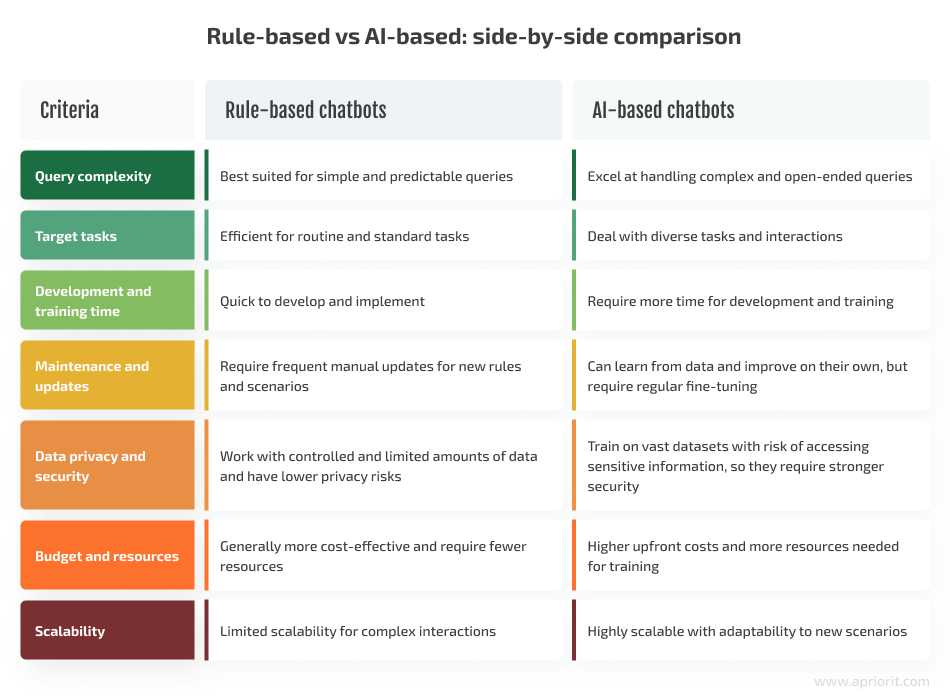
A hybrid WhatsApp chatbot uses deterministic, rule-based flows for anything that must never be wrong, things like payments, bookings, POPIA consent, and order status, and hands language understanding, ambiguous requests, and tone to an AI layer. Human handoff sits underneath both as the fallback when either layer hits its limit. That's the whole architecture. Everything else in this article is about where you draw that line, node by node, and why most vendors never explain it properly.
What a hybrid AI WhatsApp chatbot actually is
A hybrid bot is not "a chatbot with some AI sprinkled on top." It's a system where two different engines run side by side, each doing the job it's actually good at, with clear rules for when control passes from one to the other.
Deterministic flows vs AI agents: the real technical difference
A deterministic flow is a decision tree. Given input A, it always produces output B. No variation, no interpretation, no drift. This is what you want for "confirm this booking," "process this payment," or "record this consent." A large language model, by contrast, generates a probable next response based on patterns in training data. It's flexible and good at understanding messy human language, but it doesn't guarantee the same output twice. That's fine for chit-chat. It's not fine for a refund confirmation. If you want the deeper distinction between a scripted bot and something that can reason and act, read up on the actual difference between a chatbot and an agentic assistant.
Why 'hybrid' became the standard architecture, not a compromise
Two years ago, "hybrid" was a hedge, a way for vendors to avoid committing to pure AI or pure rules. Now it's the standard because both extremes failed in production. Pure AI bots hallucinated prices and confirmed bookings that didn't exist. Pure rule-based bots frustrated customers who typed anything slightly off-script. Hybrid isn't a compromise between two weaker options. It's the correct engineering answer once you've watched both extremes break in front of real customers.
Where human handoff fits into the stack
Human handoff is the third layer, not an afterthought. When the AI layer can't confidently classify intent, or when a deterministic flow hits a state it wasn't built for, the conversation needs to land on a real person's screen with full context, not a cold "someone will contact you" message. Getting this handoff right is its own discipline. We cover it in detail in how human handoff actually works on WhatsApp.
Why pure AI-only WhatsApp bots are risky for transactional use
Pure AI bots are risky wherever a wrong answer costs money, breaks a legal obligation, or damages trust in a way that's hard to walk back.
Hallucination risk on payments, bookings, and pricing
Language models generate plausible text, not verified facts. Ask a pure AI bot "is my order still coming today" and it might confidently invent a delivery time that doesn't exist in your system. Ask it to confirm a payment and it might tell a customer their transaction went through when it didn't. These aren't rare edge cases, they're a structural property of how the model works. Anywhere money or a confirmed commitment is involved, you want a deterministic node checking a real database, not a model guessing.
Cost per interaction: AI tokens vs deterministic nodes
Every message an AI model processes costs tokens, and tokens cost money. A deterministic flow node costs effectively nothing to execute. If your bot routes every single message, including "yes," "1," and "thanks," through an AI model, you're paying AI pricing for work a simple if/else statement could do for free. At scale, this difference shows up directly in your monthly bill. Scoping AI only to where it adds value isn't just safer, it's cheaper.
Auditability: why you need to know exactly what a customer will see
If a customer disputes a charge or complains to the Consumer Protection Act ombud, you need to know exactly what your bot said and why. A deterministic flow gives you that automatically, every path is documented. A pure AI conversation is harder to reconstruct with confidence because the same input can produce different phrasing each time. For anything you might need to defend later, deterministic and logged beats flexible and opaque.
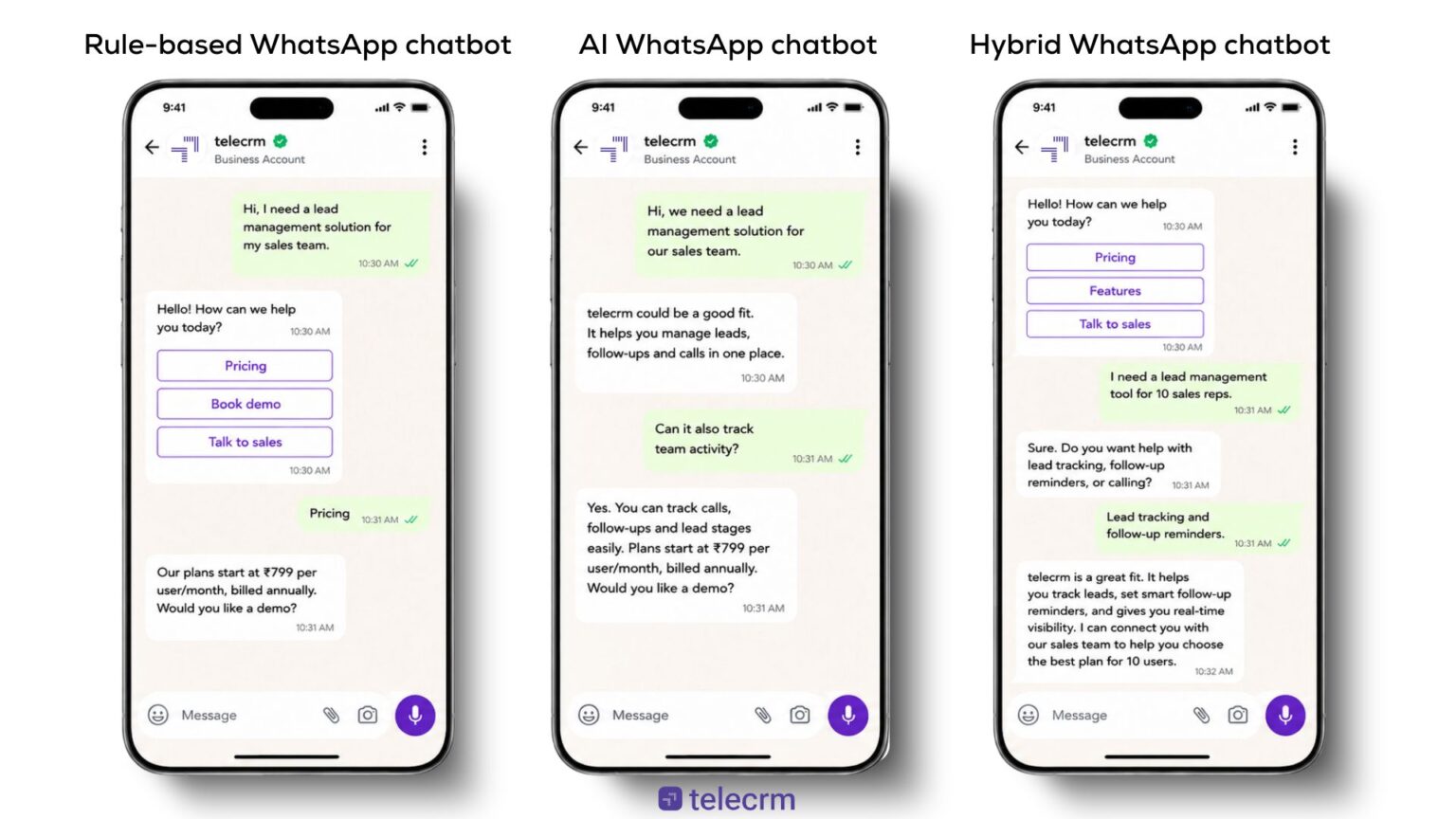
Why pure rule-based flows aren't enough either
The opposite failure is just as common. A flow-only bot that can't handle a slightly unusual phrasing pushes customers into a wall of "sorry, I didn't understand that" loops, and they leave.
Escalation rate as the signal you've outgrown a flow-only bot
If your team is manually taking over more than 15 to 20% of conversations, that's a signal your flow logic has hit its ceiling. Rule-based bots work well for the 80% of predictable requests, but the remaining fraction, people asking things sideways, combining two requests in one message, or using slang, breaks scripted logic every time. Watch your escalation rate. It tells you exactly when to add an AI layer rather than adding more branches to an already brittle tree.
What customers actually ask that breaks scripted logic
Real customer messages rarely match the neat phrasing a flow designer imagined. "Can I move my Tuesday thing to next week, also do you guys deliver on weekends?" is one message with two intents and a typo-adjacent turn of phrase. A rule-based bot built on keyword matching will misfire on this constantly. An AI layer trained to extract intent handles it in one pass, then hands the actual actions, rescheduling and checking delivery days, back to deterministic logic to execute correctly.
How to decide, node by node, what stays deterministic
This is the part most vendor content skips entirely. "Hybrid" gets used as a marketing checkbox, a word on a pitch deck with no actual decision framework behind it. The real engineering discipline is going through every node in your conversation flow and asking: if this step gets it wrong, what happens?
The Sagentics rule: never let AI touch money, consent, or confirmed bookings
Our rule is simple and we don't bend it: AI never directly executes a payment, never captures or overrides a POPIA consent decision, and never confirms a booking without a deterministic check against the real calendar or database. These are the nodes where "mostly right" isn't good enough, because the failure mode is a refund dispute, a compliance breach, or a double-booked appointment. We route these through hard-coded logic every time, with zero AI tokens involved in the actual execution step.
Where AI adds real value: tone, ambiguity, upsell, triage
On the other side, AI earns its place wherever getting it 90% right is genuinely fine. Understanding what a customer means when they phrase a question oddly. Softening tone for a frustrated customer. Suggesting a relevant upsell based on conversation context. Triaging an incoming message to the right flow. None of these carry the same downside if the model is occasionally imperfect, and all of them are things rule-based logic handles badly.
Mapping this to PayFast/Yoco payment triggers and POPIA consent gates
In practice, this means a customer can chat freely with the AI layer about pricing, availability, or general questions. The moment the conversation reaches a payment trigger, control passes to a deterministic flow that generates a real PayFast or Yoco payment link and waits for a verified webhook confirmation before saying anything is paid. Same with consent: the AI never phrases its own consent capture. A hard-coded checkpoint presents the exact required wording and logs the response. If you're building payment flows into WhatsApp, see our breakdown of accepting payments through WhatsApp using PayFast or Yoco. If bookings are your core use case, the same logic applies, and we've written specifically about WhatsApp appointment booking automation.

POPIA and hybrid WhatsApp bots in South Africa
Yes, a hybrid bot can be POPIA compliant, but compliance comes from where you put the deterministic gates, not from the AI model itself. POPIA doesn't care whether your bot is smart. It cares whether consent was properly captured, whether data is processed lawfully, and whether customers can access, correct, or delete their information on request.
Automated decision-making rules and why deterministic gates matter
Section 71 of POPIA restricts fully automated decisions that significantly affect a data subject unless specific conditions are met. If your bot is making a decision that meaningfully affects someone, such as approving credit, denying a booking, or flagging a fraud risk, that decision point needs to be deterministic, logged, and ideally reviewable by a human, not left to an AI model's probabilistic judgment call. This is exactly why we hard-code these gates rather than trusting an AI layer to handle them contextually. For the fuller compliance picture, read what actually needs to be true for POPIA compliance.
Transborder data flow considerations for AI layers hosted outside SA
Most AI models South African businesses use, OpenAI, Anthropic, Google, run on infrastructure outside South Africa. POPIA's Section 72 requires that transborder data transfers meet specific conditions, either the destination country has adequate protection, or you've got binding contractual safeguards, or the customer has consented to the transfer. This means your consent flow needs to explicitly cover what happens to a message once it's sent to an AI provider, not just what happens to the customer's contact details.
What this costs in South Africa and how to build it without a rebuild
You don't need to build a hybrid system all at once, and you don't need to throw away an existing rule-based bot to add AI later.
Starting with deterministic flows, adding AI later at friction points
The most cost-effective build order is deterministic first, AI second. Get your booking, payment, and order-status flows working reliably as pure rule-based logic. Then watch where customers actually get stuck, where escalation rates spike, where the same "I didn't understand" message keeps firing. Those friction points tell you exactly where to insert an AI layer, and it can usually be added on top of an existing flow via a routing node, not a rebuild from scratch.
Rough cost ranges in ZAR for hybrid setups
A solid deterministic-only WhatsApp flow for a single SME use case, bookings or basic FAQ, typically runs in the R15,000 to R35,000 setup range in South Africa, depending on integration complexity. Adding a genuine AI layer with proper scoping, testing, and handoff logic usually adds R20,000 to R60,000 depending on how many conversation types it needs to cover, plus ongoing token costs that scale with volume. For a fuller breakdown across different automation types, see what WhatsApp automation really costs in ZAR, and if you're specifically pricing an AI-driven support layer, what an AI customer service agent costs in South Africa covers that in more detail. To understand whether the spend is worth it for your volume, the real ROI formula for a WhatsApp support agent walks through the maths.
How Sagentics builds hybrid WhatsApp systems
We build the decision tree before we build the bot. Every conversation flow gets mapped node by node, and each node gets one label: deterministic or AI-scoped. Money, consent, and confirmed commitments go deterministic. Everything conversational goes to the AI layer, scoped tightly enough that it can't wander into territory it shouldn't touch.
Examples from real deployments
For an e-commerce client, we built order tracking and payment confirmation as fully deterministic flows tied directly to their store's webhook events, while product questions and sizing queries ran through an AI layer trained on their catalogue. See how this played out in the MerchLab case study, where the split between rigid transactional logic and flexible conversational AI directly reduced manual support load without introducing payment errors.
What to ask a vendor before you sign
Before you brief anyone, ask them directly: which parts of my flow touch money, and how are those handled. Ask what happens when the AI is uncertain. Ask to see the escalation logic, not just hear about it. If a vendor can't show you, node by node, what's deterministic and what's AI-scoped, they're selling you a marketing checkbox, not an architecture.
Common questions
What is a hybrid AI WhatsApp chatbot and how is it different from a rule-based bot or a pure AI agent? A hybrid bot combines deterministic, rule-based flows for critical actions like payments and bookings with an AI layer for language understanding and tone. A pure rule-based bot only follows scripted paths and breaks on unexpected phrasing. A pure AI agent handles language flexibly but can hallucinate on facts, prices, or confirmations, which makes it risky for transactional steps.
Is a WhatsApp AI agent the same as a chatbot? Not quite. A chatbot typically follows predefined flows or responds to matched intents. An AI agent can reason, hold context across a conversation, and take multi-step actions. Many hybrid systems use agent-like AI for understanding and triage, then execute the actual transaction through simpler chatbot-style deterministic logic underneath.
Can you upgrade an existing rule-based chatbot to include AI later, or does it need a rebuild? You can usually add AI on top of existing flows without a full rebuild. The AI layer gets inserted as a routing or interpretation step at the points where customers currently get stuck, while your existing deterministic logic for bookings, payments, and confirmations stays untouched underneath it.
What signals indicate you need to move beyond a basic rule-based chatbot? Watch your escalation rate to human agents. If more than 15 to 20% of conversations need manual takeover, or you see repeated "I didn't understand" loops on similar phrasing, that's a sign your flow logic has hit its ceiling and an AI understanding layer would reduce the drop-off.
Is my WhatsApp chatbot POPIA compliant if it uses AI? It can be, but compliance depends on where you place deterministic gates, not on the AI itself. Consent capture, automated decisions that significantly affect a customer, and data sent to AI providers outside South Africa all need explicit handling under Sections 71 and 72 of POPIA, regardless of how the conversational layer works.
Does load shedding affect a hybrid WhatsApp chatbot's uptime? WhatsApp Business API messages route through cloud infrastructure, so a well-hosted bot on reputable servers with backup power and redundancy stays up during local outages. The risk is on your side: if your business's own systems, like an on-premise booking calendar, go down during load shedding, that dependency can affect the flow even if the bot itself is live.
How much does hybrid WhatsApp automation cost in South Africa? A deterministic-only flow typically costs R15,000 to R35,000 to set up. Adding a properly scoped AI layer adds roughly R20,000 to R60,000 depending on conversation coverage, plus ongoing token costs tied to message volume. Final pricing depends on integration complexity with your payment and booking systems.
Which parts of a customer conversation should never be handled by AI alone? Payments, booking confirmations, POPIA consent capture, and order status changes should never run through AI alone. These are the points where a wrong or hallucinated answer creates a refund dispute, a compliance breach, or a broken commitment. They belong on deterministic rails checked against real data every time.
Did WhatsApp actually ban open-ended AI chatbots, and does that affect hybrid architectures? WhatsApp has tightened policies around unstructured, open-ended AI conversations outside approved use cases, particularly for marketing messages. This doesn't affect hybrid architectures, since the deterministic flows keep conversations structured and template-compliant, while AI is scoped to specific, bounded conversational tasks rather than open-ended chat.
If you're weighing this up for your own business, message Sagentics on WhatsApp and we'll walk through your flow with you, no pitch, just the node-by-node breakdown.
Common questions
What is a hybrid AI WhatsApp chatbot and how is it different from a rule-based bot or a pure AI agent?
A hybrid bot combines deterministic, rule-based flows for critical actions like payments and bookings with an AI layer for language understanding and tone. A pure rule-based bot only follows scripted paths and breaks on unexpected phrasing. A pure AI agent handles language flexibly but can hallucinate on facts, prices, or confirmations, which makes it risky for transactional steps.
Is a WhatsApp AI agent the same as a chatbot?
Not quite. A chatbot typically follows predefined flows or responds to matched intents. An AI agent can reason, hold context across a conversation, and take multi-step actions. Many hybrid systems use agent-like AI for understanding and triage, then execute the actual transaction through simpler chatbot-style deterministic logic underneath.
Can you upgrade an existing rule-based chatbot to include AI later, or does it need a rebuild?
You can usually add AI on top of existing flows without a full rebuild. The AI layer gets inserted as a routing or interpretation step at the points where customers currently get stuck, while your existing deterministic logic for bookings, payments, and confirmations stays untouched underneath it.
What signals indicate you need to move beyond a basic rule-based chatbot?
Watch your escalation rate to human agents. If more than 15 to 20% of conversations need manual takeover, or you see repeated "I didn't understand" loops on similar phrasing, that's a sign your flow logic has hit its ceiling and an AI understanding layer would reduce the drop-off.
Is my WhatsApp chatbot POPIA compliant if it uses AI?
It can be, but compliance depends on where you place deterministic gates, not on the AI itself. Consent capture, automated decisions that significantly affect a customer, and data sent to AI providers outside South Africa all need explicit handling under Sections 71 and 72 of POPIA, regardless of how the conversational layer works.
Does load shedding affect a hybrid WhatsApp chatbot's uptime?
WhatsApp Business API messages route through cloud infrastructure, so a well-hosted bot on reputable servers with backup power and redundancy stays up during local outages. The risk is on your side: if your business's own systems, like an on-premise booking calendar, go down during load shedding, that dependency can affect the flow even if the bot itself is live.
How much does hybrid WhatsApp automation cost in South Africa?
A deterministic-only flow typically costs R15,000 to R35,000 to set up. Adding a properly scoped AI layer adds roughly R20,000 to R60,000 depending on conversation coverage, plus ongoing token costs tied to message volume. Final pricing depends on integration complexity with your payment and booking systems.
Which parts of a customer conversation should never be handled by AI alone?
Payments, booking confirmations, POPIA consent capture, and order status changes should never run through AI alone. These are the points where a wrong or hallucinated answer creates a refund dispute, a compliance breach, or a broken commitment. They belong on deterministic rails checked against real data every time.
Did WhatsApp actually ban open-ended AI chatbots, and does that affect hybrid architectures?
WhatsApp has tightened policies around unstructured, open-ended AI conversations outside approved use cases, particularly for marketing messages. This doesn't affect hybrid architectures, since the deterministic flows keep conversations structured and template-compliant, while AI is scoped to specific, bounded conversational tasks rather than open-ended chat.
About Sagentics
Sagentics is an AI systems studio based in South Africa. We design and build WhatsApp automation, n8n workflows, and custom AI products for local and international clients. We write from systems we have actually shipped.
Start a WhatsApp conversation with SagenticsRelated reading
- WhatsApp automation in South Africa: what it costs and whether you need it
- WhatsApp Business API vs the app: which one your business actually needs
- AI customer service agent on WhatsApp: what it is, how it works, and what it costs in South Africa
- How to accept payments through WhatsApp in South Africa using PayFast or Yoco
- how human handoff actually works on WhatsApp
- what actually needs to be true for POPIA compliance
- accepting payments through WhatsApp using PayFast or Yoco
- WhatsApp appointment booking automation
- the actual difference between a chatbot and an agentic assistant
- what an AI customer service agent costs in South Africa
- what WhatsApp automation really costs in ZAR
- the real ROI formula for a WhatsApp support agent
- Sagentics' AI automation work
- MerchLab case study