

 Start a conversation
Custom AI product and SaaS development
AI candidate assessment in executive search: what actually works in South Africa
AI candidate assessment works for executive search when it stays in its lane: sourcing, screening, and data enrichment. The final fit and hiring decision has to stay with a human. This isn't a preference or a nice-to-have. POPIA Section 71 makes fully automated shortlisting for a role a legal liability, not just a bad hiring practice, and any tool that skips this is exposing your business, not saving it time.
We know this because we've built one of these systems for a real South African client. The hard part was never getting the AI to score candidates well. The hard part was structuring the workflow so a human reviews every advance and every rejection before it happens. That's what the law requires, and it's what most off-the-shelf ATS AI tools quietly skip.
What AI actually does in executive search right now
AI in executive search is doing real work, but it's not doing what most vendors imply it's doing. It's not replacing the recruiter's judgment. It's replacing the recruiter's admin.
Sourcing and market mapping for passive senior candidates
The biggest genuine win is at the top of the funnel. AI tools can scan LinkedIn, company registers, and industry databases to map who holds similar roles across a sector, including passive candidates who aren't job hunting. For executive search, where the best candidates are almost never active applicants, this is where AI earns its keep. It compresses weeks of manual market mapping into hours.
Screening and dossier building, not final scoring
Once candidates are identified, AI can build structured dossiers: career history, public track record, tenure patterns, qualification verification. What it shouldn't do is produce a single "fit score" that a human then rubber-stamps. Dossier building is data assembly. Final scoring is a judgment call, and at executive level that judgment call has legal weight under POPIA.
Where the 26 to 75 percent time savings actually comes from
The wide range of reported time savings in executive search (anywhere from 26 to 75 percent, depending on the study) isn't from AI making better decisions. It's from AI removing manual research, duplicate data entry, and calendar chasing. Firms that report the highest savings have automated the process around the decision, not the decision itself.
Where human judgment can't be automated out
Cultural fit and leadership assessment at the final stage
No AI model can currently assess how a CFO candidate will handle a hostile board, or whether a COO will build trust with a factory floor team in Gqeberha versus a fintech team in Sandton. These are contextual, relational judgments built on interviews, reference calls, and reading a room. That work stays human, full stop.
Why retained search firms are growing, not shrinking, because of AI noise
CounterIntuitively, AI has made retained executive search firms more valuable, not less. As AI-generated applications and AI-optimised CVs flood the market, the signal-to-noise ratio at senior level has collapsed. Retained search firms that can vouch for a shortlist with actual human vetting are now selling trust as the product, not just access.
The hiring-complexity argument: AI has made executive search noisier
Recruiter commentary suggests AI hasn't simplified hiring, it's amplified the mess. Candidates use AI to generate polished, template-perfect applications that say nothing real about them. Recruiters then need more human effort, not less, to find the signal underneath. Treat any pitch that says "AI will make executive hiring effortless" with real scepticism.
The POPIA problem nobody's US or UK content covers
Most content on AI hiring tools is written for US or UK markets, where the legal framework is different. South African HR leaders need to know this part specifically, because it changes what's legally allowed here.
Section 71 and the ban on solely automated decisions
POPIA Section 71 restricts decisions based "solely on the basis of automated processing" of personal information, where that decision has legal or similarly significant effects on the person and is intended to profile them. Rejecting or advancing a candidate for a specific role, without meaningful human review, fits this description directly. A pure AI shortlist, with no human check before candidates are told yes or no, is not compliant. This is the single most important fact in this whole conversation, and it's the one most AI hiring vendors don't mention because their product depends on you not knowing it.
How POPIA, the EEA, and the LRA all apply to one AI screening deployment
It doesn't stop at POPIA. The Employment Equity Act requires you to justify any selection criteria that could produce discriminatory outcomes, including criteria baked into an AI model's training data. The Labour Relations Act governs how you can use screening outcomes in disciplinary or dismissal-adjacent contexts (relevant if you're screening internal candidates for promotion). One AI screening tool deployment can trigger obligations under all three acts simultaneously, and most procurement decisions for HR tech only check one of them, if any.
Voice and video interview data as special personal information
If your AI screening tool records voice or video interviews, you're processing biometric data, which POPIA treats with additional care given its sensitivity. You need explicit consent, a clear retention policy, and a documented lawful basis for processing, not just a checkbox in a terms-of-service link nobody reads. The same principles apply directly to hiring workflows as they do to other automation.
Penalties: up to R10 million and what triggers them
POPIA non-compliance carries penalties up to R10 million, or imprisonment for up to 10 years for serious contraventions. What triggers enforcement in practice is usually a complaint, most often from a rejected candidate who asks how the decision was made and gets no clear answer. If you can't explain, in writing, who reviewed a candidate's rejection and why, you have a real exposure, not a theoretical one.
The accent bias risk specific to South African hiring
Why AI voice screening tools can penalise regional accents
South Africa has eleven official languages and a huge range of English accents shaped by home language, region, and schooling. AI voice screening tools trained predominantly on American or British English audio data can systematically score candidates with strong regional accents lower on clarity or "communication" metrics, not because the candidate communicated poorly, but because the model wasn't trained to understand them properly. This is a live risk, not a hypothetical one, in any tool that scores spoken responses.
Research on AI hiring bias in non-native speakers
Research on AI hiring tools has found consistent patterns of bias against non-native English speakers and candidates with accents outside the training data's dominant patterns, in both resume screening and voice assessment tools. None of these studies were conducted with South African accents specifically, which is exactly the problem: nobody has validated these tools for our market, so assuming they're neutral here is a guess, not a fact.
How to build a defensible, audited screening process
The fix isn't avoiding AI voice tools entirely. It's building an audit trail: log what the AI scored, log what a human reviewer changed and why, and periodically test the tool against a diverse sample of your actual candidate pool to check for skewed outcomes. This is the difference between a defensible process and a lawsuit waiting to happen.
The real cost of getting executive hiring wrong
R2.4 million: the ZAR cost of a bad senior hire
Estimates for the cost of a bad senior hire in South Africa run to around R2.4 million once you account for recruitment fees, onboarding, lost productivity, severance, and the opportunity cost of the role sitting wrong for months. That number should reframe how you think about AI in this process. The goal isn't shaving two weeks off time-to-shortlist. It's not making the R2.4 million mistake.
Why speed at the top of funnel doesn't offset a bad final decision
A faster shortlist that includes the wrong final hire is a worse outcome than a slower shortlist that gets it right. Any AI tool sold on speed alone, without addressing accuracy and legal defensibility at the final decision point, is optimising for the wrong metric. Speed at sourcing is a genuine win. Speed at the decision is where the real cost lives.
Where WhatsApp fits into candidate assessment in South Africa
Why WhatsApp is already the default candidate communication channel here
South African candidates, at every seniority level, respond to WhatsApp faster and more consistently than email. For executive search specifically, using WhatsApp Business API for scheduling, document collection, and structured intake questions removes friction without removing rigour, provided the workflow is built properly. This isn't a shortcut. It's using the channel candidates actually check.
Structured intake and screening via WhatsApp before human review
A well-built WhatsApp intake flow can collect structured information (availability, salary expectations, notice period, verification documents) and even run voice note responses through transcription and initial categorisation before a human recruiter ever looks at the file. This pre-assembly speeds up the human review without replacing it.
Human-in-the-loop handoff for shortlisting decisions
The critical design decision is where the handoff happens. AI can pre-sort, flag, and summarise. It cannot be the last step before a candidate hears yes or no. Every workflow built for this use case has a mandatory human checkpoint before any candidate status changes, logged and timestamped, which is what makes it defensible under POPIA rather than just fast.
Build vs buy for AI-assisted executive assessment tools
Off-the-shelf ATS AI vs a custom POPIA-compliant workflow
Most off-the-shelf ATS platforms bolt AI scoring onto their existing pipeline as a premium feature, built for US or UK compliance regimes, with no consideration for POPIA Section 71 or the EEA. They're not built badly, they're built for a different legal context. If you deploy one in South Africa without modifying the decision workflow, you inherit compliance gaps you didn't create and can't easily see.
What was built for a real executive assessment client
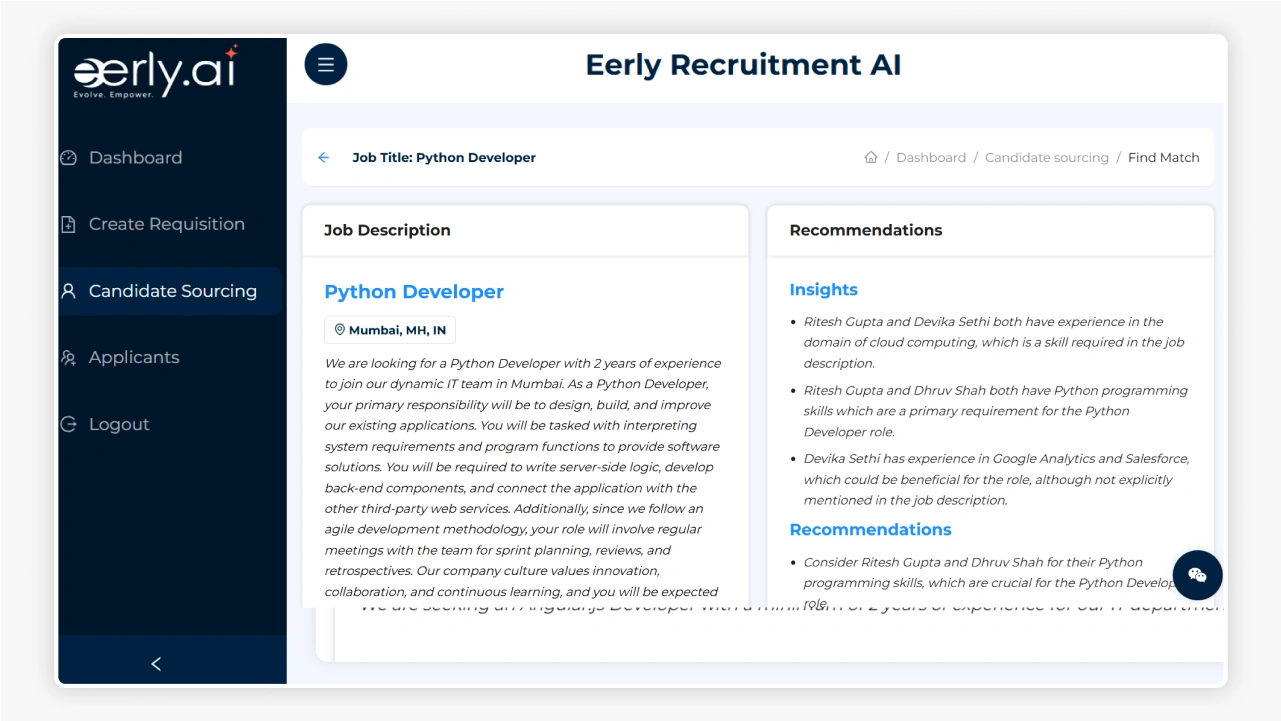
For one South African client, a custom AI-assisted candidate assessment workflow was built where AI handled sourcing, dossier assembly, and structured screening, and every advance or rejection required human sign-off with a logged reason. The system didn't remove recruiters from the process, it removed the parts of the process that shouldn't have needed them in the first place.
Common questions
Can AI legally make the final hiring decision in South Africa under POPIA? No. POPIA Section 71 restricts decisions based solely on automated processing where the decision has legal or similarly significant effects on a person, which a hiring decision clearly does. A human must meaningfully review and be able to override any AI-generated outcome before a candidate is advanced or rejected.
Does AI candidate screening discriminate against South African accents or languages? It can. AI voice screening tools trained mostly on American or British English data have shown bias against non-native speakers and regional accents. No major tool has been validated specifically for South African accents, so assume the risk exists until you've audited the tool against your own candidate pool.
Can AI improve efficiency without compromising quality at executive level? Yes, if it's confined to sourcing, market mapping, and dossier building rather than final scoring. Firms report time savings of 26 to 75 percent from automating admin and research, not from automating judgment. Quality holds up when a human still makes the final call on fit and culture.
What's the difference between AI screening tools and traditional retained executive search? AI screening tools automate data gathering and initial filtering. Retained executive search adds human vetting, reference checking, and relationship-based judgment that AI can't replicate, which is why demand for retained search is growing even as AI floods the market with noisy, template-generated applications.
How long does an AI-assisted executive search take compared to a traditional one? Sourcing and initial screening can compress from weeks to days with AI handling market mapping and dossier assembly. The final stages (interviews, reference checks, human review) take the same time they always have, because that judgment work can't be sped up without losing accuracy.
What penalties apply under POPIA for non-compliant AI hiring tools? Penalties can reach R10 million or imprisonment up to 10 years for serious contraventions. Enforcement is typically triggered by a complaint from a rejected candidate asking how the decision was made. If you can't produce a documented human review for that decision, you're exposed.
Is AI-based candidate screening legal in South Africa? Yes, for sourcing, enrichment, and initial screening, as long as the final hiring decision involves meaningful human review. What's not legal is using AI to make or effectively determine the outcome without a human genuinely able to change it. The distinction is in the workflow design, not the AI model itself.
How do you keep human oversight central when using AI for executive assessment? Build a mandatory checkpoint before any status change: every AI-flagged advance or rejection needs a logged human decision with a reason. Audit the AI's outputs periodically against a diverse candidate sample. This turns "we used AI" into a defensible, documented process rather than a liability.
If you're weighing AI for candidate assessment or any other part of hiring, and want to know what a compliant version actually looks like in practice, message Sagentics on WhatsApp. We'll talk through what we've built and whether it fits your situation.
Common questions
Can AI legally make the final hiring decision in South Africa under POPIA?
No. POPIA Section 71 restricts decisions based solely on automated processing where the decision has legal or similarly significant effects on a person, which a hiring decision clearly does. A human must meaningfully review and be able to override any AI-generated outcome before a candidate is advanced or rejected.
Does AI candidate screening discriminate against South African accents or languages?
It can. AI voice screening tools trained mostly on American or British English data have shown bias against non-native speakers and regional accents. No major tool has been validated specifically for South African accents, so assume the risk exists until you've audited the tool against your own candidate pool.
Can AI improve efficiency without compromising quality at executive level?
Yes, if it's confined to sourcing, market mapping, and dossier building rather than final scoring. Firms report time savings of 26 to 75 percent from automating admin and research, not from automating judgment. Quality holds up when a human still makes the final call on fit and culture.
What's the difference between AI screening tools and traditional retained executive search?
AI screening tools automate data gathering and initial filtering. Retained executive search adds human vetting, reference checking, and relationship-based judgment that AI can't replicate, which is why demand for retained search is growing even as AI floods the market with noisy, template-generated applications.
How long does an AI-assisted executive search take compared to a traditional one?
Sourcing and initial screening can compress from weeks to days with AI handling market mapping and dossier assembly. The final stages (interviews, reference checks, human review) take the same time they always have, because that judgment work can't be sped up without losing accuracy.
What penalties apply under POPIA for non-compliant AI hiring tools?
Penalties can reach R10 million or imprisonment up to 10 years for serious contraventions. Enforcement is typically triggered by a complaint from a rejected candidate asking how the decision was made. If you can't produce a documented human review for that decision, you're exposed.
Is AI-based candidate screening legal in South Africa?
Yes, for sourcing, enrichment, and initial screening, as long as the final hiring decision involves meaningful human review. What's not legal is using AI to make or effectively determine the outcome without a human genuinely able to change it. The distinction is in the workflow design, not the AI model itself.
How do you keep human oversight central when using AI for executive assessment?
Build a mandatory checkpoint before any status change: every AI-flagged advance or rejection needs a logged human decision with a reason. Audit the AI's outputs periodically against a diverse candidate sample. This turns 'we used AI' into a defensible, documented process rather than a liability.
About Sagentics
Sagentics is an AI systems studio based in South Africa. We design and build WhatsApp automation, n8n workflows, and custom AI products for local and international clients. We write from systems we have actually shipped.
Start a WhatsApp conversation with SagenticsRelated reading
- Build vs buy AI software: the honest answer for South African businesses
- Building a custom AI product: what it actually takes, what it costs, and why most of the work isn't the AI
- How to choose a real AI development partner in South Africa
- MVP scoping for AI SaaS: how to define the build before you pay for it
- how we built an AI-assisted executive candidate assessment system
- what actually needs to be true for POPIA-compliant automation
- how human-in-the-loop review works in production AI
- AI voice agent vs WhatsApp text agent
- how WhatsApp voice note automation actually works
- the honest build vs buy decision for AI software
- what custom AI development actually costs in South Africa
- how to choose a real AI development partner
- our profile intelligence platform case study
- Sagentics' AI automation work in South Africa