

 Start a conversation
WhatsApp and conversational AI automation
AI voice agent vs WhatsApp text agent: which one your business actually needs
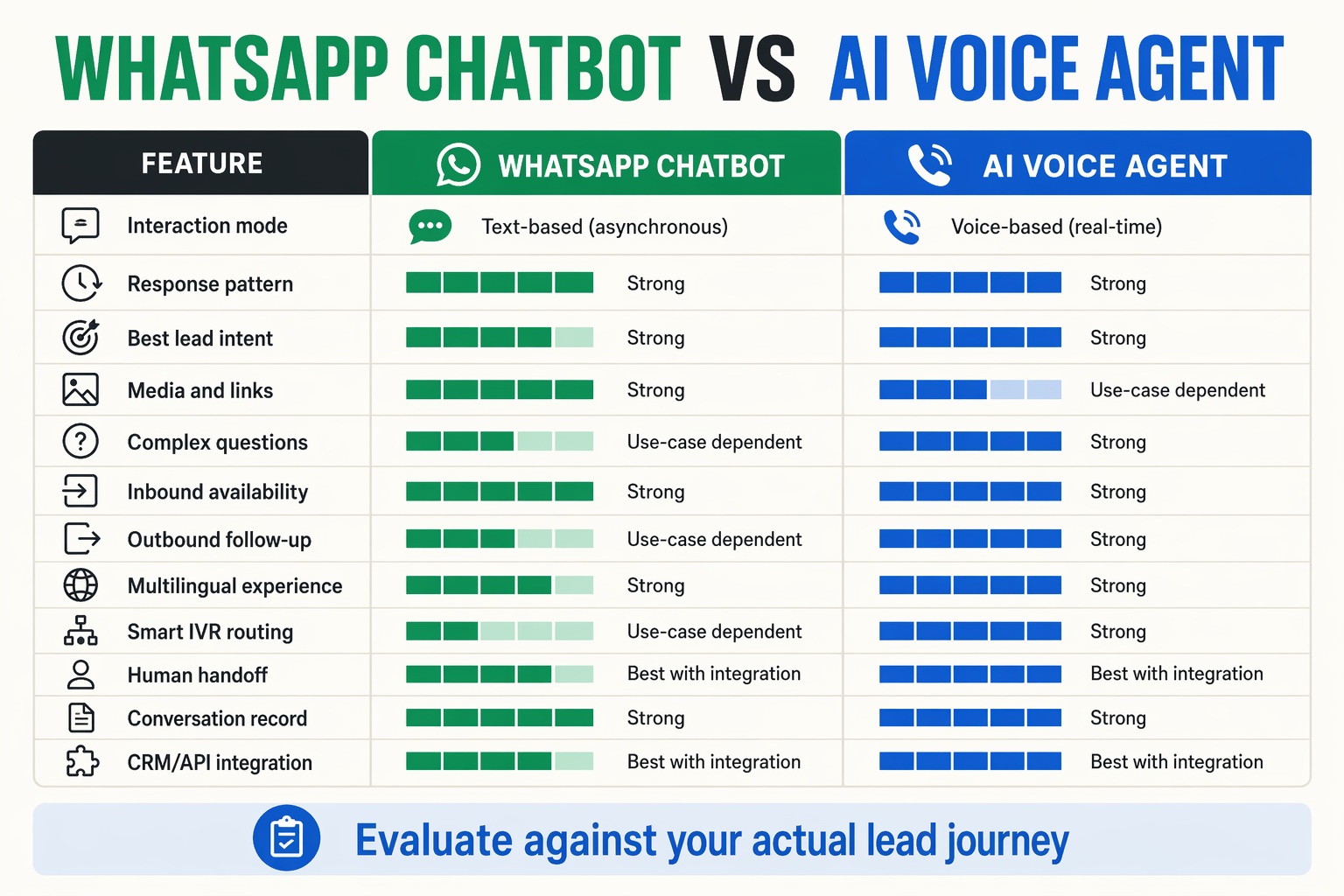
Choose a WhatsApp text agent for async, high-volume, list-heavy interactions and an AI voice agent for urgent, linear, telephonic ones. Most South African SMEs should build the WhatsApp agent first and add voice only where phone calls are already happening and costing money. That's not a hedge, it's a build order backed by cost, connectivity, and how South Africans actually use their phones.
This article breaks down the real decision factors, gives ZAR cost bands, and explains a technical reason most vendor content skips: load shedding damages voice calls in ways it doesn't damage WhatsApp.
What an AI voice agent and a WhatsApp text agent actually do
These are two different technology stacks solving two different problems. Confusing them leads to the wrong build.
AI voice agent: telephony, speech-to-text, and real-time conversation
A voice agent sits on a phone line. It converts incoming speech to text in real time, runs that text through a language model to work out intent, generates a reply, and converts that reply back to speech, all within a second or two so the call doesn't feel broken. This requires telephony infrastructure (a number, call routing), a speech-to-text engine, an LLM for reasoning, and a text-to-speech engine. Every one of those steps can introduce latency or drop a call if the connection wavers mid-sentence.
WhatsApp text agent: WhatsApp Business API, NLU, and async messaging
A WhatsApp agent runs on the WhatsApp Business API. A customer sends a message, it gets processed by natural language understanding, matched against intents or routed through a flow, and a reply gets sent back. There's no real-time pressure. If the customer's data drops for ten seconds, the message queues and delivers the moment they reconnect. This is a fundamentally more forgiving architecture, and it's the reason we cover what WhatsApp automation actually costs in South Africa as a starting point for most builds.
Why "chatbot vs AI agent" is a different question than "voice vs text"
People often conflate two separate decisions. One is channel: voice or text. The other is capability: rule-based chatbot or AI agent that understands context and can reason across a conversation. You can have a dumb voice IVR or a smart voice agent. You can have a rigid WhatsApp chatbot or a genuinely conversational WhatsApp AI agent. Don't let vendors sell you on "AI" without asking which axis they're actually improving.
The five factors that actually decide which one you need
Skip the hype and run your situation through these five filters.
Urgency: does this need to happen right now or can it wait
If a customer needs an answer in the next ten seconds because their car broke down or their payment failed mid-checkout, voice (or at least a fast text reply) matters. If they're checking an order status or booking a slot for next Tuesday, async text is fine and usually preferred, because it doesn't interrupt their day.
Complexity: lists, codes, and menus vs short linear flows
WhatsApp is built for anything involving lists, buttons, order numbers, product catalogues, or menus. Reading out a 12-item menu over a phone call is painful for everyone. Voice works best for short, linear conversations: confirm an appointment, take a simple message, triage an emergency call.
Channel habits: where your customers already are
If your customers are already messaging you on WhatsApp for quotes, support, or bookings, meet them there. If they're calling your landline because that's the habit in your industry (medical, insurance, logistics), voice has a stronger case. Don't force a channel switch that fights existing behaviour.
Volume and cost per interaction
High volume, low complexity interactions (FAQs, status checks, reminders) are cheap to automate on WhatsApp and get cheaper per message as volume scales. Voice infrastructure costs more per minute regardless of volume, so it only pays off when call volume is already high enough to justify replacing human agent hours.
Compliance and consent burden
Voice calls that get recorded trigger a POPIA disclosure requirement at the start of every call. WhatsApp opt-in is a one-time consent event, generally cleaner to manage and log. More on this below.
Cost comparison in ZAR: voice agent vs WhatsApp agent
Numbers matter more than adjectives here.
Typical monthly pricing bands for SA businesses
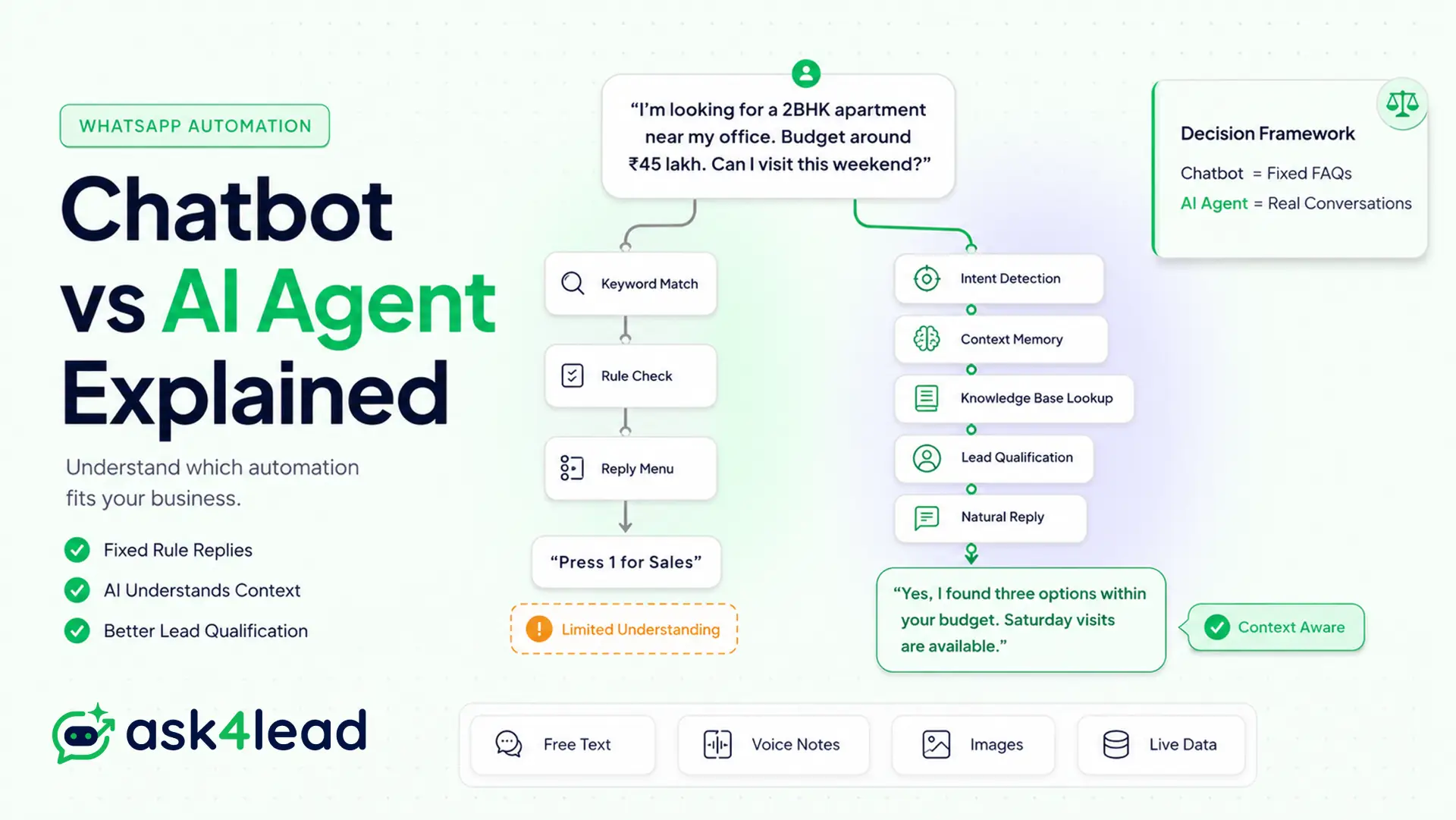
A WhatsApp text agent for a small business, handling FAQs, order status, and basic bookings, typically runs in the R2,500 to R8,000 per month band once built, covering API costs, hosting, and light maintenance. A voice agent handling similar volume, because of telephony minutes, speech-to-text/text-to-speech processing, and higher infrastructure overhead, usually starts at R8,000 to R20,000 or more per month depending on call volume and complexity. Build cost for voice is also higher upfront due to the extra integration layers.
Cost per interaction: what changes when you go voice
A WhatsApp message interaction typically costs a few cents to low rands depending on conversation category and volume tier. A voice interaction is billed by the minute across telephony and STT/TTS processing, so a three-minute call can cost several rand even before you count the human agent hours you're trying to replace. Voice only gets cost-efficient at volume, and even then the margin is tighter than text.
Payback period example using local support call volumes
Take a business fielding 500 support calls a month at an average of 3 minutes each, currently handled by two staff members. Automating even 60% of those calls with voice AI can free up meaningful agent hours, but the voice build and monthly running cost need to be weighed against what a WhatsApp agent could intercept first, since many of those calls (order status, business hours, simple queries) don't need a phone call at all. Businesses that route those queries to WhatsApp first often find call volume drops enough that a voice agent becomes optional rather than essential.
South Africa specific factors nobody else is analysing properly
This is where most SA vendor content repeats the same two lines, POPIA-ready and works during load shedding, without ever explaining why they matter. Here's the actual engineering behind it.
Load shedding and connectivity: why text tolerates outages better than voice
A voice call requires a continuous, stable data stream across the entire duration. When load shedding knocks out a cell tower's backup power or network congestion spikes during a rolling blackout window, the carrier connection degrades and the real-time audio stream breaks. The call drops with no recovery mechanism; the caller hears nothing and has to redial. WhatsApp uses a different protocol optimized for sparse, intermittent connectivity. Messages are written to a local queue on the sending device and transmitted when bandwidth is available, even on degraded 3G or with gaps between sends. A customer on patchy network during stage 5 can send a WhatsApp message that queues locally and arrives complete five minutes later intact, whereas the same customer loses a voice call in seconds. This isn't a marketing checkbox. It's a structural difference in how the two protocols handle unreliable networks, and it matters significantly in a country where load shedding makes network reliability inconsistent by design.
WhatsApp's dominance as the default channel for SA smartphone users
WhatsApp is the default communication channel for the overwhelming majority of South African smartphone users, ahead of SMS, email, or native apps for most everyday business communication. This means a WhatsApp agent doesn't require any customer behaviour change, they already have the app open. That adoption curve alone is why we've written separately about how an AI customer service agent on WhatsApp works as the more natural first build for most SA SMEs.
POPIA consent mechanics: voice recording disclosure vs WhatsApp opt-in
POPIA requires clear disclosure and, in most cases, consent before recording a voice call, meaning every automated voice interaction needs an upfront announcement that the call may be recorded and processed, and a mechanism to handle a customer who declines. WhatsApp consent is typically handled once, at the point a customer opts in to receive business messages, and that consent record is simpler to log and audit. Neither channel is blocked by POPIA, but voice carries a heavier per-interaction compliance step that needs to be built into the call flow, not bolted on afterward.
Do you need both? The handoff and context problem
For many businesses, the honest answer is eventually yes, but not on day one.
Why running voice and WhatsApp as separate systems loses context
If your voice agent and WhatsApp agent are built as two disconnected systems, a customer who calls about an order and then messages about the same order looks like two different people to your business. They repeat themselves, get inconsistent answers, and lose trust in the automation. This is the most common failure we see in deployments where voice was layered on top of an existing WhatsApp system without rebuilding the backend to share customer records.
What a shared brain across voice and text actually requires technically
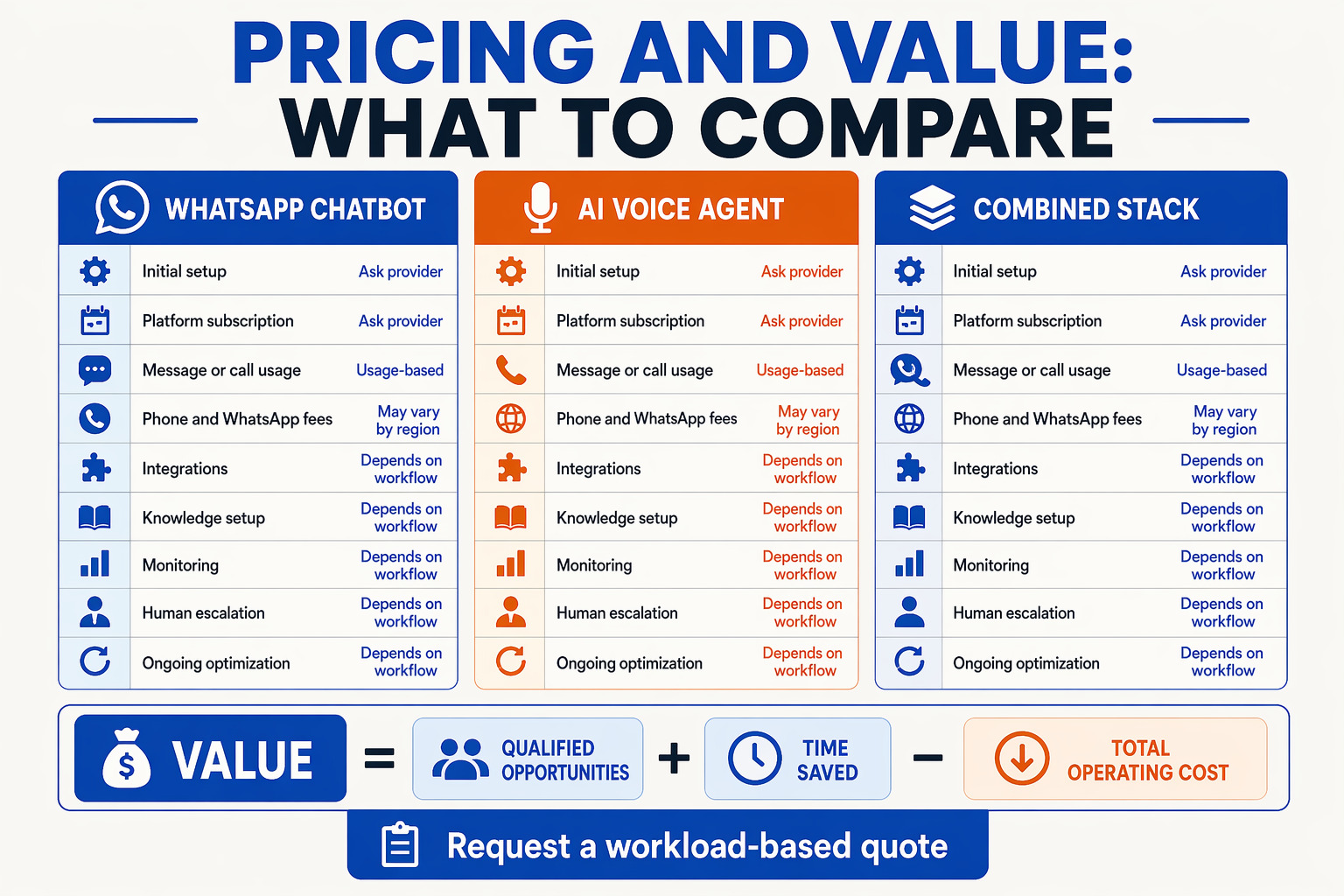
A shared context layer means both channels write to and read from the same customer record and conversation history, usually orchestrated through a workflow engine like n8n that can route data between telephony, WhatsApp Business API, and a shared database or CRM. It's not two bots, it's one logic layer with two front doors. This is harder to retrofit than to design in from the start, which is why rollout order matters.
A realistic rollout order for SA SMEs
Build WhatsApp first, get it handling your highest-volume, lowest-complexity interactions cleanly, then measure what's left. If phone call volume stays high and costly after WhatsApp absorbs the easy stuff, that's your signal to add voice, built on the same backend so context carries across both channels from day one.
When to choose a WhatsApp text agent first
For most SA SMEs, this is the correct starting point.
Order status, bookings, FAQs, and support tickets
These are exactly the high-volume, low-urgency, list-friendly interactions WhatsApp handles best. A customer can check an order, book a slot, or get an FAQ answered without waiting on hold, and your team stops fielding the same ten questions all day. We cover this build pattern in detail alongside WhatsApp appointment booking automation.
Cart recovery and payment flows with PayFast or Yoco
WhatsApp agents can trigger cart recovery messages and complete payment within the chat, linking out to or embedding accepting payments through WhatsApp with PayFast or Yoco. This closes the loop from conversation to paid transaction without a phone call ever happening.
When to add an AI voice agent
Voice earns its place once specific conditions are met, not by default.
Inbound call volume that's already costing you agent hours
If you're paying staff to answer a high volume of repetitive, linear phone queries, a voice agent can offload that cost directly. The business case is strongest when call volume is already large and mostly predictable in structure.
Time-sensitive or emotionally charged calls text can't resolve
Some situations genuinely need a live, real-time conversation: emergency triage, urgent cancellations, distressed customers who won't type. Voice is the right tool for these, and no amount of WhatsApp automation should try to replace it.
How Sagentics builds this with n8n and WhatsApp Business API
We build both channels on n8n as the orchestration layer, so voice and WhatsApp share the same customer data, conversation history, and business logic instead of operating as separate silos. See our AI automation work for South African businesses for how these builds come together, including a donor engagement case study built on WhatsApp automation.
What a working handoff rate under 20% looks like in practice
The metric we track once a voice agent goes live is handoff rate, how often the AI has to pass the call to a human. Under 20% is healthy and means the agent is resolving most calls on its own. Over 40% means the build is misconfigured, the intents are wrong, or the use case wasn't right for voice in the first place. This is a number we monitor on our own deployments, not a figure pulled from a vendor slide deck.
Where this fits with existing WhatsApp automation and appointment booking builds
If you already have WhatsApp automation running for bookings or support, adding voice becomes an extension of the same backend rather than a new project, which is the cleanest and cheapest way to eventually run both channels well.
Common questions
AI voice agent vs chatbot, which is right for your business? Depends on urgency and complexity. Use voice for urgent, linear, real-time conversations like emergency triage or simple confirmations. Use a chatbot (ideally on WhatsApp) for high-volume, list-heavy, non-urgent queries like order status or bookings. Most SA SMEs get more value starting with a WhatsApp chatbot before adding voice.
What's the difference between voice AI and conversational AI? Voice AI refers specifically to the channel, spoken conversation over a phone line, requiring speech-to-text and text-to-speech. Conversational AI is broader and refers to the reasoning capability, understanding intent and context, which can run on voice, WhatsApp, web chat, or any text channel. Voice AI is one delivery method for conversational AI.
Should I start with chat or voice automation? Start with chat, specifically WhatsApp, for most South African businesses. It's cheaper to build, tolerates load shedding and patchy connectivity, and matches where customers already communicate. Add voice later only if phone call volume remains high and costly after WhatsApp has absorbed the simpler, high-volume interactions.
Can WhatsApp handle voice calls now? WhatsApp does support voice calling between users and businesses in some markets, but this is different from an AI voice agent. Building an AI-driven voice experience currently still requires separate telephony and speech infrastructure, not the WhatsApp Business API's core messaging features, which are built for text, media, and structured messages.
Is a WhatsApp AI agent the same as a chatbot? Not necessarily. A basic WhatsApp chatbot follows fixed rules and decision trees. A WhatsApp AI agent uses natural language understanding to interpret varied customer phrasing, hold context across a conversation, and reason about intent rather than matching keywords. Both run on the same channel, but their capability level is very different.
How much does an AI voice agent cost vs a WhatsApp bot in South Africa? A WhatsApp text agent typically runs R2,500 to R8,000 per month for a small business once built. A comparable voice agent usually starts at R8,000 to R20,000 or more per month due to telephony minutes and speech processing costs. Voice also carries higher upfront build costs from the extra integration layers required.
Do I need both voice and WhatsApp automation? Eventually, possibly, but not on day one. Build WhatsApp first to handle high-volume, low-urgency interactions. Add voice only once remaining phone call volume is large enough to justify the cost, and build it on the same backend as your WhatsApp system so both channels share customer context instead of operating as disconnected silos.
Is POPIA a blocker for AI voice or WhatsApp agents in South Africa? No, POPIA doesn't block either channel, but it changes how you build them. Voice calls need an upfront recording disclosure and a way to handle customers who decline, built into every call. WhatsApp consent is typically a one-time opt-in that's simpler to log and audit. Both are manageable with the right build.
If you're trying to work out which one makes sense for your business, message us on WhatsApp and we'll talk it through.
Common questions
AI voice agent vs chatbot, which is right for your business?
Depends on urgency and complexity. Use voice for urgent, linear, real-time conversations like emergency triage or simple confirmations. Use a chatbot (ideally on WhatsApp) for high-volume, list-heavy, non-urgent queries like order status or bookings. Most SA SMEs get more value starting with a WhatsApp chatbot before adding voice.
What's the difference between voice AI and conversational AI?
Voice AI refers specifically to the channel, spoken conversation over a phone line, requiring speech-to-text and text-to-speech. Conversational AI is broader and refers to the reasoning capability, understanding intent and context, which can run on voice, WhatsApp, web chat, or any text channel. Voice AI is one delivery method for conversational AI.
Should I start with chat or voice automation?
Start with chat, specifically WhatsApp, for most South African businesses. It's cheaper to build, tolerates load shedding and patchy connectivity, and matches where customers already communicate. Add voice later only if phone call volume remains high and costly after WhatsApp has absorbed the simpler, high-volume interactions.
Can WhatsApp handle voice calls now?
WhatsApp does support voice calling between users and businesses in some markets, but this is different from an AI voice agent. Building an AI-driven voice experience currently still requires separate telephony and speech infrastructure, not the WhatsApp Business API's core messaging features, which are built for text, media, and structured messages.
Is a WhatsApp AI agent the same as a chatbot?
Not necessarily. A basic WhatsApp chatbot follows fixed rules and decision trees. A WhatsApp AI agent uses natural language understanding to interpret varied customer phrasing, hold context across a conversation, and reason about intent rather than matching keywords. Both run on the same channel, but their capability level is very different.
How much does an AI voice agent cost vs a WhatsApp bot in South Africa?
A WhatsApp text agent typically runs R2,500 to R8,000 per month for a small business once built. A comparable voice agent usually starts at R8,000 to R20,000 or more per month due to telephony minutes and speech processing costs. Voice also carries higher upfront build costs from the extra integration layers required.
Do I need both voice and WhatsApp automation?
Eventually, possibly, but not on day one. Build WhatsApp first to handle high-volume, low-urgency interactions. Add voice only once remaining phone call volume is large enough to justify the cost, and build it on the same backend as your WhatsApp system so both channels share customer context instead of operating as disconnected silos.
Is POPIA a blocker for AI voice or WhatsApp agents in South Africa?
No, POPIA doesn't block either channel, but it changes how you build them. Voice calls need an upfront recording disclosure and a way to handle customers who decline, built into every call. WhatsApp consent is typically a one-time opt-in that's simpler to log and audit. Both are manageable with the right build.
About Sagentics
Sagentics is an AI systems studio based in South Africa. We design and build WhatsApp automation, n8n workflows, and custom AI products for local and international clients. We write from systems we have actually shipped.
Start a WhatsApp conversation with SagenticsRelated reading
- WhatsApp automation in South Africa: what it costs and whether you need it
- WhatsApp Business API vs the app: which one your business actually needs
- AI customer service agent on WhatsApp: what it is, how it works, and what it costs in South Africa
- How to accept payments through WhatsApp in South Africa using PayFast or Yoco
- what WhatsApp automation actually costs in South Africa
- how an AI customer service agent on WhatsApp works
- WhatsApp Business API vs the app
- WhatsApp appointment booking automation
- accepting payments through WhatsApp with PayFast or Yoco
- our AI automation work for South African businesses
- a donor engagement case study built on WhatsApp automation