

 Start a conversation
WhatsApp and conversational AI automation
WhatsApp voice notes AI automation: how it actually works
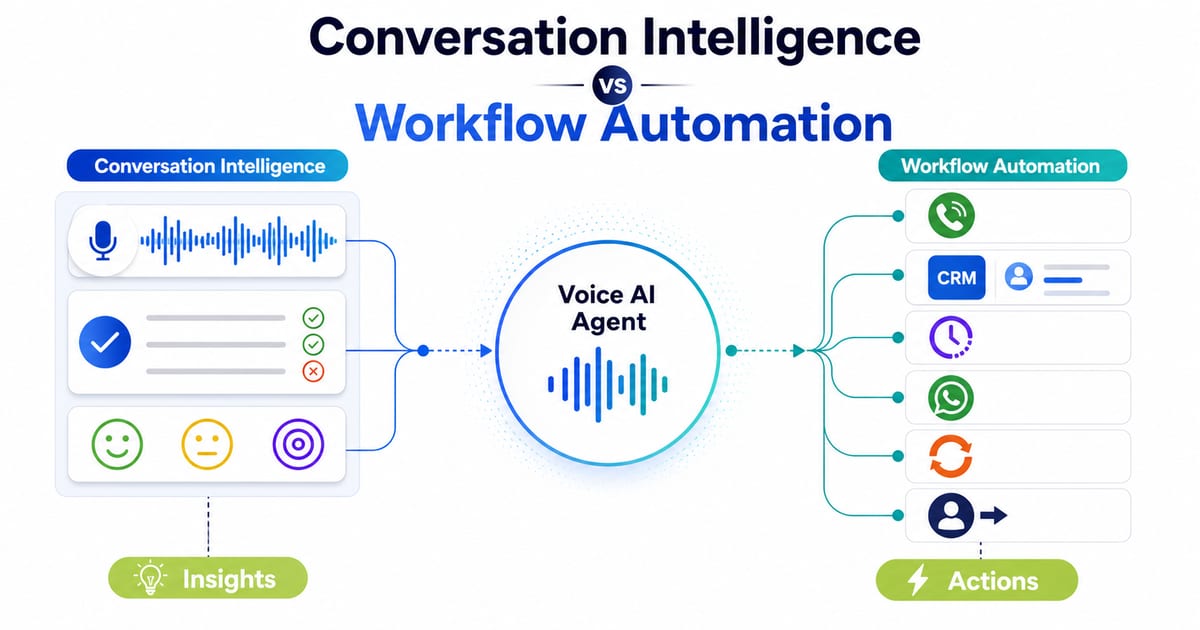
WhatsApp voice note AI automation works by transcribing incoming audio with a speech-to-text model, detecting intent from that transcript, then triggering an action such as a booking, CRM update, or reply, with a human handoff built in for anything the AI shouldn't handle alone. Transcription is the visible part. The system that decides what happens next is the part that either saves a business hours every week or quietly breaks its customer relationships.
Most vendors sell transcription as the finish line. Forward a voice note, get text back, done. In practice, transcription is the easy 20% of the build. The hard 80% is the intent-routing and escalation logic that decides what happens after the words appear on screen, and getting that wrong is what turns an AI system into a liability instead of a time-saver.
What WhatsApp voice note AI automation actually means
Transcription is step one, not the whole system
A voice note lands, gets converted to text, and that's where most tools stop. The customer still has to wait for a human to read it and respond. That's a convenience feature, not automation. Real automation means the transcript triggers something without a person in the loop for routine cases.
The five-step pipeline: capture, transcribe, classify intent, act, escalate
Every working system does five things in order. It captures the audio through a webhook. It transcribes the audio to text. It classifies what the customer actually wants: a booking, a complaint, a price query, or something unclear. It acts on that intent directly, sending a link, updating a record, or confirming a slot. And it escalates to a human the moment confidence drops or the request falls outside defined boundaries. Skip step five and you have a system that will eventually answer something it shouldn't.
Why this matters more in South Africa than text-first markets
South African customers use voice notes far more than text-first markets like the US or UK. Typing in a second or third language is slower than speaking it. A plumber in Durban or a spaza shop owner in Soweto is far more likely to send a 20-second voice note than type a paragraph. If your automation only handles text, you're missing a large share of real customer intent.
Native WhatsApp transcription vs third-party automation
What Meta's built-in transcription does since November 2024
Since November 2024, WhatsApp's own app can transcribe voice notes on-device for the person receiving them. It works entirely inside the consumer app, on supported languages, and it's genuinely useful if you're just trying to read a message without headphones on a bus.
Where it falls short: languages, manual tap-per-message, no action layer
It doesn't cover every South African language. It requires the recipient to tap "transcribe" on each message individually, which doesn't scale past a handful of conversations a day. And critically, it produces text for a human to read, not a trigger for any downstream system. There's no action layer at all. It can't book a slot, log a lead, or send a payment link.
When native transcription is genuinely enough for your business
If you're a sole trader fielding under 20 messages a day and you're the one reading every voice note anyway, native transcription is fine. You don't need a pipeline, a database, or n8n for that volume. The moment you're running a team inbox, multiple staff members, or anything above roughly 50 messages a day, you need the pipeline described above.

The technical stack: what's actually running under the hood
Whisper, Groq, and Gemini for speech-to-text: tradeoffs on cost and speed
OpenAI's Whisper is the most tested option and handles accented English and code-switched Afrikaans-English reasonably well, but it's not the fastest for real-time use. Groq runs Whisper models on its own hardware and returns transcripts in a fraction of the time, which matters if a customer is waiting for an instant reply. Gemini's audio models are competitive on cost and handle some African languages better than either alternative, though results vary by dialect. There's no single correct answer here; the right pick depends on whether you're optimising for speed, cost, or language coverage. This is where an AI voice agent vs WhatsApp text agent comparison becomes essential before you commit to a stack.
Routing transcripts through GPT-4o-mini or similar for intent and reply
Once you have text, a smaller, cheaper model like GPT-4o-mini usually handles intent classification and reply generation well enough. You don't need the most expensive model in the world to figure out that "can I get an appointment for Thursday" means booking intent. Save the bigger models for genuinely ambiguous cases.
Handling grouped voice notes, background noise, and low-confidence transcripts
Customers often send three or four short voice notes in a row instead of one long one. Your pipeline needs to group these before transcribing, or you'll process fragments out of context. Background noise, taxi ranks, generators, kids, degrades accuracy fast. Every serious build needs a confidence threshold. If the transcript looks garbled or the model flags low confidence, that message goes straight to a human rather than triggering an automated action on a guess.
Where n8n fits versus building custom
n8n is the practical middle ground for most South African businesses. It handles the webhook, the API calls to your transcription and language models, the CRM update, and the escalation logic, without you writing a backend from scratch. For high volume operations with unusual logic, a custom build makes more sense, but for the vast majority of local businesses, n8n gets you a working system in days rather than months.
WhatsApp Business App vs Cloud API for voice notes
Why some CRMs and no-code platforms don't pass audio through at all
Plenty of no-code CRMs integrate with WhatsApp for text but drop audio entirely, or forward it as an unusable link instead of a processable file. This isn't an accident. Handling binary audio properly, downloading it, converting formats, storing it temporarily, takes real engineering effort that many platforms didn't bother with because most of their customers only asked for text automation.
What co-existence (2026) changes for SA businesses keeping their existing number
From 2026, Meta's co-existence feature lets a business run the WhatsApp Business App and the Cloud API on the same number at the same time. This matters in South Africa specifically because plenty of small businesses built their customer base on a single WhatsApp number for years and didn't want to migrate to a new one just to add automation. Co-existence means you can automate parts of the conversation through the API while staff keep using the familiar app for the rest, without splitting your number or losing chat history. Read the full breakdown in WhatsApp Business API vs the app: which one your business actually needs.
Choosing the right setup based on daily message volume
Under roughly 50 messages a day, the app alone is usually fine. Between 50 and 200, co-existence gives you automation without disruption. Above 200, or if you need multiple staff logins and proper API access, you need the Cloud API as your primary setup.

From transcript to action: what should actually happen next
Booking a slot, updating a CRM record, sending a payment link
A transcript that says "I need a haircut Saturday morning" should check calendar availability and confirm a slot, not just log the request for someone to action later. A transcript with a delivery address should update the CRM record directly. A transcript asking about price should trigger a PayFast or Yoco payment link where appropriate. This is what WhatsApp appointment booking automation actually looks like in practice, not a chatbot that reads back a menu.
When to reply automatically vs when to escalate to a human
Automatic replies work for known, bounded requests: business hours, pricing, availability, confirmations. Escalation should trigger for complaints, anything involving money disputes, medical or legal specifics, or a transcript the model isn't confident about. Get this boundary wrong in either direction and you either overload your staff with routine questions or let the AI answer something it has no business answering. We've written in detail about how human handoff actually works on WhatsApp.
Meta's 2026 rules on AI chatbots needing a concrete business task
Meta's updated policy for 2026 requires AI-driven WhatsApp bots to be tied to a specific, definable business task rather than operating as an open-ended general assistant. A booking bot, a support triage bot, an order status bot, these qualify. A bot that just chats about anything doesn't. This pushes the whole industry toward exactly the intent-and-action model described above, rather than generic conversational AI bolted onto WhatsApp.
POPIA and data handling for voice note automation in South Africa
What actually needs to be true for compliance, not just marketing language
Voice notes are personal information under POPIA, and a transcript of one is too. That means you need a lawful basis for processing it, usually consent given at the point the customer starts messaging your business number, clear purpose limitation, and a way to delete data on request. None of this is exotic, but it needs to be built into the system, not bolted on as a privacy policy nobody reads. We cover what actually needs to be true for POPIA compliance in more depth.
Data retention, storage location, and consent for recorded voice data
Decide upfront how long raw audio and transcripts are kept, and delete audio files once transcribed if you don't have a specific reason to retain them. Where your data is stored matters too. Hosting transcripts and CRM data in a South African or EU region is generally safer for POPIA purposes than defaulting to US-only infrastructure with no data residency controls.
What it costs in South Africa (ZAR)
Rough pricing tiers seen in the local market
Simple transcription-only setups with basic n8n routing typically run R3,500 to R8,000 as a one-off build, plus modest monthly API costs. Full pipelines with intent classification, CRM integration, and escalation logic usually land between R15,000 and R45,000 depending on complexity, with monthly maintenance and API usage from R500 to R2,500 depending on volume.
What changes the price: volume, languages, action complexity
The three biggest cost drivers are message volume, how many languages you need covered well, and how many distinct actions the system needs to trigger. A single-language booking bot is cheap. A multi-language system that updates three separate systems and handles payments is not. For a full breakdown, see what WhatsApp automation really costs in ZAR.
How to evaluate the stats vendors use to sell this
Why claims like '47% conversion lift' need a source before you trust them
Any vendor quoting a precise conversion lift number without naming the business, the sample size, or the time period is giving you a marketing number, not a result. Ask which client it came from, over what period, and what was actually measured. If they can't answer, treat the number as noise.
Realistic accuracy expectations for accented, noisy, multi-language audio
Expect 85 to 95% transcription accuracy on clear, single-language audio in a quiet environment, and expect that to drop meaningfully, sometimes below 70%, with heavy background noise, strong code-switching between languages mid-sentence, or unusual accents the model wasn't trained heavily on. Design your escalation thresholds around this reality, not around a vendor's best-case demo.
How Sagentics builds this differently
Why we treat transcription as the easy 20% of the build
We don't sell transcription as the product. It's a utility step. The real engineering time goes into the intent classification rules, the escalation thresholds, and the integrations that turn a transcript into a booked appointment or an updated record. That's what should stay rule-based and what AI should touch, and getting that split right is most of the actual work.
Designing escalation logic before designing the AI reply
We design the failure paths before we design the happy path. What happens when the transcript is unclear. What happens when load-shedding takes down a webhook mid-conversation and the customer thinks they've booked something that never saved. What happens when a customer asks something outside the bot's defined task. These questions get answered before a single AI reply gets written.
What this looks like for a real South African business
For a creator platform managing high volumes of fan messages, we built a system that handled onboarding through voice and text without losing context between messages, see how we built WhatsApp onboarding for a creator platform. The same principles apply whether it's a clinic booking appointments, a retailer confirming orders, or a support desk running an AI customer service agent on WhatsApp: transcribe accurately, classify honestly, act where it's safe to, and hand off the rest.
Common questions
Can WhatsApp automatically transcribe voice notes without third-party tools? Yes, since November 2024 the WhatsApp app itself can transcribe voice notes on-device, but only for the person reading the message, one tap at a time, and only in supported languages. It produces readable text, not a trigger for any action. For automation that books, logs, or replies without a human reading every message, you need a third-party pipeline layered on top.
How do I automate WhatsApp voice notes with n8n or similar tools? Connect a WhatsApp Business API webhook to n8n, download the audio file, send it to a speech-to-text API like Whisper or Groq, then route the transcript through a language model node for intent classification. From there, branch into action nodes: CRM updates, calendar bookings, payment links, with a fallback branch that flags low-confidence results to a human.
What's the best AI model to transcribe WhatsApp voice messages? There isn't one universal best option. Whisper is well tested for accented and code-switched audio but slower. Groq runs Whisper-based models much faster for real-time replies. Gemini's audio models are cost-competitive and handle some African languages reasonably well. Pick based on whether speed, cost, or language coverage matters most for your customer base.
Can AI actually respond to or act on a WhatsApp voice note, not just transcribe it? Yes, but only if the system includes an intent classification and action layer beyond transcription. A transcript alone does nothing. Once the system identifies what the customer wants (booking, order status, pricing), it can trigger a real action: sending a confirmation, updating a database, or generating a payment link, without a human typing a response.
Does the WhatsApp Business API support voice messages in automated workflows? Yes, the Cloud API delivers voice note media as a downloadable file through its webhook, which your automation can then pass to a transcription service. The consumer WhatsApp Business App does not offer this kind of programmatic access, which is why businesses needing automation eventually move to the Cloud API or a co-existence setup.
Why do some CRMs and no-code platforms not support WhatsApp voice notes at all? Handling audio properly requires downloading binary files, converting formats, and managing temporary storage, work that many platforms skipped because most customers only asked for text automation. The result is tools that either drop voice notes entirely or forward an unusable file link instead of processable audio.
Is WhatsApp voice note automation POPIA compliant in South Africa? It can be, but compliance has to be designed in, not assumed. You need a lawful basis for processing voice data, usually consent, clear limits on why the data is used, defined retention periods, and a deletion process on request. Storing audio and transcripts in a controlled, known location matters more for compliance than any marketing claim about "POPIA-ready" software.
How much does WhatsApp AI voice automation cost in ZAR? Basic transcription-only setups start around R3,500 to R8,000 as a one-off build. Full pipelines with intent classification, CRM integration, and escalation logic typically run R15,000 to R45,000, plus R500 to R2,500 a month in API and maintenance costs depending on message volume and language coverage.
What's the difference between the WhatsApp Business App and the Cloud API for handling voice notes? The app is a consumer tool built for one person managing a number manually, with no programmatic access to media. The Cloud API exposes voice notes as downloadable files through webhooks, which automation tools can process. Co-existence, available from 2026, lets both run on the same number simultaneously.
How accurate is AI transcription on real-world WhatsApp voice notes with accents or background noise? Expect 85 to 95% accuracy on clear audio in a quiet setting with a single language. Accuracy drops, sometimes below 70%, with heavy background noise, strong accents the model wasn't trained heavily on, or mid-sentence code-switching between languages. Any serious build sets a confidence threshold and escalates uncertain transcripts to a human rather than guessing.
If you're weighing up whether this is worth building for your business, message Sagentics WhatsApp automation for South African businesses on WhatsApp and we'll talk through what actually makes sense for your volume and setup, no pitch deck required.
Common questions
Can WhatsApp automatically transcribe voice notes without third-party tools?
Yes, since November 2024 the WhatsApp app itself can transcribe voice notes on-device, but only for the person reading the message, one tap at a time, and only in supported languages. It produces readable text, not a trigger for any action. For automation that books, logs, or replies without a human reading every message, you need a third-party pipeline layered on top.
How do I automate WhatsApp voice notes with n8n or similar tools?
Connect a WhatsApp Business API webhook to n8n, download the audio file, send it to a speech-to-text API like Whisper or Groq, then route the transcript through a language model node for intent classification. From there, branch into action nodes: CRM updates, calendar bookings, payment links, with a fallback branch that flags low-confidence results to a human.
What's the best AI model to transcribe WhatsApp voice messages?
There isn't one universal best option. Whisper is well tested for accented and code-switched audio but slower. Groq runs Whisper-based models much faster for real-time replies. Gemini's audio models are cost-competitive and handle some African languages reasonably well. Pick based on whether speed, cost, or language coverage matters most for your customer base.
Can AI actually respond to or act on a WhatsApp voice note, not just transcribe it?
Yes, but only if the system includes an intent classification and action layer beyond transcription. A transcript alone does nothing. Once the system identifies what the customer wants (booking, order status, pricing), it can trigger a real action: sending a confirmation, updating a database, or generating a payment link, without a human typing a response.
Does the WhatsApp Business API support voice messages in automated workflows?
Yes, the Cloud API delivers voice note media as a downloadable file through its webhook, which your automation can then pass to a transcription service. The consumer WhatsApp Business App does not offer this kind of programmatic access, which is why businesses needing automation eventually move to the Cloud API or a co-existence setup.
Why do some CRMs and no-code platforms not support WhatsApp voice notes at all?
Handling audio properly requires downloading binary files, converting formats, and managing temporary storage, work that many platforms skipped because most customers only asked for text automation. The result is tools that either drop voice notes entirely or forward an unusable file link instead of processable audio.
Is WhatsApp voice note automation POPIA compliant in South Africa?
It can be, but compliance has to be designed in, not assumed. You need a lawful basis for processing voice data, usually consent, clear limits on why the data is used, defined retention periods, and a deletion process on request. Storing audio and transcripts in a controlled, known location matters more for compliance than any marketing claim about POPIA-ready software.
How much does WhatsApp AI voice automation cost in ZAR?
Basic transcription-only setups start around R3,500 to R8,000 as a one-off build. Full pipelines with intent classification, CRM integration, and escalation logic typically run R15,000 to R45,000, plus R500 to R2,500 a month in API and maintenance costs depending on message volume and language coverage.
What's the difference between the WhatsApp Business App and the Cloud API for handling voice notes?
The app is a consumer tool built for one person managing a number manually, with no programmatic access to media. The Cloud API exposes voice notes as downloadable files through webhooks, which automation tools can process. Co-existence, available from 2026, lets both run on the same number simultaneously.
How accurate is AI transcription on real-world WhatsApp voice notes with accents or background noise?
Expect 85 to 95% accuracy on clear audio in a quiet setting with a single language. Accuracy drops, sometimes below 70%, with heavy background noise, strong accents the model wasn't trained heavily on, or mid-sentence code-switching between languages. Any serious build sets a confidence threshold and escalates uncertain transcripts to a human rather than guessing.
About Sagentics
Sagentics is an AI systems studio based in South Africa. We design and build WhatsApp automation, n8n workflows, and custom AI products for local and international clients. We write from systems we have actually shipped.
Start a WhatsApp conversation with SagenticsRelated reading
- WhatsApp automation in South Africa: what it costs and whether you need it
- WhatsApp Business API vs the app: which one your business actually needs
- AI customer service agent on WhatsApp: what it is, how it works, and what it costs in South Africa
- How to accept payments through WhatsApp in South Africa using PayFast or Yoco
- WhatsApp Business API vs the app: which one your business actually needs
- what actually needs to be true for POPIA compliance
- what WhatsApp automation really costs in ZAR
- how human handoff actually works on WhatsApp
- an AI customer service agent on WhatsApp
- WhatsApp appointment booking automation
- what should stay rule-based and what AI should touch
- the real ROI formula for a WhatsApp support agent
- AI voice agent vs WhatsApp text agent
- how we built WhatsApp onboarding for a creator platform
- Sagentics WhatsApp automation for South African businesses