

 Start a conversation
AI system design and integration
Retrieval grounding and AI context: what it actually means and where it breaks
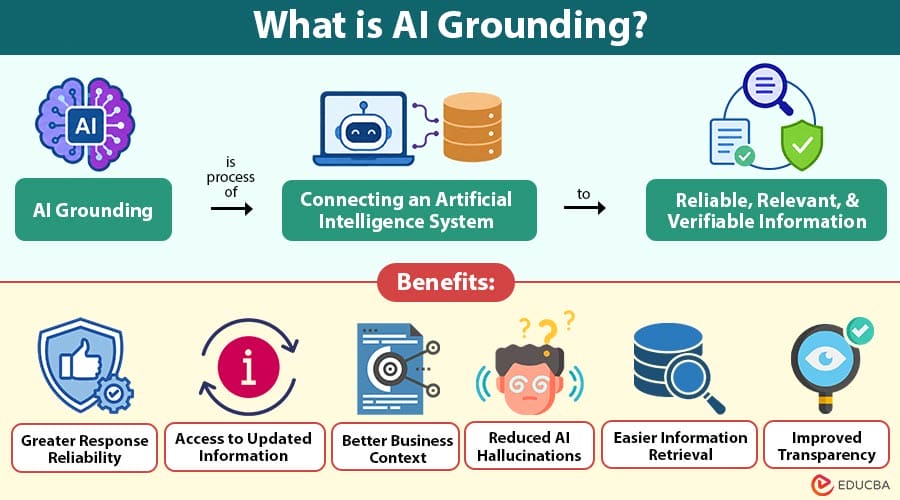
Grounding is the practice of tying an AI model's output to specific, retrievable source material so every claim can be traced to evidence. RAG (retrieval-augmented generation) is one architecture for achieving that, not a guarantee that it works. You can build a RAG pipeline that retrieves documents, feeds them to a model, and still produces confidently wrong answers, because retrieval succeeding and grounding succeeding are two different things.
That distinction matters more than most vendor pitches let on. It matters even more when the system is handling South African customer data over WhatsApp, where a wrong answer isn't just embarrassing, it can be a POPIA problem.
What grounding actually means
Grounding as a property, not a feature you install
Grounding isn't a checkbox in a product dashboard. It's a property of an answer: does it trace back to something real, checkable, and current? An AI system is grounded when you can point at the exact passage, record, or document that produced a given claim. A system "has RAG" in the sense that it retrieves documents before generating. Whether the output is actually grounded depends on whether the right document was retrieved, whether the model used it correctly, and whether the citation trail holds up under scrutiny.
How Google's Vertex AI defines it
Google's own documentation on grounding in Vertex AI ties it to three outcomes: fewer hallucinations, answers that are sourced to specific data, and auditability. That third one is the part most teams skip. It's not enough for an answer to sound right and even be right this one time. You need to be able to show, after the fact, which document, record, or row produced it. Without that trail, you're trusting a black box that occasionally gets lucky.
Why a fluent answer isn't the same as a grounded one
Large language models are built to produce fluent, confident text. That's the whole point of the architecture. Fluency is not evidence. A model can write a perfectly structured, grammatically sound paragraph that states a product's price, delivery window, or stock status with total confidence, and be wrong on every count, because it either retrieved a stale document or filled a gap in the retrieved context with a plausible-sounding guess. The tell isn't in the tone. It's in whether the claim can be traced to a specific, current source.
Grounding vs RAG: the distinction nobody explains clearly
RAG is an architecture, grounding is the goal
Is grounding the same as RAG? No. Grounding is the outcome: answers tied to verifiable, current source material. RAG is one method for getting there, retrieve relevant documents, then generate an answer using them as context. You can have RAG without grounding (retrieval succeeds, generation ignores or misuses it) and grounding without classic RAG (a tool call that pulls a single authoritative record). Treating them as synonyms is where a lot of system design goes wrong.
The three components of a grounded system
How does grounding work, step by step? First, a source of truth: structured, current data the business actually trusts (a database, a CMS, a product catalogue). Second, a retrieval layer that finds the relevant slice of that source for a given query, usually via embeddings and a vector search, sometimes via keyword or hybrid search. Third, a generation step where the model composes an answer using only the retrieved material, ideally with citations back to source. Weaken any one of the three and the whole chain degrades, often silently.
Where fine-tuning fits in and why it's not the same thing
What is the difference between grounding, RAG, and fine-tuning? Fine-tuning changes the model's weights using example data, which shifts how it writes, reasons, or formats answers. It does not give the model access to current facts after training, and it doesn't produce a citation trail. RAG and grounding address what the model knows at answer time. Fine-tuning addresses how it behaves. The two solve different problems and get conflated constantly in vendor marketing. For most customer-facing systems, picking the right combination starts with understanding the task itself, which is where how to select an AI model for a given task becomes a more useful question than "which model is best".
Retrieval is not automatically grounding
Stale, irrelevant, or poorly ranked documents still get cited as fact
Can grounding fail even when retrieval succeeds? Yes, routinely. Retrieval can return a real, correctly indexed document that is simply the wrong one, an old pricing sheet, a superseded policy, a competitor's spec sheet that happened to rank high on similarity. The model doesn't know the document is stale. It treats whatever lands in its context window as truth and writes a fluent, citation-looking answer around it. The failure is upstream of generation, in the ranking and indexing layer, but it shows up downstream as a wrong answer delivered with full confidence.
The lost in the middle problem
Research on long-context models has repeatedly shown that models pay less attention to information placed in the middle of a long context window than to information at the start or end. Pile more retrieved documents into a prompt hoping for better coverage, and the answer can actually get worse, because the one relevant sentence is now buried on page three of six retrieved chunks. More retrieval is not the same as better retrieval. This is one reason retrieval systems need deliberate ranking and chunking strategy, not just "retrieve the top 10 and hope".
Seven common failure points in production RAG systems
Real-world RAG deployments consistently hit the same wall: missing content the retriever never found, missed top documents that ranked too low, content excluded by overly aggressive context limits, answers that ignored retrieved context entirely, wrong format outputs, incorrect specificity (too vague or too narrow), and incomplete answers that stopped short of the full picture. None of these are exotic edge cases. They show up in ordinary production systems within weeks of launch, which is exactly why evaluation has to be built in from day one, not bolted on after a complaint.
Does RAG actually reduce hallucinations? The numbers
What the research shows
Does RAG eliminate hallucinations? No. The honest answer, based on published benchmarks, is that RAG reduces hallucination rates meaningfully, commonly cited in the range of 18 to 40 percent depending on domain and setup, but it does not eliminate them. The reduction is real and worth building for. It is not a cure. Any claim that a system has "solved" hallucinations should be read as a marketing statement, not an engineering one.
Why vendor claims of nearly zero hallucinations deserve scrutiny
Vendors measure hallucination rates on their own benchmark sets, often narrow, often favourable. A system that hallucinates rarely on a curated test set can still hallucinate often on messy real-world queries, ambiguous phrasing, or questions that fall just outside the indexed document set. The only number worth trusting is the one measured on your own data, your own query patterns, and your own edge cases, ideally with a human reviewing a sample of real outputs on a schedule.
What production RAG actually costs
Retrieval adds real overhead. Every call to a vector database or search index consumes latency and tokens that the generation step has to wait for. For a WhatsApp bot handling hundreds of customer queries a day, that's typically 500 to 1000 milliseconds added per response, plus around $0.0001 to $0.0005 per query depending on index size and search complexity. For systems doing retrieval on every turn of a long conversation, it adds up fast, and it's worth designing around rather than discovering after the invoice arrives. The math changes if you're pulling from a single source versus scanning a large distributed index, so measure your own setup before committing to a given pattern.

RAG vs long-context models: do you still need retrieval?
Why huge context windows don't remove the need for grounding
RAG vs long context, which is better, and do you still need RAG with huge context windows? Context windows have grown to the point where you can stuff an entire product catalogue or policy manual into a single prompt. That doesn't solve grounding. A long context window still needs the right documents selected and ordered, still suffers from the lost-in-the-middle problem, and still costs real money and latency per call. It replaces retrieval's precision problem with a cost and attention problem. Bigger context is not the same as better grounding.
When long-context wins vs when RAG wins
Long context tends to win when the source material is static, small enough to fit comfortably, and doesn't need per-user access control, think a fixed policy document or a single product manual. RAG tends to win when data is dynamic (prices, stock, order status), large (a full customer database), or access-controlled (different customers should see different records). Most real business systems, especially ones touching customer data, fall into the second category.
The honest answer
It depends on data freshness, cost, and audit requirements. If your data changes daily and different users need different slices of it, you need retrieval with proper filtering, not just a bigger context window. Getting this choice right is part of a broader decision about system design, which is covered in the real decision framework for integration architecture.
The access-control failure mode nobody talks about
How retrieval can expose more data than intended
Why does retrieval sometimes expose data it shouldn't? Because most retrieval layers are built to find the most relevant document, not the most permitted one. A vector search over a shared index doesn't inherently know that customer A shouldn't see customer B's order history. If the embeddings aren't filtered by permission before ranking, a similarity match can surface the wrong customer's record, and the model will ground its answer on it faithfully. This is a retrieval-layer problem, not a model problem, and it's the one most grounding explainers skip entirely.
Grounding on the wrong material still produces a polished, unsafe answer
What causes hallucinations even when RAG is in place? Sometimes it isn't hallucination at all. It's a correctly grounded answer built on the wrong source, which is arguably worse, because it won't look like an error. A confidently written, well-cited answer that quotes someone else's account balance or delivery address is a data breach wearing the costume of a good response. Standard hallucination metrics won't catch this, because technically nothing was invented. The retrieval layer handed over the wrong truth.
Why this matters for POPIA-covered customer data in WhatsApp bots
Any system that handles customer names, order history, contact details, or payment status is handling personal information under POPIA, whether or not anyone designed it with that in mind. A retrieval layer that doesn't enforce permission boundaries per query is a compliance exposure before it's a quality one. This is exactly the gap covered in what actually needs to be true for WhatsApp automation to stay POPIA compliant, and it's worth reading before building, not after a customer complains.
What this means for a WhatsApp bot handling real customer data
Wrong ZAR pricing pulled from a stale product sheet
A bot retrieving from an outdated spreadsheet will quote last month's ZAR price with total confidence, because nothing in the retrieval layer flags the document as stale. The fix isn't a smarter model. It's a source-of-truth pipeline that keeps the indexed data in sync with whatever system actually owns pricing, ideally the same system your Yoco or PayFast checkout reads from.
Wrong stock or delivery info surfaced with confidence
The same failure applies to stock counts and delivery windows. If the retrieval layer is indexing a snapshot that's hours or days old, the model will state the old number as current fact. For understanding what a properly built version of this looks like end to end, it's worth reading how an AI customer service agent on WhatsApp actually works.
Customer records crossing POPIA boundaries at the retrieval stage
This is the core of the original problem: a shared vector store with no per-customer filtering can retrieve the wrong customer's order, invoice, or support history and hand it to the model as grounding material. The model does its job perfectly, generating a fluent, sourced, polished answer, about the wrong person. The leak happens before generation even starts, which is why fixing it at the model layer (better prompts, stricter instructions) never actually closes the gap.
How Sagentics builds grounded systems
Source of truth first, model second
We start by identifying the actual system of record, the database, order platform, or CMS the business already trusts, before picking a model or a vector database. A grounded system is only as good as the source feeding it, which is the foundation behind custom AI development built around a real source of truth.
Permission-aware retrieval, not just relevance-ranked retrieval
Every retrieval call we build filters by who is asking before it ranks by relevance. A customer's WhatsApp number maps to their own records, nothing else, at the query level, not as an afterthought in the prompt. This is the difference between a chatbot that answers plausibly and an agentic system that respects boundaries, a distinction explored in the actual difference between a chatbot and an agentic assistant.
Citations and human handoff as the audit trail
Every answer we ship carries a traceable link back to its source record, and every low-confidence or boundary case routes to a person instead of guessing. That pairing, visible citations plus a real escalation path, is what makes a system auditable rather than just fluent, following the approach in how human-in-the-loop AI should be built in production and how human handoff works when the AI isn't confident.
Common questions
Is grounding the same as RAG? No. Grounding is the outcome, answers traceable to real, current source material. RAG is one architecture for getting there, retrieving documents before generating a response. You can implement RAG and still fail to achieve grounding if retrieval returns the wrong or stale document, or if the model ignores the retrieved context entirely.
How does grounding work, step by step? A trusted source of truth (database or document store) feeds a retrieval layer that finds the relevant slice for a given query, usually via vector or hybrid search. The generation step then composes an answer strictly from that retrieved material, ideally with a citation back to the exact source, so the claim can be checked afterward.
Does RAG eliminate hallucinations? No. Published research puts reduction rates around 18 to 40 percent depending on domain and setup, which is meaningful but not a cure. Hallucinations still occur from stale retrieval, poor ranking, context overload, or the model ignoring retrieved material. Treat any "nearly zero hallucination" claim as a marketing line, not an engineering fact.
RAG vs long context, which is better, and do you still need RAG with huge context windows? Long context works for static, smaller document sets without access control needs. RAG wins for dynamic data (pricing, stock, customer records) and anything needing per-user filtering. Bigger context windows don't solve retrieval precision, permission control, or the lost-in-the-middle attention problem, so most real business systems still need proper retrieval.
What causes hallucinations even when RAG is in place? Stale or poorly ranked documents treated as current fact, the lost-in-the-middle effect burying relevant content in a crowded context, the model ignoring retrieved material and defaulting to its training data, or retrieval returning the wrong but real record, which produces a polished, confidently wrong answer.
What is the difference between grounding, RAG, and fine-tuning? Grounding is the goal: traceable, current, evidence-backed answers. RAG is one method to achieve it, via retrieval plus generation. Fine-tuning changes the model's weights to shift tone, format, or reasoning style, but doesn't give it access to current facts or produce a citation trail. They solve different problems and shouldn't be used interchangeably.
Can grounding fail even when retrieval succeeds? Yes. Retrieval can return a real, correctly indexed document that is simply the wrong one, outdated, irrelevant, or belonging to a different record than the one being asked about. The model will still generate a fluent, confident answer from it, which is grounding in form but not in substance.
Why does retrieval sometimes expose data it shouldn't? Because most vector search systems rank by relevance, not by permission. If a shared index isn't filtered by who's asking before ranking runs, a similarity match can surface another customer's record. The model grounds its answer faithfully on that wrong, but real, document, which turns a retrieval design flaw into a data exposure.
If you're weighing whether your retrieval setup actually protects customer data or just sounds confident, send us a message on WhatsApp and we'll walk through it with you.
Common questions
Is grounding the same as RAG?
No. Grounding is the outcome, answers traceable to real, current source material. RAG is one architecture for getting there, retrieving documents before generating a response. You can implement RAG and still fail to achieve grounding if retrieval returns the wrong or stale document, or if the model ignores the retrieved context entirely.
How does grounding work, step by step?
A trusted source of truth (database or document store) feeds a retrieval layer that finds the relevant slice for a given query, usually via vector or hybrid search. The generation step then composes an answer strictly from that retrieved material, ideally with a citation back to the exact source, so the claim can be checked afterward.
Does RAG eliminate hallucinations?
No. Published research puts reduction rates around 18 to 40 percent depending on domain and setup, which is meaningful but not a cure. Hallucinations still occur from stale retrieval, poor ranking, context overload, or the model ignoring retrieved material. Treat any 'nearly zero hallucination' claim as a marketing line, not an engineering fact.
RAG vs long context, which is better, and do you still need RAG with huge context windows?
Long context works for static, smaller document sets without access control needs. RAG wins for dynamic data (pricing, stock, customer records) and anything needing per-user filtering. Bigger context windows don't solve retrieval precision, permission control, or the lost-in-the-middle attention problem, so most real business systems still need proper retrieval.
What causes hallucinations even when RAG is in place?
Stale or poorly ranked documents treated as current fact, the lost-in-the-middle effect burying relevant content in a crowded context, the model ignoring retrieved material and defaulting to its training data, or retrieval returning the wrong but real record, which produces a polished, confidently wrong answer.
What is the difference between grounding, RAG, and fine-tuning?
Grounding is the goal: traceable, current, evidence-backed answers. RAG is one method to achieve it, via retrieval plus generation. Fine-tuning changes the model's weights to shift tone, format, or reasoning style, but doesn't give it access to current facts or produce a citation trail. They solve different problems and shouldn't be used interchangeably.
Can grounding fail even when retrieval succeeds?
Yes. Retrieval can return a real, correctly indexed document that is simply the wrong one, outdated, irrelevant, or belonging to a different record than the one being asked about. The model will still generate a fluent, confident answer from it, which is grounding in form but not in substance.
Why does retrieval sometimes expose data it shouldn't?
Because most vector search systems rank by relevance, not by permission. If a shared index isn't filtered by who's asking before ranking runs, a similarity match can surface another customer's record. The model grounds its answer faithfully on that wrong, but real, document, which turns a retrieval design flaw into a data exposure.
About Sagentics
Sagentics is an AI systems studio based in South Africa. We design and build WhatsApp automation, n8n workflows, and custom AI products for local and international clients. We write from systems we have actually shipped.
Start a WhatsApp conversation with SagenticsRelated reading
- AI system design implementation: what it actually means and why most projects skip it
- AI process mapping: what it is, what it isn't, and whether it's worth paying for
- How to select an AI model for a task
- Integration architecture for AI systems: the real decision framework for South African businesses
- what actually needs to be true for WhatsApp automation to stay POPIA compliant
- how an AI customer service agent on WhatsApp actually works
- the actual difference between a chatbot and an agentic assistant
- how human-in-the-loop AI should be built in production
- the real decision framework for integration architecture
- how to select an AI model for a given task
- custom AI development built around a real source of truth
- how human handoff works when the AI isn't confident