

 Start a conversation
AI system design and integration
AI implementation roadmap for mid-size business: a 90-day plan that actually ships
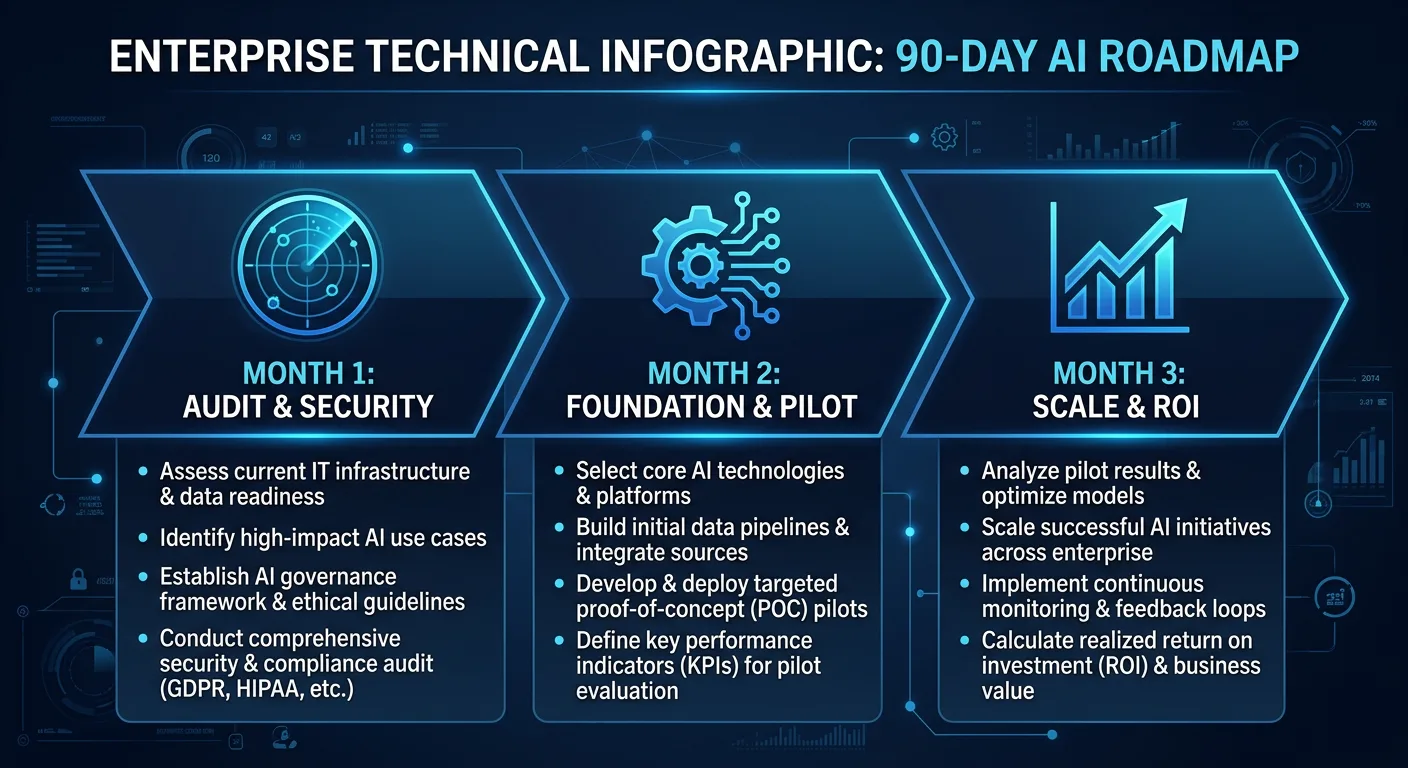
A mid-size business AI roadmap works best as a 90-day cycle covering 2 to 3 narrow use cases, not a company-wide transformation plan. It needs named owners, a POPIA-aware data audit before any model touches customer data, and a hard decision point at day 90 on what gets scaled, what gets rebuilt, and what gets killed. Everything else in this article is detail on how to run that cycle without it stalling the way most do.
What an AI implementation roadmap actually is (and isn't)
An AI implementation roadmap is a sequenced, time-boxed plan for getting one or two AI use cases from idea to working system with measured results. It is not a strategy document. It is not a 40-page vision deck. If your roadmap doesn't name a person, a deadline, and a success metric for each use case, it's a wish list with a logo on it.
Roadmap vs strategy vs implementation plan: who owns each one
These three get used interchangeably and that's where confusion starts. An AI strategy is the executive-level answer to "why are we doing this and where." It's owned by leadership and rarely has dates attached. An AI roadmap sits underneath it: it picks the specific use cases, phases, and timelines, and it's owned by whoever runs operations or digital transformation. An implementation plan is the engineering-level detail, the actual build steps, API calls, and integration points, owned by whoever is building or your development partner. Most SA mid-size firms skip straight from strategy to implementation and wonder why nothing lines up. The roadmap is the missing middle layer, and why most projects skip proper system design is usually traceable to exactly this gap.
Why mid-size companies need a different roadmap than enterprise
Enterprise roadmaps assume a dedicated AI team, a data platform already in place, and a budget that survives a 12-month pilot before anyone asks about ROI. Mid-size companies in South Africa have none of that. You have one or two ops people doing this alongside their day job, a patchwork of Sage, Xero, and spreadsheets instead of a data lake, and a board that wants to see payback within two quarters. The roadmap has to be compressed, cheap to fail fast on, and built around tools you already run rather than a platform migration.
The adoption numbers worth knowing before you start
Before picking a use case, it helps to know that most of the adoption statistics quoted in vendor decks are inflated by the gap between "we tried it once" and "this runs our business."
The gap between survey hype and measured usage (McKinsey vs Census)
McKinsey's widely quoted figure puts AI adoption at 88% of organisations using it somewhere. The US Census Bureau's actual measured usage, based on firms reporting AI in production processes, sits closer to 19.8%. Eurostat's hard-usage number for EU firms lands around 20%. That's not a contradiction, it's two different questions. One asks "have you used AI," the other asks "is AI embedded in how you run the business." The roadmap in this article is built for the second question, not the first.
What South African data says: Xero's 2026 small business report
Xero's 2026 small business report shows a similar split locally: enthusiasm for AI tools is high, but structured, measured use in day-to-day operations such as invoicing, reconciliation, or customer support remains the minority behaviour. Most SA small and mid-size firms are experimenting with a chatbot or a copilot plugin, not running AI inside a core process with a named owner and a tracked outcome.
Mid-market specific: RSM's 86% integration vs 36% fully embedded stat
RSM's mid-market research found 86% of mid-size firms have integrated AI into at least one process, but only 36% describe it as fully embedded with measured impact. That 50-point gap is the entire problem this roadmap exists to close. Integration without embedding means someone turned a tool on. Embedding means it's load-bearing, has an owner, and gets reviewed.
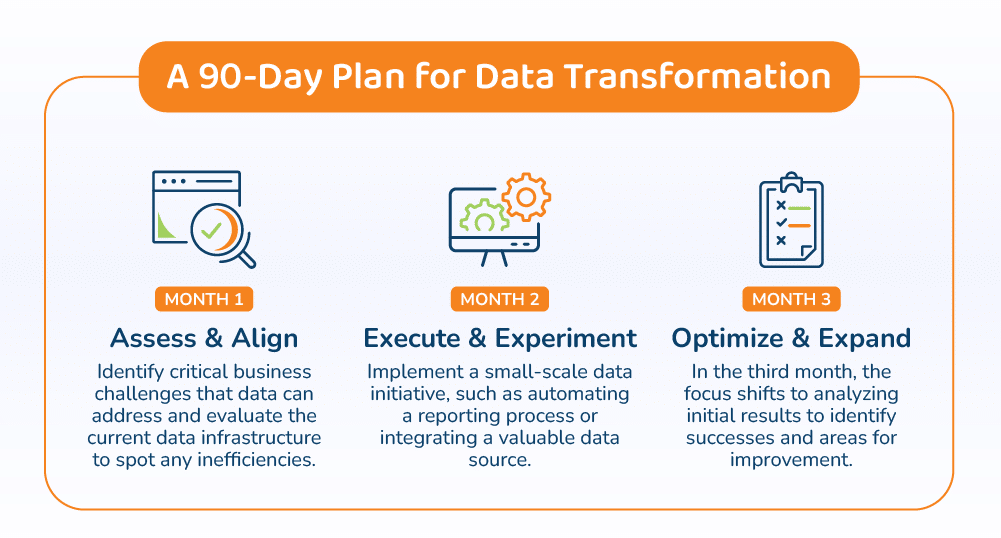
Phase 1 (days 1-30): readiness and use case selection
The first 30 days are not about building anything. They're about deciding what to build and proving you're allowed to build it.
Naming an executive sponsor and a business owner per use case
Every use case needs two names attached on day one: an executive sponsor who can unblock budget and politics, and a business owner who runs the process being automated and will be accountable for the metric moving. Without both, pilots drift because nobody has authority to say "stop" or "scale."
Running a POPIA data audit before anything else
Before any customer data touches a model, you need to know what data you hold, where it sits, who can access it, and what your legal basis is for processing it through an AI system. This is not optional paperwork, it's the thing that stops a pilot from becoming a compliance incident. If your first use case touches WhatsApp messages, customer records, or payment data, read what POPIA actually requires for automated systems before you write a single prompt.
How to pick use cases: existing data, defined process, measurable impact
Good first use cases share three traits: the data already exists in a usable form, the process has clear steps rather than constant exceptions, and you can measure the before-and-after in hours saved or revenue protected. If you can't answer "what does success look like in a number" in one sentence, it's not ready. This is also the point where mapping your process before you automate it pays for itself, because most failed pilots automate a process nobody has actually documented.
Typical first use cases for SA mid-size firms
The reliable starting points we see across SA mid-size clients: WhatsApp customer query handling and order status, invoice and reconciliation matching against Sage or Xero, lead qualification and booking for service businesses, and basic support ticket triage. None of these require a data platform. All of them have a measurable before-and-after.
Phase 2 (days 31-60): building the pilot
This is where the roadmap turns into a working system, scoped tightly enough to finish in a month.
Why 4-6 weeks is the right pilot window
Four to six weeks is long enough to build something real and short enough that the business owner stays engaged and the sponsor doesn't lose patience. Longer pilots drift into scope creep. Shorter ones don't survive contact with real data quality problems, which always surface in week two or three.
Build vs buy: when a pre-built tool beats a custom build
If your use case matches an off-the-shelf tool's design assumptions closely, buy it and move on. Custom builds earn their cost when your process has a quirk a generic tool can't handle, when you need deep integration with Sage or Xero, or when the volume justifies owning the system long-term. We've written the honest build vs buy answer for South African businesses because this decision gets oversold in both directions by people with something to sell you.
Where this breaks: integrating with Sage, Xero, Yoco, or PayFast
This is the part generic, US-written roadmaps never mention because they're not built for our stack. Sage and Xero have workable APIs but inconsistent documentation. Yoco and PayFast handle payments cleanly but need careful webhook handling if you're triggering AI actions off a transaction. If your pilot involves accepting payments through PayFast or Yoco on WhatsApp, budget extra time here. Integration is where pilots slip their timeline, not the AI model itself.
Phase 3 (days 61-90): measuring, fixing, and deciding what scales
The last 30 days decide whether the first two phases were worth running.
The ROI formula for a pilot (cost saved vs cost to run)
Keep it simple: hours saved per week multiplied by loaded hourly cost (your total employment cost divided by billable hours per week), plus revenue protected or gained, minus the monthly cost to run the system including any subscription, hosting, and oversight time. If that number isn't clearly positive by day 90, you don't scale it, you fix it or kill it. For a deeper breakdown of this math, see whether automations actually pay for themselves.
Human oversight checkpoints before wider rollout
No AI system should go from pilot to full rollout without defined points where a human reviews output before it reaches a customer or triggers a financial action. This is especially true for anything touching payments or personal data. The oversight checkpoints that actually work are built into the pilot from week one, not bolted on after something goes wrong.
What to kill, what to scale, what to rebuild
At day 90 you have three honest options. Kill it if the ROI never materialised or the process turned out to have more exceptions than you thought. Scale it if the numbers are clean and oversight held up. Rebuild it if the concept was right but the execution, data quality, or integration was wrong. Most pilots land in the third category, and that's a normal, healthy outcome, not a failure.
Why most mid-size SA roadmaps stall at month 2
Roadmaps rarely die from bad AI. They die from bad change management.
Cost and training, not technical failure, are the real blockers (Bredin data)
Bredin's research on SME and mid-market AI adoption found the leading barriers are cost of implementation and lack of staff training, well ahead of concerns about the technology itself failing. The model works. The team doesn't know how to use it, trust it, or fit it into their existing workflow, and nobody budgeted time or money to fix that.
The skills shortage problem and what it means for in-house vs partner builds
South Africa has a real shortage of people who can both build AI systems and understand local compliance and payment infrastructure. Hiring for this in-house is slow and expensive for a mid-size firm running one pilot. This is usually the point where partnering makes more sense than building a team from scratch, provided you know how to choose a real AI development partner rather than a reseller with a chatbot template.
Timeline and budget benchmarks by company size
Numbers help set expectations before anyone promises you a six-week enterprise transformation.
Small vs mid-market vs enterprise rollout timelines
Small businesses typically run a single narrow pilot in 4 to 6 weeks using off-the-shelf tools. Mid-market firms run the 90-day cycle described here, covering 2 to 3 use cases with some custom integration. Enterprise rollouts run 6 to 18 months because they involve data platform work, multiple business units, and governance layers a mid-size firm simply doesn't have.
What a realistic ZAR budget range looks like for a mid-size first phase
A realistic first-phase budget for a mid-size SA business, covering readiness, one pilot build, and 90 days of oversight, typically runs from the low tens of thousands to around R150,000 to R300,000 ZAR depending on integration complexity. For a real ZAR timeline and budget range broken down by use case type, it's worth reading before you set internal expectations.
Choosing the right build partner for the roadmap
The roadmap only works if whoever builds phase two actually understands the compliance and integration load, not just the model.
Questions to ask before signing anyone
Ask for a named person who will own delivery, not a sales rep. Ask how they handle POPIA compliance specifically for your data types. Ask what happens to the system and the data if you end the contract. Ask for a reference client running a similar integration, ideally with Sage, Xero, Yoco, or PayFast. If they can't answer these in plain language, keep looking.
Why in-house teams often underestimate the compliance and integration work
In-house teams usually scope the AI part correctly and underestimate everything around it: the POPIA audit, the Sage API quirks, the WhatsApp Business API approval process, the ongoing oversight hours. What custom AI development actually involves is mostly this surrounding work, not the model call itself, and what custom AI actually costs over two years reflects that reality far better than a single build quote does.
Common questions
What is an AI implementation roadmap? It's a time-boxed, sequenced plan for taking one or two specific AI use cases from selection to measured results, usually over 90 days for a mid-size business. It names owners, deadlines, and success metrics for each use case. It sits below an AI strategy and above a detailed implementation plan.
How is a mid-market AI roadmap different from an enterprise one? Mid-market roadmaps run in weeks, not months, cover one to three use cases instead of company-wide rollout, and work with existing tools like Sage or Xero rather than a new data platform. Enterprise roadmaps assume dedicated teams and governance layers mid-size firms don't have and don't need yet.
What's the difference between an AI roadmap, AI strategy, and AI implementation plan? Strategy is the executive-level why, owned by leadership, with no dates attached. The roadmap is the phased what and when, owned by operations, naming use cases and owners. The implementation plan is the engineering-level how, owned by the build team, covering the actual technical steps.
How long should a first AI pilot take? Four to six weeks for the build itself, inside a broader 90-day cycle that includes readiness work before and measurement after. Shorter pilots rarely survive contact with real data quality issues. Longer ones lose momentum and sponsor attention before you've proven anything.
Should we build custom AI or buy existing tools? Buy when an off-the-shelf tool matches your process closely and you don't need deep integration. Build custom when your process has quirks generic tools can't handle, or you need tight integration with Sage, Xero, Yoco, or PayFast at meaningful volume. Most mid-size firms should pilot with buy and build only what proves its worth.
What percentage of mid-size businesses actually use AI, versus claim to? Survey figures like McKinsey's 88% measure any AI usage at all. Hard-usage data from the US Census and Eurostat puts embedded, operational use closer to 20%. RSM found 86% of mid-market firms have integrated AI somewhere, but only 36% describe it as fully embedded with measured impact.
What are the biggest barriers to AI adoption for mid-size businesses specifically? Bredin's research identifies cost of implementation and lack of staff training as the leading barriers, ahead of technical failure. Mid-size firms underestimate the change management work: getting staff to trust, use, and correctly oversee a new system, far more than they underestimate the model's capability.
How do you measure AI ROI for a pilot? Calculate hours saved per week multiplied by loaded hourly cost, add any revenue protected or gained, then subtract the monthly running cost including subscriptions, hosting, and human oversight time. If the result isn't clearly positive by day 90, the use case needs fixing or should be retired rather than scaled.
What does POPIA require before you start an AI pilot? You need to know what personal data you hold, where it's stored, who can access it, and your lawful basis for processing it through an AI system before any customer data touches a model. This applies especially to WhatsApp, customer records, or payment data, and should be audited in phase one, not after launch.
What's a realistic budget and timeline for a mid-size business in South Africa? A first-phase budget typically runs from the low tens of thousands to R150,000 to R300,000 ZAR over 90 days, covering readiness, one pilot build, and measurement, depending on integration complexity with systems like Sage, Xero, Yoco, or PayFast. Enterprise-scale rollouts cost and take considerably more.
If you want to walk through what a 90-day plan would look like for your business specifically, send us a message on WhatsApp and we'll talk it through, no pitch required. You can also see Sagentics' AI automation work if you want to look at what we've actually shipped before you call.
Common questions
What is an AI implementation roadmap?
It's a time-boxed, sequenced plan for taking one or two specific AI use cases from selection to measured results, usually over 90 days for a mid-size business. It names owners, deadlines, and success metrics for each use case. It sits below an AI strategy and above a detailed implementation plan.
How is a mid-market AI roadmap different from an enterprise one?
Mid-market roadmaps run in weeks, not months, cover one to three use cases instead of company-wide rollout, and work with existing tools like Sage or Xero rather than a new data platform. Enterprise roadmaps assume dedicated teams and governance layers mid-size firms don't have and don't need yet.
What's the difference between an AI roadmap, AI strategy, and AI implementation plan?
Strategy is the executive-level why, owned by leadership, with no dates attached. The roadmap is the phased what and when, owned by operations, naming use cases and owners. The implementation plan is the engineering-level how, owned by the build team, covering the actual technical steps.
How long should a first AI pilot take?
Four to six weeks for the build itself, inside a broader 90-day cycle that includes readiness work before and measurement after. Shorter pilots rarely survive contact with real data quality issues. Longer ones lose momentum and sponsor attention before you've proven anything.
Should we build custom AI or buy existing tools?
Buy when an off-the-shelf tool matches your process closely and you don't need deep integration. Build custom when your process has quirks generic tools can't handle, or you need tight integration with Sage, Xero, Yoco, or PayFast at meaningful volume. Most mid-size firms should pilot with buy and build only what proves its worth.
What percentage of mid-size businesses actually use AI, versus claim to?
Survey figures like McKinsey's 88% measure any AI usage at all. Hard-usage data from the US Census and Eurostat puts embedded, operational use closer to 20%. RSM found 86% of mid-market firms have integrated AI somewhere, but only 36% describe it as fully embedded with measured impact.
What are the biggest barriers to AI adoption for mid-size businesses specifically?
Bredin's research identifies cost of implementation and lack of staff training as the leading barriers, ahead of technical failure. Mid-size firms underestimate the change management work: getting staff to trust, use, and correctly oversee a new system, far more than they underestimate the model's capability.
How do you measure AI ROI for a pilot?
Calculate hours saved per week multiplied by loaded hourly cost, add any revenue protected or gained, then subtract the monthly running cost including subscriptions, hosting, and human oversight time. If the result isn't clearly positive by day 90, the use case needs fixing or should be retired rather than scaled.
What does POPIA require before you start an AI pilot?
You need to know what personal data you hold, where it's stored, who can access it, and your lawful basis for processing it through an AI system before any customer data touches a model. This applies especially to WhatsApp, customer records, or payment data, and should be audited in phase one, not after launch.
What's a realistic budget and timeline for a mid-size business in South Africa?
A first-phase budget typically runs from the low tens of thousands to R150,000 to R300,000 ZAR over 90 days, covering readiness, one pilot build, and measurement, depending on integration complexity with systems like Sage, Xero, Yoco, or PayFast. Enterprise-scale rollouts cost and take considerably more.
About Sagentics
Sagentics is an AI systems studio based in South Africa. We design and build WhatsApp automation, n8n workflows, and custom AI products for local and international clients. We write from systems we have actually shipped.
Start a WhatsApp conversation with SagenticsRelated reading
- Designing AI human oversight: the checkpoints that actually work
- AI system design implementation: what it actually means and why most projects skip it
- AI process mapping: what it is, what it isn't, and whether it's worth paying for
- How to select an AI model for a task
- the honest build vs buy answer for South African businesses
- mapping your process before you automate it
- what POPIA actually requires for automated systems
- the oversight checkpoints that actually work
- a real ZAR timeline and budget range
- what custom AI actually costs over two years
- whether automations actually pay for themselves
- accepting payments through PayFast or Yoco on WhatsApp
- how to choose a real AI development partner
- why most projects skip proper system design
- what custom AI development actually involves
- Sagentics' AI automation work