

 Start a conversation
AI system design and integration
AI change management: how to get your team to actually use the tools you buy
AI change management works when a small cross-functional team, not one IT person or a top-down mandate, owns adoption end to end. Leadership uses the tools before asking staff to, and training gets built around the actual workflow the tool touches rather than a generic rollout deck. Everything else, the frameworks, the champions programs, the 90-day plans, is detail that supports those three things. Miss them and the detail doesn't matter.
Why most AI adoption fails before they start
The real failure point is usage, not technology
Most AI rollouts that stall aren't killed by bad models or broken integrations. They're killed by nobody using the thing six weeks after launch. The tool works. The demo was fine. Then it sits there because the people who were supposed to use it daily never had a reason to change how they work. If you want the fuller picture on this, we've written separately about why AI projects fail, and usage, not capability, is the recurring theme.
The exec/frontline perception gap (and why South Africa's numbers are worse than you'd think)
There's a specific, measurable gap behind most failed rollouts: executives believe the company has a clear AI vision, frontline staff don't see it the same way. In South Africa the split is stark, 33% of executives say their company has a clear AI vision versus 10% of non-managerial staff. That's not a communication gap you close with a better all-hands presentation. It's a sign the vision was built in a room without the people who'll actually use the tool, and it shows up as quiet non-adoption rather than open pushback.
Shadow AI use as a symptom, not the problem
When staff ignore the sanctioned tool and start using ChatGPT or another AI tool on the side to get their actual work done faster, that's usually read as a security problem. It's really an adoption signal. People aren't rejecting AI, they're rejecting the version of AI that was built for someone else's workflow. Shadow AI use tells you exactly where the official rollout missed the mark, and it's worth treating as free research rather than a policy violation to shut down.
Who should actually lead AI adoption
Why a single owner (CTO, CDO, 'the AI person') doesn't work
Appointing one person, usually in IT, to "own AI adoption" sets them up to fail. They don't control HR's training budget, they don't sit in sales or ops meetings, and staff read a single technical owner as proof the initiative is an IT project rather than a business one. Single-owner AI rollouts consistently stall at the handoff between "we bought the tool" and "people in finance actually use it every day."
What a cross-functional AI change team looks like in practice
A working team is small, usually four to six people, and it includes someone from the team actually using the tool, not just someone describing how that team works. In practice that's an operations lead who knows the workflow, an IT or technical person who understands the system's limits, an HR or people lead who can read resistance correctly, and one frontline staff member with real authority to say "this step doesn't match how we actually work." This is also where mapping the process before you automate it comes in, because a change team arguing from an accurate process map makes better calls than one arguing from assumptions.
Where IT, HR, and operations each carry responsibility
IT owns whether the system is reliable and secure. HR owns how training lands and how performance expectations shift. Operations owns whether the tool actually fits the workflow it's meant to improve. None of these are optional and none of them can substitute for the others. A rollout that's 90% IT and 10% everything else will look like a system deployment, not a change in how people work, and staff treat it accordingly.
Choosing a change framework without overthinking it
Kotter, ADKAR, Prosci, McKinsey 7-S: what each actually solves
Kotter's eight-step model is good for building urgency and a guiding coalition in larger organisations. ADKAR (awareness, desire, knowledge, ability, reinforcement) is useful at the individual level when you need to diagnose exactly where one team is stuck. Prosci wraps structure and tooling around ADKAR for bigger change programs. McKinsey's 7-S is more useful for checking organisational alignment, strategy, structure, systems, than for running a single tool rollout. Each solves a real problem. None of them was built with a 40-person SA business in mind.
Why most SA SMEs need a lighter version of all of them
Full-scale Prosci implementation assumes a change management function with dedicated headcount, which most South African SMEs simply don't have. The honest version is to borrow the diagnostic questions, is there awareness, is there desire, is there capability, without the full program architecture. One person running change management as 20% of their job, using ADKAR's five questions as a checklist, will outperform a company that bought Prosci training and never applied it because nobody had time.
The 'middle-out' model: leaders visibly using the tool first
The model that consistently works in smaller teams isn't top-down or bottom-up, it's middle-out: a manager or team lead visibly using the AI tool in their own daily work before asking their team to. Staff don't adopt tools because leadership announced a vision. They adopt tools because someone they report to is visibly using it and getting something out of it. This is cheaper than any formal framework and it's the single highest-leverage thing a change team can insist on.
Training staff without overwhelming them
Why basic tool training doesn't move adoption
A 90-minute session showing every feature of a new AI tool produces confident clicking and zero behaviour change. People forget features they don't use in the first week, and a feature tour doesn't tell anyone when, in their actual day, they're supposed to reach for the tool. Training that doesn't attach to a specific moment in a specific workflow gets forgotten by Friday.
Designating AI champions inside teams
One person per team, ideally someone already respected for being good at their job rather than someone who's "into tech," becomes the first point of contact for questions and the person who models correct use day to day. Champions work because peer modelling beats top-down instruction, and because a champion surfaces friction in the tool faster than a formal feedback form ever will.
Training tied to one workflow at a time, not a platform-wide rollout
Train on the one task the tool touches this week, not the platform in general. If the tool drafts customer replies, train on drafting customer replies, including when to edit the draft and when to escalate to a person. This is also where building oversight checkpoints into the workflow itself matters: if the system has a clear point where a human reviews or approves before anything goes out, that checkpoint becomes the natural training moment. Staff learn the tool at exactly the point they'd need to trust or override it, not in the abstract.
Measuring whether adoption is actually working
Adoption vs transformation: different targets, different timelines
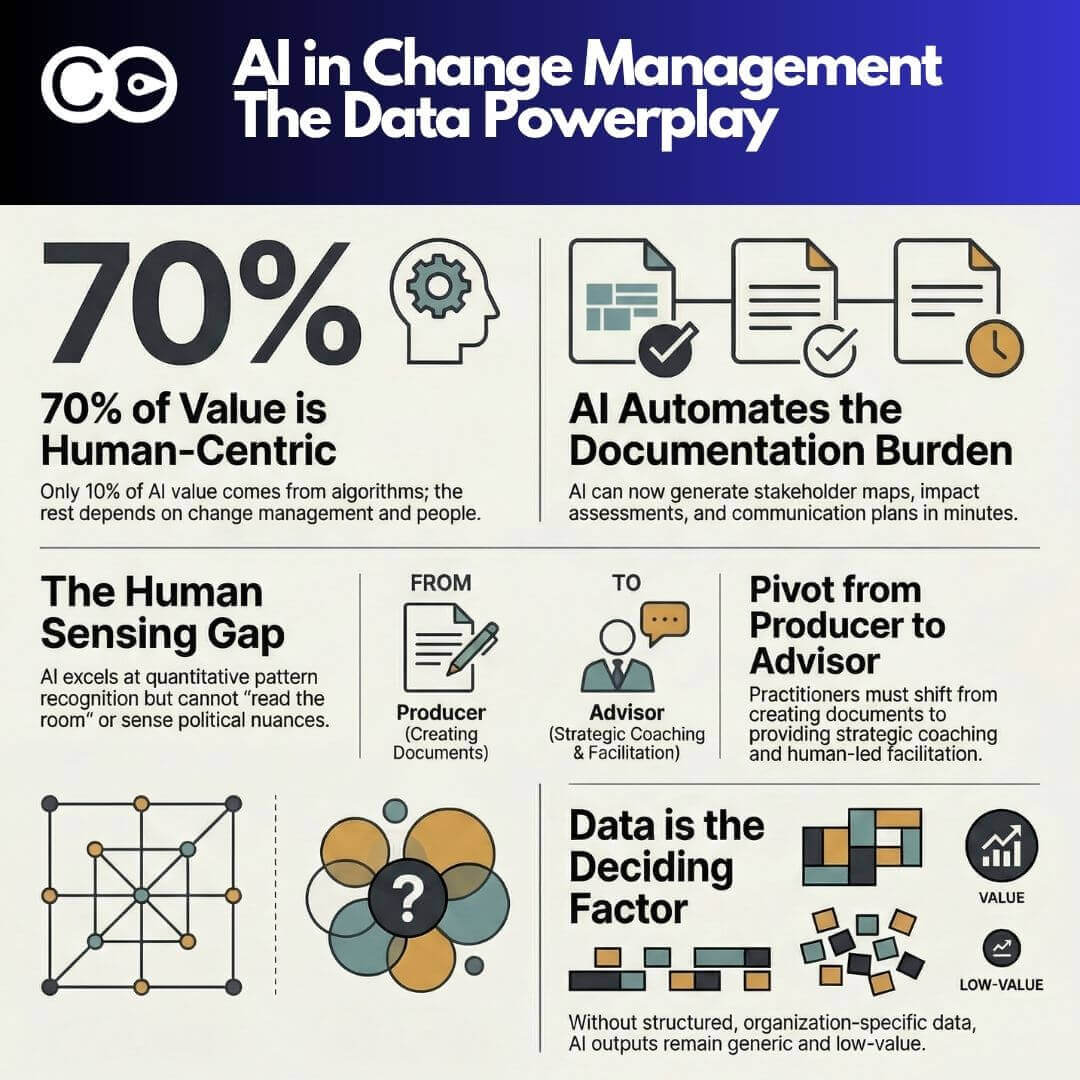
Adoption means people are using the tool as intended. Transformation means the business has changed how it operates because of that use, faster response times, fewer manual steps, measurably different output. Adoption is a 30 to 90 day target. Transformation is a 12 to 24 month one. Treating adoption metrics as proof of transformation is how companies declare premature victory and then wonder why nothing structural changed a year later.
Engagement metrics vs outcome metrics
Engagement metrics, logins, messages sent, prompts run, tell you whether people are touching the tool. Outcome metrics, response time, error rate, resolution rate, cost per ticket, tell you whether touching the tool is actually helping. Track both, but don't let engagement numbers stand in for outcomes. A team can log in daily and still be doing the same manual work they did before, just with an AI tab open.
What to check at 30, 60, and 90 days
At 30 days, check whether the champions and the change team can name specific friction points, if they can't, nobody's really using it yet. At 60 days, check usage data against the actual workflow, not just login counts. At 90 days, check outcome metrics against your pre-rollout baseline. For a structured version of this timeline, see the 90-day AI implementation roadmap, and for what to track once the tool is live, measuring an AI system after launch covers the specific numbers worth watching.
The South African context most frameworks ignore
Lean teams, tight budgets, and why that changes the rollout plan
Most SA SMEs don't have a change management department, a dedicated L&D team, or spare budget for a multi-month rollout program. That's not a smaller version of the enterprise problem, it's a different problem. The change team has to be smaller, closer to daily operations, and empowered to make calls fast rather than escalate through layers that don't exist. Budgets in ZAR terms mean every rand spent on training has to justify itself against the cost of a PayFast integration or a Yoco terminal upgrade sitting in the same quarter's priority list.
POPIA and internal AI tools: what staff need to know before adoption starts
If the AI tool touches customer data, staff need to understand what's actually being processed and stored before they start using it, not after a compliance review flags it. This isn't just a legal box to tick, it affects how comfortable staff feel using the tool with real customer information. We've covered what POPIA actually requires for AI systems in detail, and if the tool runs through WhatsApp specifically, it's worth checking whether your WhatsApp automation is POPIA compliant before rollout, not during an audit.
What we see building WhatsApp and n8n systems for SA businesses
Most AI adoption content treats resistance as a training or communication problem. From building WhatsApp and n8n systems for South African SMEs, the pattern we actually see is different. Adoption fails when the tool is built and explained for executives, then handed down to frontline staff who were never in the room, which tracks exactly with that 33% versus 10% vision gap. We fix this at the build stage, not the training stage, by putting human-in-the-loop checkpoints where the actual users touch the system, escalation points on WhatsApp, approval steps inside an n8n workflow, so adoption is forced by design rather than requested after launch. Lean SA teams don't have headcount for a dedicated change function, so the "team" has to be smaller and closer to the work than Prosci or McKinsey models ever assume. Designing human-in-the-loop AI systems and human handoff points on WhatsApp isn't a nice-to-have layered on top of the change plan, it is the change plan in miniature, built into the system instead of bolted onto training.
When to bring in outside help vs run it internally
Signs your internal team can handle adoption alone
If you already have a manager visibly using similar tools, a workflow that's been mapped and is well understood, and a team small enough that word of mouth travels fast, you can likely run this internally with a lightweight ADKAR-style checklist and a 90-day review. The core requirement is someone with enough authority and enough proximity to the daily work to make fast calls.
Signs you need an implementation partner
If your workflows haven't been mapped, if the tool touches customer data and nobody's confident about the POPIA implications, or if previous software rollouts have quietly died from non-use, that's a sign the build itself needs oversight checkpoints designed in from day one rather than retrofitted. That's usually the point to look at choosing an AI development partner who builds adoption into the system rather than treating it as a training problem to solve later.
Common questions
Why do employees resist AI at work? Usually not because they distrust AI itself. They resist tools built around someone else's understanding of their job, with no visible leadership use and no clear moment in their actual workflow where the tool helps. Resistance is often a rational response to a tool that doesn't fit, not an emotional reaction to automation.
Why do most AI change management initiatives fail? They treat adoption as a communication problem solved with training decks and town halls, rather than a design problem solved at the build stage. The gap between executive vision and frontline understanding, 33% versus 10% in SA, rarely gets closed by messaging. It gets closed by involving frontline staff in the build itself.
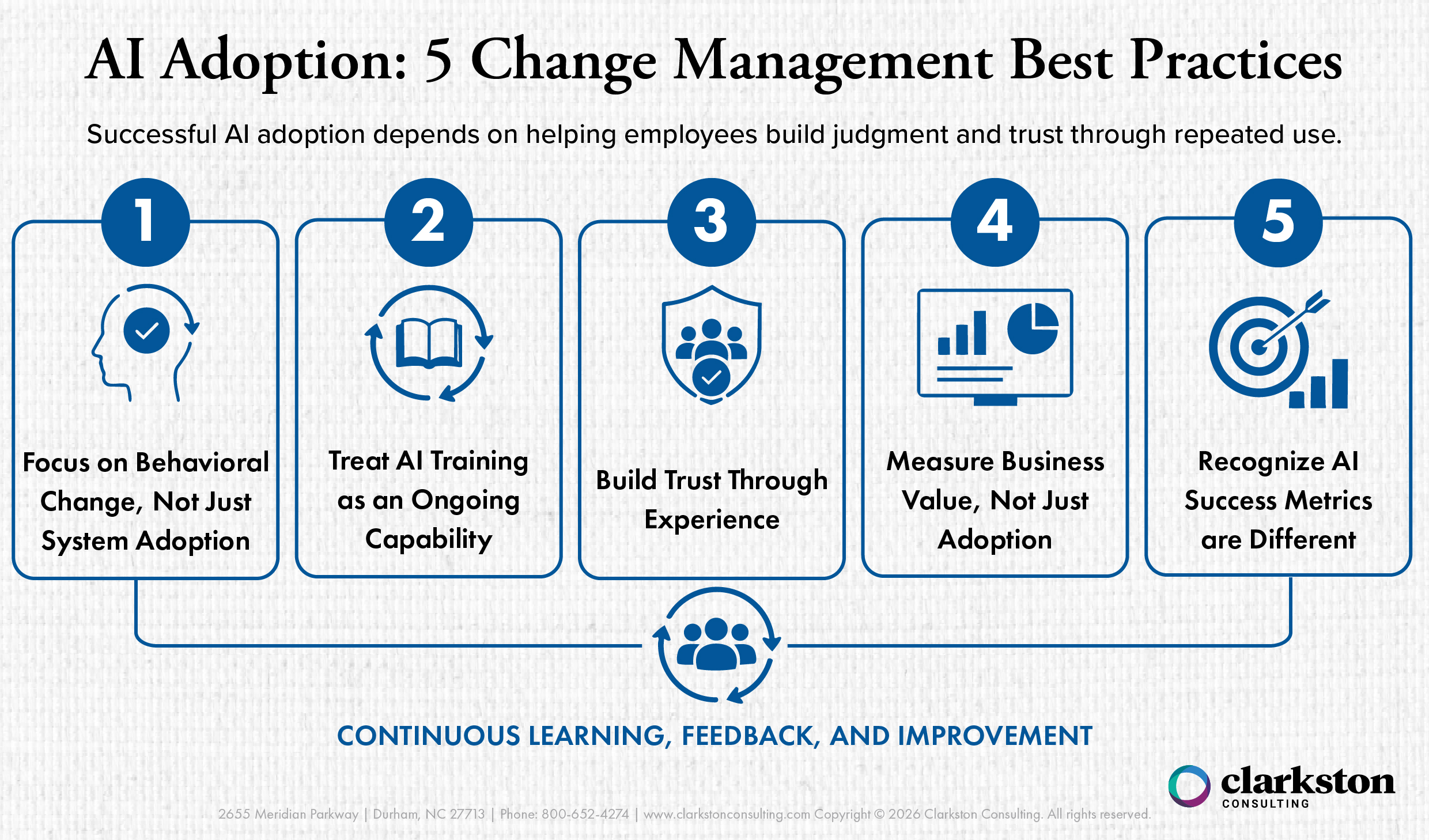
What change management framework should I use for AI adoption? Don't adopt one framework wholesale. Borrow ADKAR's diagnostic questions (awareness, desire, knowledge, ability, reinforcement) to spot where a team is stuck, and use Kotter's urgency-building ideas if you're larger. For most SA SMEs, a lightweight hybrid run by a small cross-functional team outperforms a full enterprise program nobody has time to maintain.
Who should lead AI adoption: IT, HR, or a cross-functional team? A cross-functional team of four to six people, including someone from the frontline team actually using the tool, not just a manager describing their work. IT, HR, and operations each carry a distinct piece: reliability, training and resistance, workflow fit. No single department can carry all three alone.
How do you train employees on AI without overwhelming them? Train on one workflow at a time, tied to the exact moment the tool enters that task, not a platform-wide feature tour. Pair training with a designated champion on each team who models correct use daily. People retain training that attaches to something they do this week, not a general capability demo.
How long does it take for AI adoption to actually stick? Basic adoption, people using the tool as intended, typically takes 30 to 90 days with active champions and leadership modelling. Deeper transformation, measurable changes in how the business operates, takes 12 to 24 months. Treating 90-day adoption numbers as proof of transformation is a common and costly mistake.
What's the difference between AI adoption and AI transformation? Adoption is people using the tool correctly day to day. Transformation is the business operating differently because of that use, faster turnaround, fewer manual steps, different cost structures. Adoption is measured in weeks with engagement metrics. Transformation is measured in months to years with outcome metrics against a real baseline.
Should leadership use AI tools themselves before rolling out to teams? Yes, and it's one of the highest-leverage moves available. Staff adopt tools faster when they see a manager they report to using it visibly and getting something real out of it, not when they receive a vision statement from senior leadership. This "middle-out" approach costs nothing and consistently outperforms formal change programs.
How do you measure AI adoption success? Track engagement metrics (logins, messages, prompts run) alongside outcome metrics (response time, error rate, resolution rate) against a pre-rollout baseline. Check progress at 30, 60, and 90 days. Engagement without improved outcomes means people are touching the tool without it actually changing how work gets done.
Does POPIA affect how we roll out internal AI tools to staff? Yes, if the tool processes customer or employee personal information, which most AI tools in customer-facing SA businesses do. Staff need to understand what data the tool handles before they start using it, not after a compliance review. This matters even more for WhatsApp-based tools, where customer data moves through the automation by default.
If you're planning an AI rollout and want the adoption checkpoints built into the system itself rather than bolted on after launch, send us a message on WhatsApp and we'll talk through what that looks like for your team.
Common questions
Why do employees resist AI at work?
Usually not because they distrust AI itself. They resist tools built around someone else's understanding of their job, with no visible leadership use and no clear moment in their actual workflow where the tool helps. Resistance is often a rational response to a tool that doesn't fit, not an emotional reaction to automation.
Why do most AI change management initiatives fail?
They treat adoption as a communication problem solved with training decks and town halls, rather than a design problem solved at the build stage. The gap between executive vision and frontline understanding, 33% versus 10% in SA, rarely gets closed by messaging. It gets closed by involving frontline staff in the build itself.
What change management framework should I use for AI adoption?
Don't adopt one framework wholesale. Borrow ADKAR's diagnostic questions (awareness, desire, knowledge, ability, reinforcement) to spot where a team is stuck, and use Kotter's urgency-building ideas if you're larger. For most SA SMEs, a lightweight hybrid run by a small cross-functional team outperforms a full enterprise program nobody has time to maintain.
Who should lead AI adoption: IT, HR, or a cross-functional team?
A cross-functional team of four to six people, including someone from the frontline team actually using the tool, not just a manager describing their work. IT, HR, and operations each carry a distinct piece: reliability, training and resistance, workflow fit. No single department can carry all three alone.
How do you train employees on AI without overwhelming them?
Train on one workflow at a time, tied to the exact moment the tool enters that task, not a platform-wide feature tour. Pair training with a designated champion on each team who models correct use daily. People retain training that attaches to something they do this week, not a general capability demo.
How long does it take for AI adoption to actually stick?
Basic adoption, people using the tool as intended, typically takes 30 to 90 days with active champions and leadership modelling. Deeper transformation, measurable changes in how the business operates, takes 12 to 24 months. Treating 90-day adoption numbers as proof of transformation is a common and costly mistake.
What's the difference between AI adoption and AI transformation?
Adoption is people using the tool correctly day to day. Transformation is the business operating differently because of that use, faster turnaround, fewer manual steps, different cost structures. Adoption is measured in weeks with engagement metrics. Transformation is measured in months to years with outcome metrics against a real baseline.
Should leadership use AI tools themselves before rolling out to teams?
Yes, and it's one of the highest-leverage moves available. Staff adopt tools faster when they see a manager they report to using it visibly and getting something real out of it, not when they receive a vision statement from senior leadership. This 'middle-out' approach costs nothing and consistently outperforms formal change programs.
How do you measure AI adoption success?
Track engagement metrics (logins, messages, prompts run) alongside outcome metrics (response time, error rate, resolution rate) against a pre-rollout baseline. Check progress at 30, 60, and 90 days. Engagement without improved outcomes means people are touching the tool without it actually changing how work gets done.
Does POPIA affect how we roll out internal AI tools to staff?
Yes, if the tool processes customer or employee personal information, which most AI tools in customer-facing SA businesses do. Staff need to understand what data the tool handles before they start using it, not after a compliance review. This matters even more for WhatsApp-based tools, where customer data moves through the automation by default.
About Sagentics
Sagentics is an AI systems studio based in South Africa. We design and build WhatsApp automation, n8n workflows, and custom AI products for local and international clients. We write from systems we have actually shipped.
Start a WhatsApp conversation with SagenticsRelated reading
- Designing AI human oversight: the checkpoints that actually work
- AI system design implementation: what it actually means and why most projects skip it
- AI process mapping: what it is, what it isn't, and whether it's worth paying for
- How to select an AI model for a task
- building oversight checkpoints into the workflow itself
- human-in-the-loop AI systems
- human handoff points on WhatsApp
- why AI projects fail
- a 90-day AI implementation roadmap
- measuring an AI system after launch
- what POPIA actually requires for AI systems
- whether your WhatsApp automation is POPIA compliant
- choosing an AI development partner
- mapping the process before you automate it