

 Start a conversation
AI system design and integration
POPIA and responsible AI in South Africa: what the law actually requires in 2026

South Africa has no AI Act. POPIA, the Protection of Personal Information Act, is the law that governs how you use AI today, and it already covers automated decision-making, profiling, and sending data across borders to tools like ChatGPT, Gemini, or Claude. If your business touches personal information and uses AI, POPIA applies, full stop.
The Information Regulator has already issued six administrative fines since enforcement began, and is currently investigating major companies including Truecaller, Pick n Pay, and Standard Bank. Most South African businesses are still operating on the assumption that AI regulation is "coming." It isn't. It's here, it's POPIA, and the consequences for ignoring it start at R100,000 and go up to R10 million.
Does South Africa have an AI law
No. There is no standalone South African AI Act, and there isn't one close to being signed into law. What exists is a draft policy document, and even that has had a rough year.
Why there is no standalone AI Act
South Africa's legislative approach to AI has followed the same pattern as most countries outside the EU: regulate the use of data, not the technology itself. POPIA was drafted technology-neutral, which means it doesn't mention "AI" anywhere in its text, but its provisions on automated processing, profiling, and data transfers apply regardless of whether a human or a model is doing the processing. That's deliberate. It means the law doesn't need to be rewritten every time a new model ships.
The Draft National AI Policy: published, then withdrawn
The Department of Communications and Digital Technologies published a Draft National AI Policy intended to set direction for AI governance, research, and economic strategy. It was meant to be the first real signal of a coordinated national position. It didn't survive contact with scrutiny.
Why it was withdrawn: fabricated references found in a government AI policy
The policy was pulled after researchers found that roughly one in ten of its academic references were fabricated. Citations pointed to papers, authors, or studies that didn't exist. The pattern is consistent with AI-generated text that nobody fact-checked before publication. A government document meant to set the tone for responsible AI in South Africa was itself a case study in what happens when AI output goes out the door without a human checkpoint.
That's not a minor irony. It's the clearest evidence available that "responsible AI" isn't primarily a policy problem or a legal problem. It's an operational discipline problem. Every AI output, whether it's a national policy draft or a WhatsApp auto-reply to a customer, needs a human to check it before it ships. The regulator just demonstrated, in public, at the national level, what happens when that checkpoint is skipped.
What happens next: revised draft expected at Cabinet by November 2026
A revised draft is expected to go to Cabinet by November 2026. Until then, there is no national AI policy in force, and even once there is, it will be a policy document, not binding legislation with enforcement teeth. POPIA remains the operative law in the meantime, and will remain the primary enforcement mechanism even after any AI policy lands, unless Parliament passes something with actual legal force.
What POPIA actually requires when you use AI
POPIA doesn't say "AI" but it covers almost everything AI systems do with personal information. Four sections matter most if you're deploying AI in a South African business.
Automated decision-making and profiling under Section 71
Section 71 restricts decisions "based solely on the automated processing" of personal information intended to profile a person, where that decision has legal or similarly significant effect on them. If an AI system scores, ranks, or filters people, job applicants, loan applicants, insurance customers, without a human reviewing the outcome, you're likely in breach. The fix isn't complicated: a person has to be able to request human review, and ideally a human is in the loop before any adverse outcome is finalised. This is exactly the kind of thing we cover in our piece on compliance-first AI hiring under POPIA and King V, because hiring is where automated decision-making risk shows up first and hardest.
Cross-border transfers under Section 72: why your US AI vendor doesn't make you exempt
Section 72 governs sending personal information outside South Africa. Using ChatGPT, Gemini, or Claude almost always means data crosses a border, because the processing happens on servers in the US or EU. POPIA requires that the destination country have adequate data protection, or that you put contractual safeguards in place, or that the data subject consents. "The AI vendor is a global company" is not a defence. You still need a lawful basis for that transfer, and you still need to know where the prompt, and anything in it, actually ends up.
Operator agreements under Section 21: what must be in writing with your AI vendor
If an AI vendor processes personal information on your behalf, they're an "operator" under POPIA, and Section 21 requires a written agreement establishing and maintaining the security measures they use to protect that data. Most businesses skip this when they sign up for an AI tool with a credit card and a click-through terms page. That click-through almost never satisfies Section 21. If you're serious about this, you need an actual operator agreement, not a vendor's generic terms of service.
Purpose specification and Section 18: telling people what you're collecting and why
Section 18 requires you to tell people what personal information you're collecting, why, and what you'll do with it, at the point of collection. If a WhatsApp bot captures a customer's name, number, and query, and that data later feeds into an AI model for training or enrichment, your customer needs to have been told that upfront. This is the specific gap we walk through in what actually needs to be true for WhatsApp automation to be POPIA compliant, because WhatsApp Business API deployments in South Africa are where this requirement gets skipped most often.

POPIA enforcement is no longer theoretical
For years, POPIA was treated as a law with no teeth. That changed.
The Information Regulator's August 2026 numbers: 8,000+ notifications, six fines
By August 2026, the Information Regulator had logged more than 8,000 data breach notifications since POPIA's enforcement provisions came into effect, and had issued six administrative fines. Six fines against 8,000-plus notifications looks small, but the trend line matters more than the absolute number. Enforcement is ramping, not stalling.
Fine table: from R100,000 to R5 million, and what triggered each one
| Fine amount | Trigger |
|---|---|
| R100,000 | Failure to respond to an enforcement notice within the required period |
| R250,000 | Ignoring a compliance notice after a breach investigation |
| R1 million | Non-compliance following a repeat breach finding |
| R2 million | Failure to implement required security safeguards after being warned |
| R3.5 million | Continued non-cooperation with an Information Regulator investigation |
| R5 million | Repeated, uncorrected failure to secure personal information after multiple notices |
The pattern: fines follow ignoring an enforcement notice, not the original mistake
Look at the table again. None of these fines were issued purely for the original data breach or mistake. Every one of them escalated because the organisation ignored, delayed, or failed to respond to an enforcement notice. The Information Regulator is not fining South African businesses for having a bad day. It's fining them for not fixing the problem once it's been flagged. That's an important distinction if you're trying to gauge your own risk: the cost of a mistake is usually recoverable, the cost of ignoring the regulator is not.
Why WhatsApp itself was issued an enforcement notice in April 2025
In April 2025, the Information Regulator issued an enforcement notice to WhatsApp over its handling of personal information. The notice is a reminder that even the largest platforms are inside POPIA's jurisdiction when South African users' data is involved, and that using a major platform doesn't transfer compliance responsibility away from the business using it.
Who's under investigation now: Truecaller, Pick n Pay, Standard Bank, and others
The Information Regulator currently has open investigations into companies including Truecaller, Pick n Pay, and Standard Bank, covering issues from data sharing practices to breach handling. These aren't small businesses caught off guard. They're large, well-resourced organisations, which tells you compliance maturity and company size don't automatically correlate.
POPIA's fine ceiling versus GDPR: real but not Europe-scale, for now
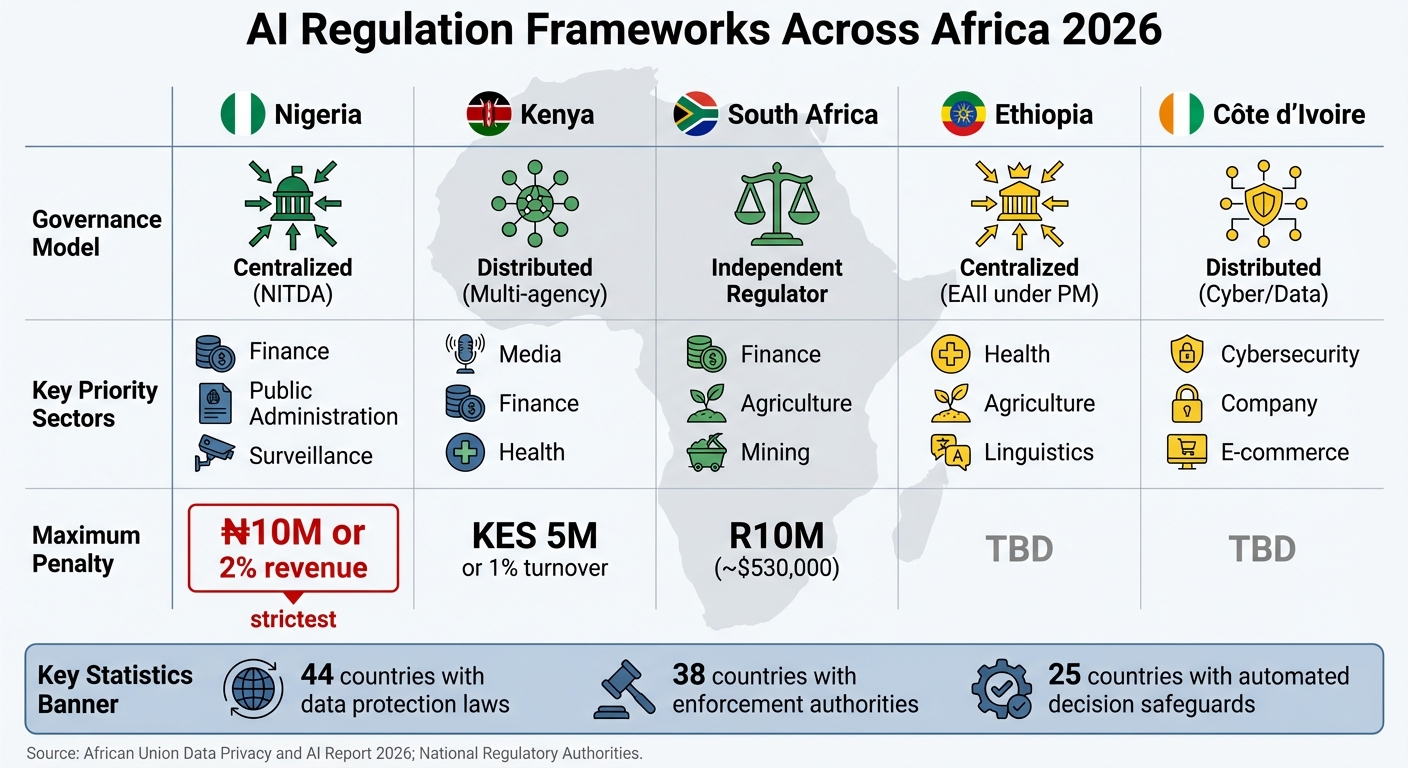
POPIA's maximum fine is R10 million, compared to GDPR's ceiling of 4% of global annual turnover, which for large multinationals runs into billions of rand. South Africa's approach is similar in structure to the EU AI Act and GDPR in that it's built around accountability, lawful basis, and human oversight, but the financial consequences are currently much smaller. That could change if the revised AI policy introduces sector-specific penalties, but as of now, POPIA's ceiling is a real number, not a Europe-scale one.
The HR and chatbot risk most businesses miss
The single most common POPIA violation we see isn't exotic. It's an employee pasting a CV, a payslip, or a client list into a free AI chatbot to save time.
Uploading employee or applicant data into ChatGPT, Gemini, or Claude
When HR staff paste applicant CVs into ChatGPT to summarise them, or paste employee records into Gemini to draft a performance review, that data leaves your organisation's control and enters a third-party system, often without an operator agreement, often without the applicant's knowledge, and often across a border. This is a textbook Section 72 and Section 21 problem, and it happens dozens of times a day in South African offices without anyone flagging it as a compliance event.
Employer liability when staff paste personal data into public AI tools
The employer, not the individual staff member, carries POPIA liability for this. "An employee did it without authorisation" is not a strong defence if there was no policy, no training, and no technical control preventing it. If your business has no written AI usage policy, you have no basis to argue the action was outside the scope of employment.
The 'less is more' rule: why feeding AI more data is a compliance risk, not a feature
The instinct with AI tools is to feed them more context for a better result. Under POPIA, that instinct is backwards. The more personal information you put into a prompt, the more exposure you create. The discipline that actually works is minimal necessary data: strip names, ID numbers, and identifying details before anything goes into a third-party AI tool, and build your workflows so that's the default, not a manual step someone has to remember.
Sovereign AI: the difference between hosted in SA and routed through SA
"Sovereign AI" gets used loosely. It matters because where your data physically sits, and who can access it, changes your POPIA exposure.
What actually counts as sovereign infrastructure
True sovereign infrastructure means the data storage, processing, and model inference all happen within South African jurisdiction, under South African legal control, with no routine transfer offshore. Very few AI products actually offer this today.
Why a South African endpoint on a US cloud isn't the same thing
A vendor with a ".co.za" domain or a Johannesburg office isn't automatically sovereign. If the underlying model runs on AWS or Azure infrastructure in Virginia or Dublin, your data is crossing that border regardless of where the company is registered. This is the same architectural question that comes up when you're choosing how POPIA changes the build for profile enrichment tools: the legal entity on the invoice isn't where the compliance risk lives.
What to ask any AI vendor about where your data and prompts actually go
Ask directly: where is the model hosted, where is data stored at rest, is anything used for model training, and can you get a written operator agreement specifying security measures under Section 21. If a vendor can't answer clearly, that's your answer.
What a responsible AI setup looks like in practice
Information Officer: who needs one (everyone, including small businesses)
Every business that processes personal information, including small businesses, needs a registered Information Officer under POPIA. There's no size exemption. It can be the owner, but the role and its responsibilities need to be formally assigned and registered with the Information Regulator.
Human oversight checkpoints that are active, not symbolic
A human oversight checkpoint that exists on paper but isn't actually used in the workflow doesn't satisfy Section 71 or reduce real risk. The checkpoint has to interrupt the process, not rubber-stamp it after the fact. We write about designing human oversight checkpoints that actually work because this is where most "responsible AI" policies quietly fail in practice.
Operator agreements and data flow audits before you deploy
Before any AI tool goes live in your business, map where the data goes, get the operator agreement signed, and run a basic data flow audit. This is the same groundwork we cover when explaining what human-in-the-loop AI means in production, and it's the difference between an AI deployment that survives a regulator inquiry and one that doesn't.
Common questions
Does POPIA apply to AI systems in South Africa? Yes. POPIA is technology-neutral and applies to any processing of personal information, whether done by a person or an AI system. Automated decision-making, profiling, and cross-border data transfers to AI vendors all fall within its scope, regardless of whether the law mentions "AI" directly.
Does South Africa have an AI law or AI Act? No. There is no binding AI Act in South Africa. POPIA is the operative law governing AI use. A Draft National AI Policy exists but was withdrawn, and a revised version isn't expected at Cabinet until November 2026, and even then it would be policy, not legislation.
What happened to the Draft National AI Policy? It was published, then withdrawn after researchers found roughly one in ten of its academic references were fabricated, consistent with unchecked AI-generated text. A revised draft is expected to reach Cabinet by November 2026.
Can I use ChatGPT, Gemini, or Claude for HR or client data in South Africa? Only with safeguards: a written operator agreement, a lawful basis for cross-border transfer, and minimal personal data in any prompt. Without those, pasting CVs, payslips, or client records into public AI tools likely breaches Sections 21 and 72 of POPIA.
What happens if an employee pastes personal data into a public AI tool? The employer carries the liability, not the employee, unless there's a clear written policy and training showing the action was unauthorised. Without that, the business is exposed to Information Regulator action for failing to prevent unlawful cross-border data transfer.
Who enforces POPIA? The Information Regulator, an independent body with powers to investigate complaints, issue enforcement and compliance notices, and levy administrative fines up to R10 million. It has issued six fines since enforcement began and currently has several major companies under investigation.
Has anyone been fined under POPIA for AI or data issues? Six administrative fines have been issued as of August 2026, ranging from R100,000 to R5 million. Each escalated because the organisation ignored or failed to respond to an enforcement notice, not purely because of the original data incident.
What is an Information Officer and do small businesses need one? An Information Officer oversees POPIA compliance within an organisation and must be registered with the Information Regulator. Every business that processes personal information needs one, including small businesses and sole proprietors, with no size-based exemption.
Does POPIA cover cross-border AI processing on US or EU cloud infrastructure? Yes. Section 72 governs sending personal information outside South Africa, and most AI tools process data on US or EU servers. You need an adequacy basis, contractual safeguards, or consent before that data lawfully crosses the border.
Is South Africa's approach similar to the EU AI Act? Structurally yes, both emphasise accountability, lawful basis, and human oversight of automated decisions. Practically no, South Africa has no risk-tiered AI-specific legislation like the EU AI Act, and POPIA's fine ceiling is far lower than GDPR's.
What is the maximum fine under POPIA? R10 million, or imprisonment for certain offences. The highest fine issued so far is R5 million, for repeated, uncorrected failure to secure personal information after multiple Information Regulator notices.
If you're trying to work out what any of this means for a specific WhatsApp bot, hiring tool, or AI workflow you're planning to build, it's worth talking it through before you ship anything. Our overview of what AI automation agencies in South Africa actually build and whether they're POPIA compliant and our guide to how to choose a custom AI development partner in South Africa are both good starting points, and our custom AI development South Africa page covers how we approach this on every build.
If you want to talk through where your own AI setup stands, message us on WhatsApp. No pitch, just a straight conversation about what you're building and what POPIA actually requires for it.
Common questions
Does POPIA apply to AI systems in South Africa?
Yes. POPIA is technology-neutral and applies to any processing of personal information, whether done by a person or an AI system. Automated decision-making, profiling, and cross-border data transfers to AI vendors all fall within its scope, regardless of whether the law mentions AI directly.
Does South Africa have an AI law or AI Act?
No. There is no binding AI Act in South Africa. POPIA is the operative law governing AI use. A Draft National AI Policy exists but was withdrawn, and a revised version isn't expected at Cabinet until November 2026, and even then it would be policy, not legislation.
What happened to the Draft National AI Policy?
It was published, then withdrawn after researchers found roughly one in ten of its academic references were fabricated, consistent with unchecked AI-generated text. A revised draft is expected to reach Cabinet by November 2026.
Can I use ChatGPT, Gemini, or Claude for HR or client data in South Africa?
Only with safeguards: a written operator agreement, a lawful basis for cross-border transfer, and minimal personal data in any prompt. Without those, pasting CVs, payslips, or client records into public AI tools likely breaches Sections 21 and 72 of POPIA.
What happens if an employee pastes personal data into a public AI tool?
The employer carries the liability, not the employee, unless there is a clear written policy and training showing the action was unauthorised. Without that, the business is exposed to Information Regulator action for failing to prevent unlawful cross-border data transfer.
Who enforces POPIA?
The Information Regulator, an independent body with powers to investigate complaints, issue enforcement and compliance notices, and levy administrative fines up to R10 million. It has issued six fines since enforcement began and currently has several major companies under investigation.
Has anyone been fined under POPIA for AI or data issues?
Six administrative fines have been issued as of August 2026, ranging from R100,000 to R5 million. Each escalated because the organisation ignored or failed to respond to an enforcement notice, not purely because of the original data incident.
What is an Information Officer and do small businesses need one?
An Information Officer oversees POPIA compliance within an organisation and must be registered with the Information Regulator. Every business that processes personal information needs one, including small businesses and sole proprietors, with no size-based exemption.
Does POPIA cover cross-border AI processing on US or EU cloud infrastructure?
Yes. Section 72 governs sending personal information outside South Africa, and most AI tools process data on US or EU servers. You need an adequacy basis, contractual safeguards, or consent before that data lawfully crosses the border.
Is South Africa's approach similar to the EU AI Act?
Structurally yes, both emphasise accountability, lawful basis, and human oversight of automated decisions. Practically no, South Africa has no risk-tiered AI-specific legislation like the EU AI Act, and POPIA's fine ceiling is far lower than GDPR's.
What is the maximum fine under POPIA?
R10 million, or imprisonment for certain offences. The highest fine issued so far is R5 million, for repeated, uncorrected failure to secure personal information after multiple Information Regulator notices.
About Sagentics
Sagentics is an AI systems studio based in South Africa. We design and build WhatsApp automation, n8n workflows, and custom AI products for local and international clients. We write from systems we have actually shipped.
Start a WhatsApp conversation with SagenticsRelated reading
- Designing AI human oversight: the checkpoints that actually work
- AI system design implementation: what it actually means and why most projects skip it
- AI process mapping: what it is, what it isn't, and whether it's worth paying for
- How to select an AI model for a task
- what actually needs to be true for WhatsApp automation to be POPIA compliant
- designing human oversight checkpoints that actually work
- what human-in-the-loop AI means in production
- compliance-first AI hiring under POPIA and King V
- how POPIA changes the build for profile enrichment tools
- what AI automation agencies in South Africa actually build and whether they're POPIA compliant
- how to choose a custom AI development partner in South Africa
- custom AI development South Africa