

 Start a conversation
Custom AI product and SaaS development
Prompt-driven development: what it is and why the AI was never the bottleneck
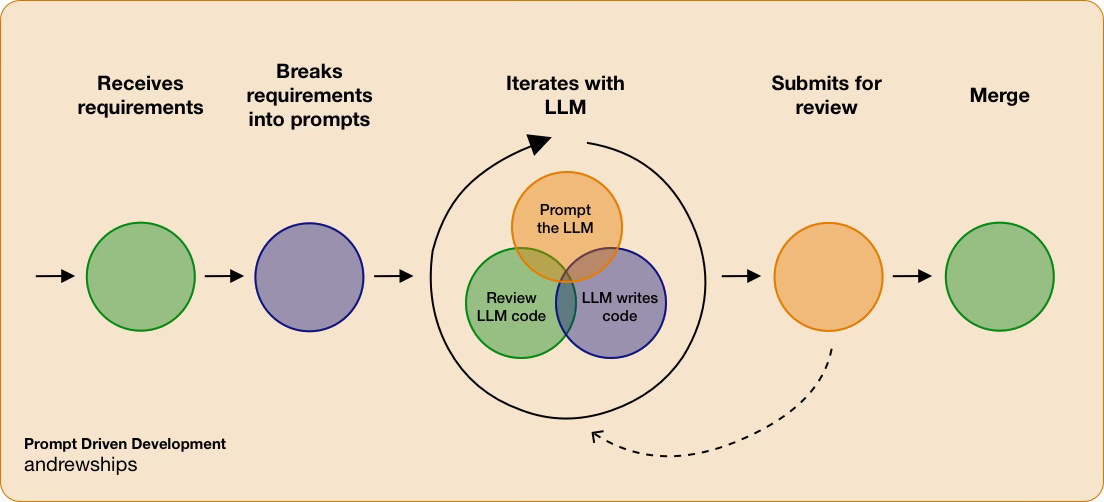
Prompt-driven development is a way of building software where you write structured prompts as the primary input, let an AI model generate the code, and then review, test, and refine that output instead of writing most of the code by hand. It is not the same as typing loose instructions into a chat window and shipping whatever comes back. The discipline is in the review, not the prompt.
We say this having actually built things this way. Sagentics runs n8n workflows and WhatsApp/AI systems for South African clients using prompt-driven development every week, and the honest finding after doing it for real client work is that generating code was never the slow part. Reviewing it was. A prompt-generated integration can look completely correct and still fail silently on a WhatsApp webhook, or mishandle POPIA-relevant customer data in a way that doesn't show up until the system is live. That changes how you should think about this whole approach.
What prompt-driven development actually means
The competing definitions (loose vs structured)
There are two versions of "prompt-driven development" floating around, and they get confused constantly. The loose version is: describe what you want in plain English, accept the AI's output, move on. The structured version is: write a detailed specification-style prompt covering inputs, outputs, edge cases, error handling, and constraints, then treat the AI's output as a first draft that gets reviewed against that spec. Both get called prompt-driven development online. Only one of them produces software you can put in front of a client.
Where it comes from: prompt engineering applied to code
Prompt-driven development grew out of prompt engineering, the practice of crafting inputs to get reliable, specific outputs from a language model. Prompt engineering was originally about getting good text, summaries, classifications, answers. Applying the same rigor to code generation, where the prompt describes a function's contract rather than a paragraph's tone, is what turned prompt engineering into a development method rather than a writing technique.
Prompt-driven development vs spec-driven development
Spec-driven development writes a formal specification first and treats code as an implementation detail. Prompt-driven development borrows that instinct but keeps the spec informal, living inside the prompt itself rather than in a separate document.
In spec-driven development the spec is the source of truth and code is regenerated from it. In prompt-driven development the prompt is a one-time instruction, and the code that comes out becomes the source of truth once a human has reviewed it. The practical difference lies in what you return to when something needs to change.
Prompt-driven development vs vibe coding
The difference is discipline, not the tool
How is prompt-driven development different from vibe coding? People use the same tools, sometimes the same model, for both. Vibe coding means you prompt, glance at the output, and ship it because it runs without errors. Prompt-driven development means you prompt, then deliberately review the logic, test the edge cases, and correct what's wrong before it goes anywhere near production. The tool doesn't separate them. The checklist does.
Why "it looks correct but isn't reliable" is the real failure mode
The dangerous thing about AI-generated code is that it rarely fails obviously. It compiles. It runs. The demo works. What it doesn't do is handle the WhatsApp message that arrives with an unexpected field, or the webhook that times out, or the customer record that needs to be redacted under POPIA before it's logged anywhere. Code that looks correct and isn't reliable is worse than code that visibly breaks, because nobody goes looking for a bug in something that appears to work.
This is the exact gap that separates teams that ship demos from teams that ship production systems. We've found it's the reason workflow failures happen silently in production: the AI-generated error handling takes the happy path, the code looks correct on first read, and nobody catches it until a customer hits the edge case at scale.
When vibe coding is fine and when it isn't
Vibe coding is fine for a throwaway prototype, an internal script nobody depends on, or a proof of concept you're going to rebuild anyway. It is not fine for anything touching customer data, payment processing through PayFast or Yoco, or a WhatsApp Business API integration that a real customer will hit at 11pm on a Sunday. The stakes decide which mode you're in, not personal preference.

How prompt-driven development actually works
A five-step working process: define, prompt, review, run, correct
In practice this looks like five repeatable steps. Define the exact behaviour you need, including what should happen when things go wrong. Prompt the AI with that definition, specific enough that there's only one reasonable interpretation. Review the generated code line by line against the definition, not just against "does it look reasonable." Run it against real and edge-case inputs, not just the happy path. Correct what's wrong, either by re-prompting with the failure described or by editing the code directly. Skip step three and you're vibe coding with extra words.
What a well-structured coding prompt looks like
How do you write a good coding prompt? A good coding prompt specifies the function's exact inputs and types, expected outputs, error conditions and how to handle them, and any external system it touches, like a webhook format or a database schema. Vague prompts ("build me a WhatsApp bot") produce vague code. Specific prompts ("handle a WhatsApp webhook payload with this exact JSON shape, return a 200 within 5 seconds, log failures without storing customer phone numbers in plaintext") produce code you can actually review against a standard.
Structured Prompt-Driven Development (SPDD) and PromptOps
What is PromptOps and SPDD? Structured Prompt-Driven Development (SPDD) is prompt-driven development with an enforced review and testing layer bolted on, so prompts are treated like specs and outputs are checked against acceptance criteria before merge. PromptOps is the operational discipline around it: version-controlling prompts, tracking which prompt produced which code, and treating prompt changes like code changes that need review.
What the data says about AI coding productivity
Adoption is near-universal (Stack Overflow, JetBrains, DORA)
Surveys from Stack Overflow, JetBrains, and the DORA (DevOps Research and Assessment) team all point the same direction: the overwhelming majority of professional developers now use AI tools in their daily workflow. This isn't a niche practice anymore. It's the default starting point for writing a new function, a new endpoint, or a new integration.
The trust gap: only 29% trust AI output to be accurate
The same surveys show a wide trust gap. Roughly 29% of developers say they trust AI-generated code to be accurate without checking it closely. That means about seven in ten developers who use these tools every day still don't fully trust the output, which tells you the industry consensus already matches what we've found doing this for client work: the generation is the easy part, the trust problem is the actual bottleneck.
The productivity paradox: slower in practice, faster in perception
DORA's research has flagged something counterintuitive: developers using AI tools often feel faster while measured outcomes show no change, or in some cases a slowdown, once review and rework time is counted. That matches our own experience. Prompting is fast. Reviewing carefully, testing edge cases, and correcting subtle mistakes takes real time, and skipping that step is how "faster" projects end up shipping bugs that cost more to fix later than they would have to prevent.

Is AI-generated code production ready
What still needs a human reviewer, every time
Is AI-generated code safe or production ready? AI-generated code can be production ready, but only after a human reviews it against the original requirement, tests it against edge cases and failure conditions, and checks how it handles sensitive data. Treated as a finished product straight out of the model, it isn't reliable enough for anything customer-facing or regulated. The risk isn't the AI. It's skipping the review step because the output looks clean.
Some things need a human eye every single time, no exceptions: anything that touches customer personal information, anything that calls an external API where failure has to be handled explicitly rather than assumed away, and anything with a retry or idempotency requirement, because AI models default to the naive happy-path version unless told otherwise.
Why this matters more when client data and POPIA are involved
South African businesses building WhatsApp automation or customer-facing AI systems are handling personal information under POPIA whether they've thought about it or not. An AI-generated function might correctly process a WhatsApp message and completely fail to consider that the phone number and message content it just logged is personal information that needs a retention policy, an access control, or a consent basis. This is exactly the kind of gap that shows up when asking whether WhatsApp automation is POPIA compliant, and it's not something an AI model will flag unless the prompt explicitly asks it to.
We've reviewed generated code that would have violated POPIA in three separate ways if it had shipped. None of those violations were obvious on first read. All of them were in systems that would have failed a compliance audit. The review step is what catches these, not the model.
The review bottleneck nobody talks about
Most content about AI coding tools focuses on how fast they generate code. Almost none of it focuses on the fact that review time doesn't shrink at the same rate, and in regulated or customer-facing systems it often grows, because you now have to review code you didn't write, against a standard you have to hold yourself to explicitly rather than by habit. That's the actual bottleneck in shipping real systems with this method, and it's rarely mentioned by people who haven't shipped anything with it.
How Sagentics actually uses prompt-driven development
What we let AI generate vs what we hand-write ourselves
We let AI generate boilerplate, standard integration code, first-pass logic for well-understood patterns, and repetitive n8n node configuration. We hand-write, or heavily rewrite, anything involving webhook reliability, error handling, retry logic, and data handling that touches POPIA obligations. That split isn't arbitrary. It's based on where we've actually found AI-generated first drafts to be wrong often enough that skipping review would have caused a client-facing failure.
On a recent n8n workflow for a ZAR-based e-commerce integration, the AI generated webhook parsing that looked structurally sound but didn't handle duplicate delivery, which meant orders could be created twice. On a WhatsApp customer service system, the generated message logging included customer phone numbers in plaintext in logs that the client wasn't treating as regulated data. Both shipped because the code looked correct. Neither would have survived a real review.
Why our build time is mostly review time, not prompt time
If you asked us to break down hours on a typical WhatsApp automation or n8n build, prompting the AI and getting a first draft is a small fraction of it. Most of the time goes into testing that draft against real message payloads, checking failure modes, and correcting the parts that looked fine but weren't. This is also where the decision between n8n vs custom code actually gets made in practice, because the review overhead differs sharply depending on which one you're generating.
What this means if you're choosing a build partner
If a studio's pitch is entirely about how fast AI lets them generate code, ask what their review process looks like, because that's the part that determines whether what you get is a demo or a production system. This is one of the clearest signals in how to choose a real AI development partner: speed of generation tells you nothing, speed and rigor of review tells you almost everything.
Does prompt-driven development replace developers
What changes in the day-to-day job
Does prompt-driven development replace developers? No. It changes what developers spend their time on, shifting hours from typing code to writing precise specifications and reviewing generated output critically. The job becomes less about producing lines of code and more about defining exactly what correct behaviour looks like and verifying that the AI actually delivered it, which is arguably a harder skill, not an easier one.
What doesn't change: architecture, judgment, accountability
System architecture, decisions about what to build versus what to integrate, and accountability for what ships still sit with a human. An AI model doesn't decide whether a WhatsApp bot needs a fallback to human support, or whether a workflow should fail open or fail closed when an external API is down. Those calls require judgment about the business, not just about the code, and they matter directly when you're weighing build vs buy AI software or scoping something like scoping an AI SaaS MVP.
Common questions
What is prompt-driven development? Prompt-driven development is building software by writing structured, spec-like prompts, letting an AI model generate the code from them, then reviewing, testing, and correcting that output before it ships. The prompt replaces most manual typing, but the human review step is what makes the resulting code trustworthy enough for production use.
How is prompt-driven development different from vibe coding? Vibe coding accepts AI output because it runs without errors. Prompt-driven development treats that output as a first draft, reviewed against the original requirement, tested against edge cases, and corrected where wrong. Both can use identical tools and models. The difference is entirely in whether a disciplined review step happens before the code ships.
Is prompt-driven development the same as prompt engineering? No. Prompt engineering is the general skill of crafting inputs to get reliable outputs from a language model, used for text, summaries, and classification as well as code. Prompt-driven development is prompt engineering applied specifically to software, combined with a structured review and testing process before the generated code is considered finished.
What tools are used for prompt-driven development? Common tools include AI coding assistants built into IDEs, standalone code-generation models accessed through chat or API, and workflow platforms like n8n where AI nodes generate logic inside a visual pipeline. The tool matters less than the process wrapped around it: defining requirements clearly and reviewing every output before it runs anywhere important.
Is AI-generated code safe or production ready? It can be, but only after a human reviews it against the original requirement, tests it against real and edge-case inputs, and checks how it handles sensitive or regulated data. Unreviewed AI output that merely runs without visible errors is not reliable enough for customer-facing systems, payment processing, or anything handling personal information under POPIA.
Does prompt-driven development replace developers? No. It shifts developer time from typing code toward writing precise specifications and reviewing AI output critically. Architecture decisions, judgment calls about failure handling, and accountability for what ships still require a human. The skillset changes, the need for experienced developers making sound decisions does not disappear.
What is PromptOps and SPDD? SPDD, Structured Prompt-Driven Development, treats prompts like specifications with enforced review and testing before code merges. PromptOps is the operational layer around that: version-controlling prompts, tracking which prompt generated which code, and reviewing prompt changes with the same rigor as code changes, so the process stays auditable over time.
How do you write a good coding prompt? A good coding prompt specifies exact inputs and types, expected outputs, error and edge-case handling, and any external systems involved, like a webhook's payload shape or a database schema. Vague prompts produce vague, unreviewable code. Specific prompts give you something concrete to test against, which is what makes the review step actually possible.
If you're weighing whether prompt-driven development is right for your next build, or trying to work out integrating AI into an existing system, or want a straight answer on what building a custom AI product actually takes, it's worth talking through your specific case rather than guessing from a checklist. Sagentics builds custom AI development in South Africa using exactly this method, and we're happy to walk through what that looks like for your project.
If any of this raised questions about your own build, message us on WhatsApp and we'll talk it through, no pitch required.
Common questions
What is prompt-driven development?
Prompt-driven development is building software by writing structured, spec-like prompts, letting an AI model generate the code from them, then reviewing, testing, and correcting that output before it ships. The prompt replaces most manual typing, but the human review step is what makes the resulting code trustworthy enough for production use.
How is prompt-driven development different from vibe coding?
Vibe coding accepts AI output because it runs without errors. Prompt-driven development treats that output as a first draft, reviewed against the original requirement, tested against edge cases, and corrected where wrong. Both can use identical tools and models. The difference is entirely in whether a disciplined review step happens before the code ships.
Is prompt-driven development the same as prompt engineering?
No. Prompt engineering is the general skill of crafting inputs to get reliable outputs from a language model, used for text, summaries, and classification as well as code. Prompt-driven development is prompt engineering applied specifically to software, combined with a structured review and testing process before the generated code is considered finished.
What tools are used for prompt-driven development?
Common tools include AI coding assistants built into IDEs, standalone code-generation models accessed through chat or API, and workflow platforms like n8n where AI nodes generate logic inside a visual pipeline. The tool matters less than the process wrapped around it: defining requirements clearly and reviewing every output before it runs anywhere important.
Is AI-generated code safe or production ready?
It can be, but only after a human reviews it against the original requirement, tests it against real and edge-case inputs, and checks how it handles sensitive or regulated data. Unreviewed AI output that merely runs without visible errors is not reliable enough for customer-facing systems, payment processing, or anything handling personal information under POPIA.
Does prompt-driven development replace developers?
No. It shifts developer time from typing code toward writing precise specifications and reviewing AI output critically. Architecture decisions, judgment calls about failure handling, and accountability for what ships still require a human. The skillset changes, the need for experienced developers making sound decisions does not disappear.
What is PromptOps and SPDD?
SPDD, Structured Prompt-Driven Development, treats prompts like specifications with enforced review and testing before code merges. PromptOps is the operational layer around that: version-controlling prompts, tracking which prompt generated which code, and reviewing prompt changes with the same rigor as code changes, so the process stays auditable over time.
How do you write a good coding prompt?
A good coding prompt specifies exact inputs and types, expected outputs, error and edge-case handling, and any external systems involved, like a webhook's payload shape or a database schema. Vague prompts produce vague, unreviewable code. Specific prompts give you something concrete to test against, which is what makes the review step actually possible.
About Sagentics
Sagentics is an AI systems studio based in South Africa. We design and build WhatsApp automation, n8n workflows, and custom AI products for local and international clients. We write from systems we have actually shipped.
Start a WhatsApp conversation with SagenticsRelated reading
- Build vs buy AI software: the honest answer for South African businesses
- Building a custom AI product: what it actually takes, what it costs, and why most of the work isn't the AI
- How to choose a real AI development partner in South Africa
- MVP scoping for AI SaaS: how to define the build before you pay for it
- build vs buy AI software
- custom AI development in South Africa
- how to choose a real AI development partner
- what building a custom AI product actually takes
- n8n vs custom code
- how to stop workflows failing silently in production
- integrating AI into an existing system
- whether WhatsApp automation is POPIA compliant
- scoping an AI SaaS MVP